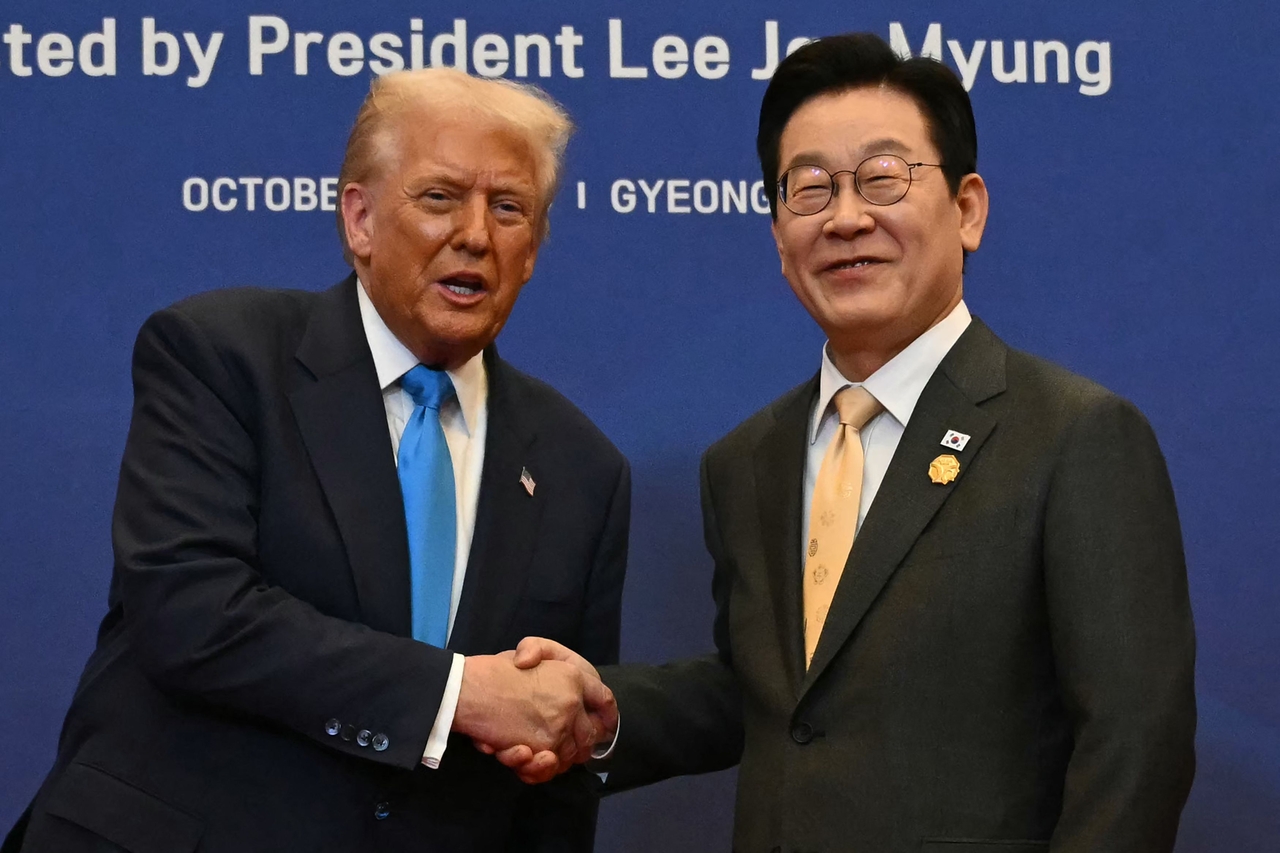
The Gyeongju summit has fundamentally redefined the South Korea-US alliance, transforming it into a transaction-driven framework that links US security guarantees to South Korea’s economic contributions, according to a new research report.
The meeting between South Korean President Lee Jae Myung and US President Donald Trump on Oct. 29 “clearly illustrates how the bilateral relationship is being redefined” under Trump’s "America First" paradigm and Lee’s pragmatic diplomacy, the state-funded Institute for National Security Strategy said in a jointly authored report Monday.
“It signifies a shift from a traditional values-based alliance to a pragmatic, transaction-based alliance,” the report read.
The report pointed out that Trump and Lee also "shared a consensus that their meeting marked a pivotal turning point, fundamentally reshaping the nature of the Korea-US alliance beyond merely reaffirming it."
The core of the Lee-Trump summit lay in the "conclusion of a grand bargain that explicitly linked South Korea’s concrete economic contributions with US security and technological concessions," it added.
At their summit in Gyeongju, North Gyeongsang Province, Lee and Trump agreed on specific terms of South Korea’s $350 billion investment plan, achieving a leader-level breakthrough after months of delay since the initial tariff deal — including the investment framework — was reached in late July.
At the same time, Trump publicly gave the green light for South Korea to develop nuclear-powered submarines at Hanwha Philly Shipyard, a commercial yard in Philadelphia purchased by South Korea's Hanwha Group in 2024, following Lee’s formal request during their talks for Washington to supply nuclear fuel for propulsion.
Seoul and Washington will release the outcome of the agreement in the trade and security sectors in the form of a fact sheet.
The INSS, under the auspices of the National Intelligence Service, assessed that “specific agreements were reached to modernize the alliance through an explicit exchange — South Korea’s substantial economic commitments in return for the transfer of key US military technologies.”
Such agreements reached during the summit have "institutionalized a transaction system of security guarantees and economic contributions,” it added.
However, the report also acknowledged criticism that such outcomes risk turning the alliance into a commercial arrangement and reducing peace to a tradable commodity, noting that the balance of the partnership now tilts toward maximizing US national interests rather than safeguarding South Korea’s autonomy on the Korean Peninsula.
In response to criticism, the research institute elucidated that the outcomes show “South Korea’s status is shifting from a unilateral beneficiary of the alliance to a partner in a mutually reciprocal relationship.”
In other words, the shift from the traditional Korea-US alliance model — once grounded in shared values and mutual defense obligations — has established a new precedent: Allies are now expected to make significant, direct contributions to the US domestic economy in exchange for the level of security cooperation they seek.
“This is expected to become an important reference case for other US allies as they formulate their future policies toward Washington,” the report underscored.
"Through the Gyeongju Agreement, the Korea-US alliance is expected to evolve into a model in which economic and industrial contributions become the top-tier precondition for security cooperation."
The INSS predicted that “such transactional characteristics will likely become further entrenched” across a wide range of areas — from defense cost-sharing to technological cooperation and supply chain restructuring — in future alliance discussions.
Against this backdrop, the report said, Seoul must continue to demonstrate its value not merely as a military ally, but as a core economic and technological partner capable of strengthening the US domestic industrial base.
“South Korea must diversify the ways in which it contributes to the alliance and employ a proactive strategy that leverages its own industrial and technological competitiveness as strategic assets of the alliance,” it added.
dagyumji@heraldcorp.com