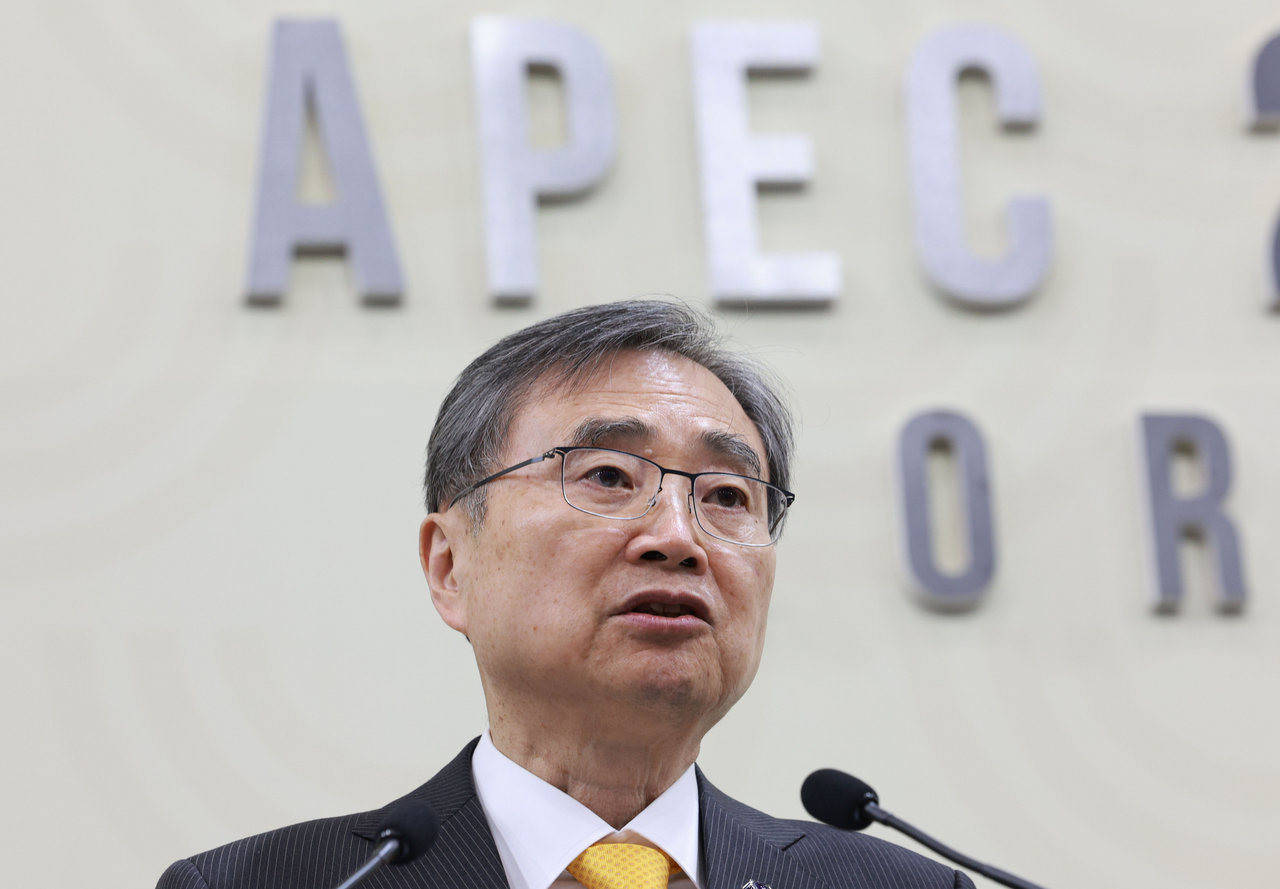
GYEONGJU, North Gyeongsang Province — South Korea’s Foreign Minister Cho Hyun said Thursday that the 21 APEC member economies “are very close” to finalizing a Gyeongju Declaration to be made after the APEC summit on Friday and Saturday.
As the 2025 chair of the Asia-Pacific Economic Cooperation, South Korea is pursuing the declaration, which requires consensus among all 21 members at the conclusion of the APEC Economic Leaders’ Meeting on Saturday.
The key question is whether a statement will be issued amid growing friction among APEC member economies over their differing views on trade.
Another question is whether the wording of the joint statement will uphold APEC’s spirit of free and open trade, economic cooperation, and integration, despite rising protectionism and the weaponization of trade.
Cho was unable to provide a clear answer when asked whether a joint declaration would include explicit references to free trade.
“It would be premature for me to make any definitive comments at this stage, since member economies are still engaged in last-minute negotiations,” Cho said Thursday afternoon during a news conference following the APEC Ministerial Meeting held in the city of Gyeongju.
However, a senior South Korean diplomatic source, speaking on condition of anonymity, said this year’s APEC summit is likely to yield a Gyeongju Declaration.
The agreement forged between US President Donald Trump and Chinese President Xi Jinping to call a truce in their trade war during their summit in the port city of Busan on Thursday has created conditions conducive to adopting the Gyeongju Declaration by consensus.
Since being elevated to a leaders’ level platform in 1993, APEC has failed to issue a final joint communique only once — in 2018, when host Papua New Guinea was unable to bridge widening divisions between the US and China.
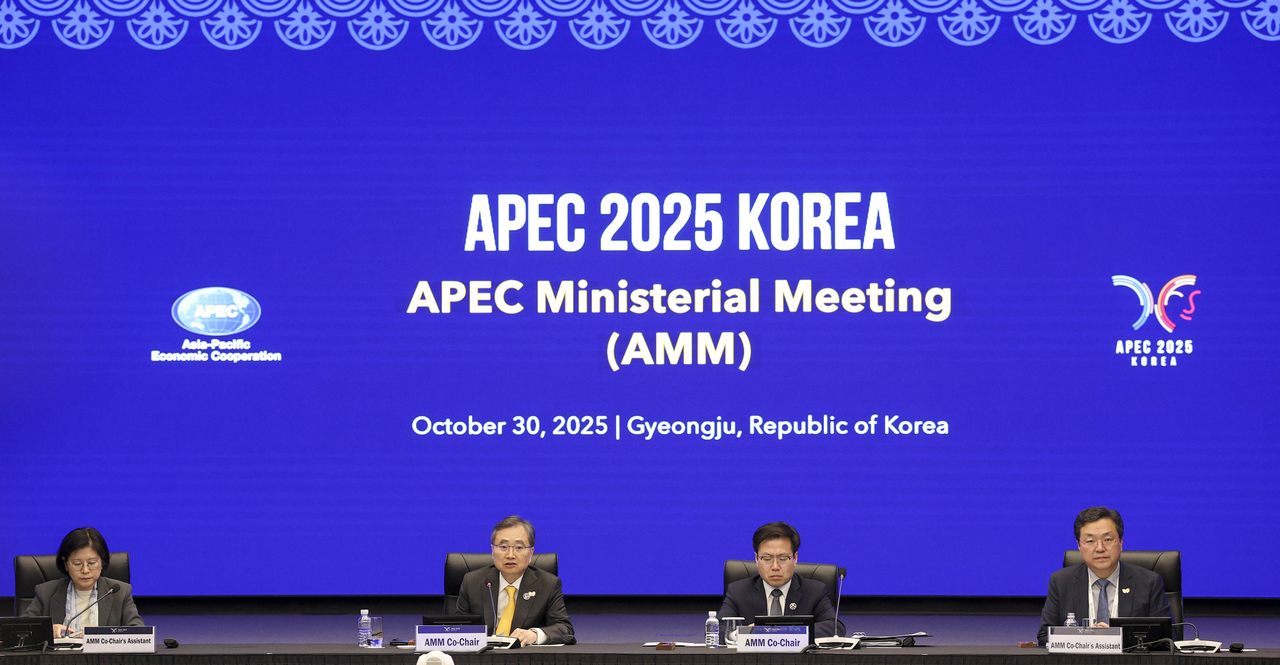
To that end, foreign and trade ministers from the 21 APEC member economies gathered for the APEC Ministerial Meeting, held from Wednesday to Thursday, to make a final push for consensus on the declaration.
The meeting, which was also attended by World Trade Organization Director-General Ngozi Okonjo-Iweala, served as the final checkpoint before the two-day leaders’ summit.
Cho further explained that the 21 member economies are also still negotiating a separate joint statement on the outcome of the APEC Ministerial Meeting.
“Although it was not adopted today, I am hopeful it will be finalized (before the end of the summit),” Cho told reporters. “Traditionally, the joint statement of the ministerial meeting is coordinated alongside the leaders’ declaration, as the two complement each other — and in many past cases, both have been concluded simultaneously.”
While chairing the APEC Ministerial Meeting on Thursday morning, Cho underscored the importance of APEC, which represents a grouping that accounts for 61 percent of global gross domestic product and 49 percent of world trade — particularly amid volatile geopolitical and geo-economic conditions.
“Economic uncertainty, geopolitical tension, climate disruption and demographic shifts are testing both our resilience and our resolve,” Cho said during the meeting. “Yet amid these headwinds, the Asia-Pacific region remains the engine of global growth and the best hope for a more prosperous and sustainable future.”
Trade Minister Yeo Han-koo also underscored the importance of preserving APEC’s core values amid growing headwinds, citing South Korea as an example of achieving prosperity through openness and trade.
South Korea has transformed from a $108-per-capita economy in 1965 into one more than 300 times larger, with its trade volume expanding 2,000-fold — becoming a global trading powerhouse.
“This success story mirrors the broader Asia-Pacific experience. Since APEC’s founding in 1989, trade and investment facilitation have lifted over 1 billion people out of poverty,” Yeo said. “Amid profound shifts in the global economy, there is no better time than now to rekindle the spirit of openness and cooperation.”
Yeo reaffirmed that “Korea’s commitment to a rules-based multilateral trading system centered on the WTO remains unwavering.”
He also emphasized APEC’s role in strengthening connectivity among Asia-Pacific economies through "open plurilateralism" — a flexible and inclusive form of international cooperation in which a group of countries voluntarily agrees to work together on specific issues.
“Founded on voluntary cooperation, APEC has long served as an incubator of ideas and a cornerstone of open plurilateralism,” Yeo said. “Looking ahead, open plurilateralism will complement the WTO and reinforce regional connectivity, with APEC’s role as an incubator of ideas more vital than ever.”
dagyumji@heraldcorp.com