Being in between always comes with a sense of unease. Sometimes it feels like going through a dark tunnel and telling yourself, “Hang in there, light will come.”
Media artist Lee Jin-joon regards the times we are living in as such a state: People are experiencing the overwhelming technology of artificial intelligence. After this period, the artist said, we will enter an era of the post-AI where the AI is deeply integrated into society as a foundational infrastructure.
“What terrifies me is not losing our jobs to AI, but the fact that our entire way of perceiving the world has changed. We call it 'epistemological crisis,’ meaning a crisis in how we perceive and define reality,” Lee said Thursday at BB&M, a Seoul gallery where his solo exhibition “Champagne Supernova” was on view. The show closed Saturday.
Lee currently serves as an associate professor at the Graduate School of Culture Technology at KAIST.
“With so many images flooding us, we can no longer tell real memories from the ones shaped by images. People no longer really know who they are — they live inside their own fantasies,” he said.
“AI accelerates this epistemological crisis because it only shows you what you want to see and hear.”
Lee said “Champagne Supernova,” which marks his first solo exhibition at a commercial gallery, shows his attempts to find a creative breakthrough within reality in the flood of technology.
“Ignoring AI and sticking to carving stones by hand — that is not creativity. We already live in the age of AI, and there is no way back,” Lee said.
After studying sculpture at Seoul National University, Lee earned a master’s degree in moving image design and design interaction from the Royal College of Art, London, and a Ph.D in Fine Art from the University of Oxford.
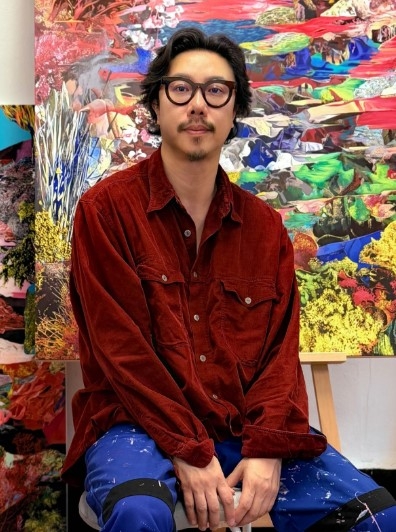
Among the works at the exhibition were two collage paintings done in collaboration with AI: “On Some Faraway Shore No.6” and “On Some Faraway Shore No.7” — inspired by the artist’s hometown near the southern coast of Korea.
Lee’s collage works explore how an artist today can recreate something truly personal or uniquely their own when the memories AI creates are standardized. “For example, when I tried to express the moment my mother gave me sweet strawberries when I was sick, the AI simply drew a random woman handing out strawberries,” the artist said.
The collage works begin with Lee’s writing of memories, which were then fed into an AI image generator. The resulting images were printed, cut and reassembled by hand into collages, over which he painted in acrylic paint.
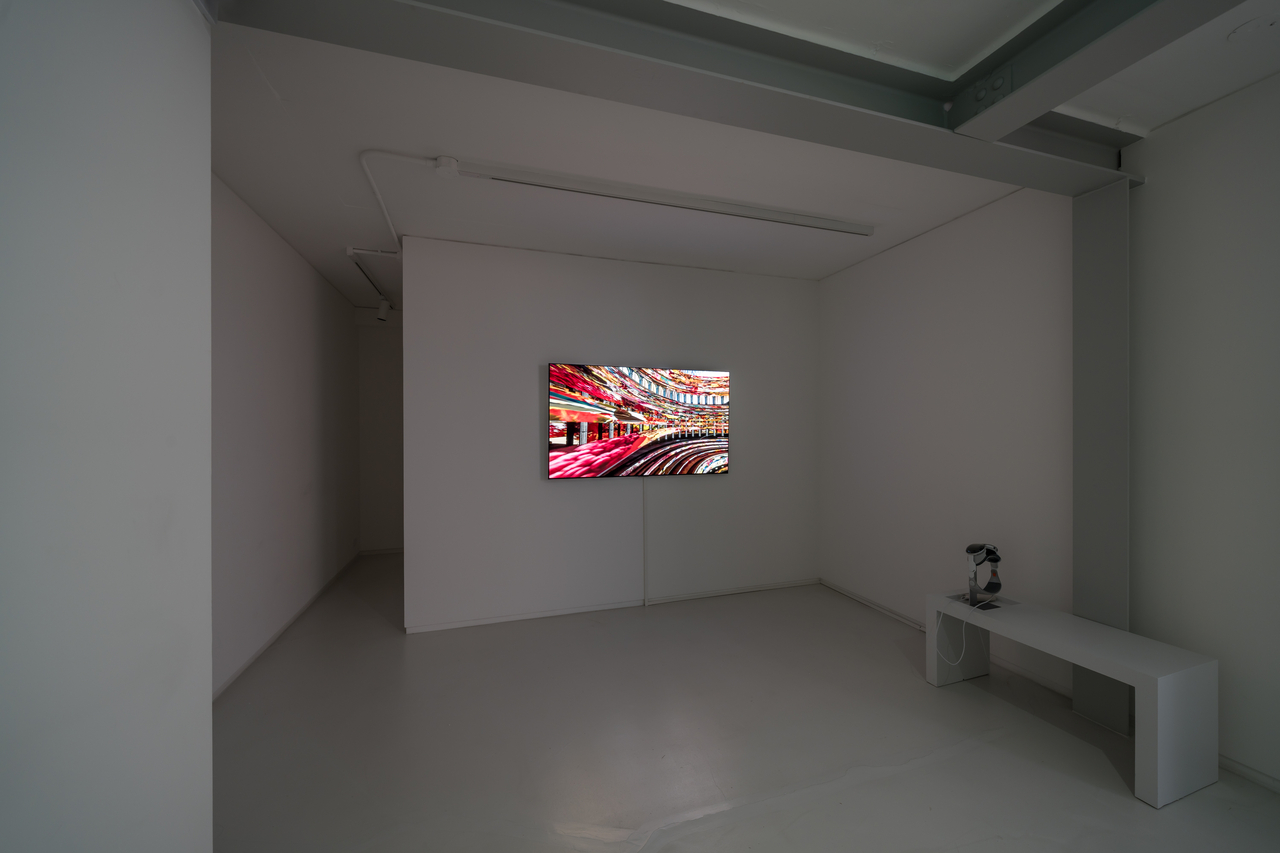
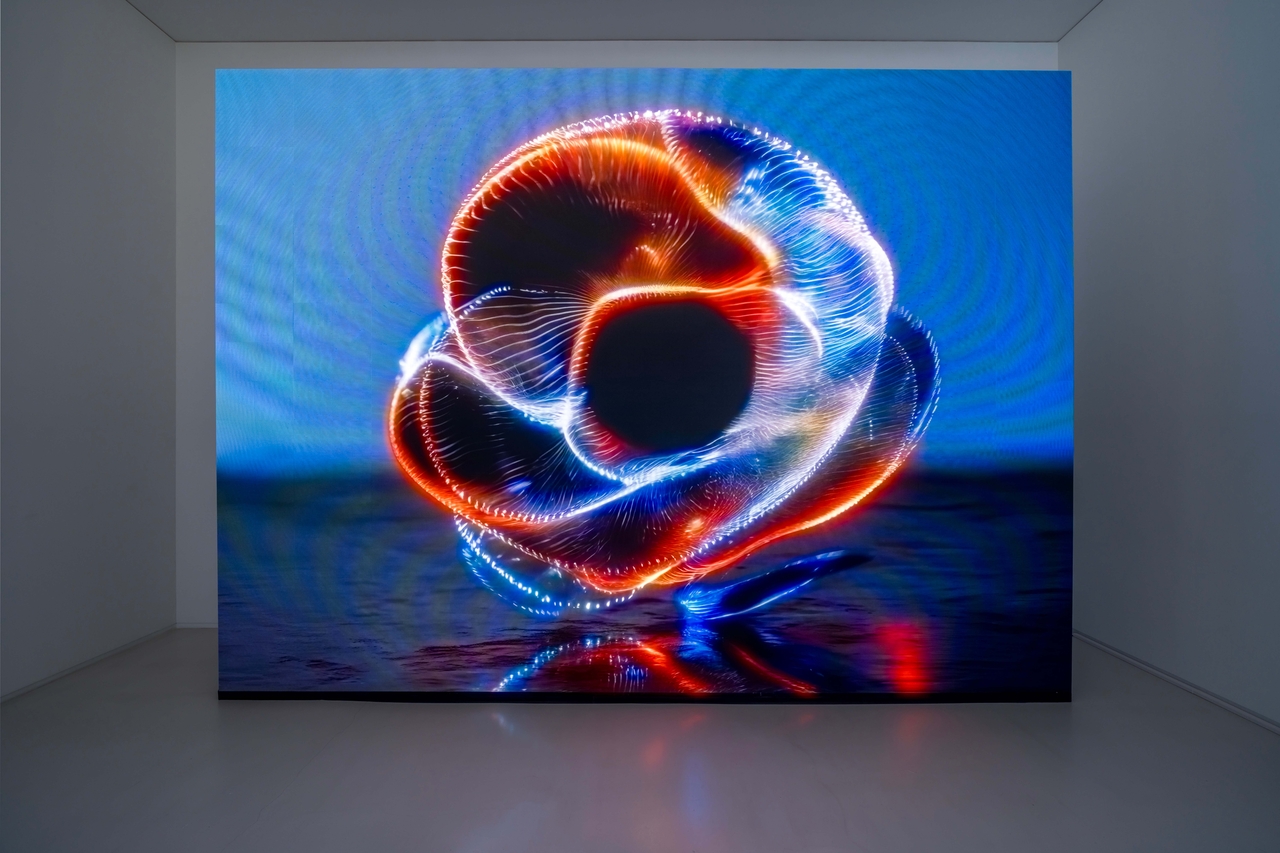
Inspired by the Renaissance philosopher Giulio Camillo’s “Theatre of Memory” — an imaginary architectural structure that sought to spatially organize all human knowledge and memory — Lee created the VR video “Mnemosyne Theatre” and a companion single-channel video “Memory Theatre.”
“Giulio Camillo imagined a theater filled with the universe’s knowledge, where just stepping inside would let you recall everything. I created my own version of that theater in three dimensions, to process the memories of my own childhood.”
“AI is frightening, but it’s also fascinating,” Lee said. “Something new is always born from fear and the unknown.”
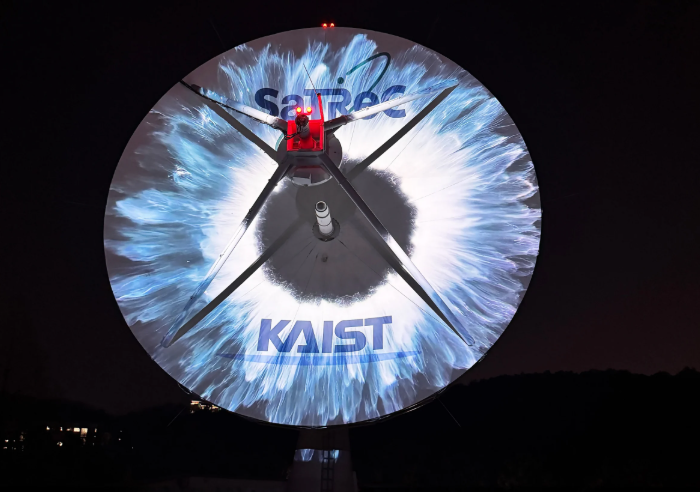
In April, Lee attracted international attention with “Good Morning Mr. G-Dragon,” a project that transmitted into space an AI-generated video based on K-pop artist G-Dragon’s iris data along with his music.
Another project, “Cine-Forest: Awakening Bloom,” a large-scale media performance that transforms an urban forest into an open-air theatre of light, sound and storytelling, was conducted in September at Bundang Central Park. Directed by Lee, the performance drew more than 1,000 visitors.
yunapark@heraldcorp.com