Lee becomes 1st S. Korean leader to convene UNSC open debate
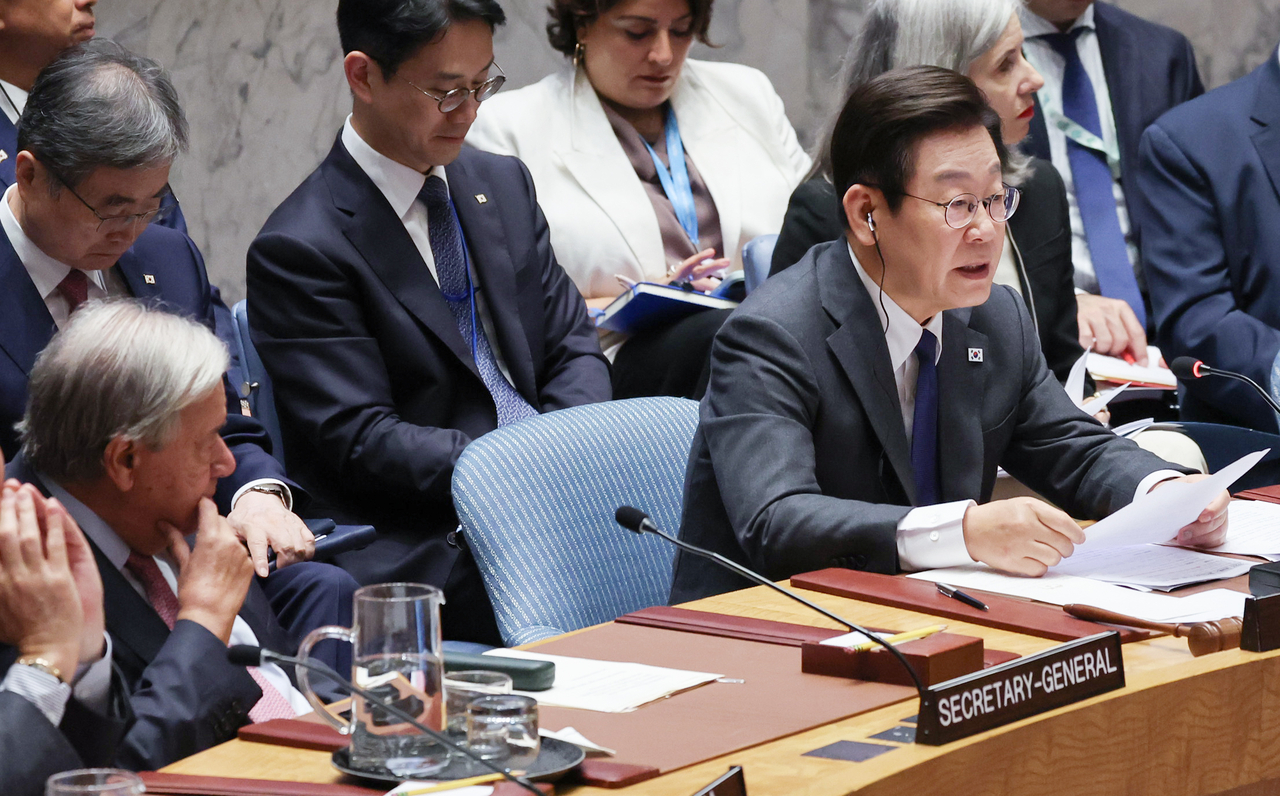
NEW YORK – President Lee Jae Myung on Wednesday called on the United Nations Security Council to take collective action to deter global security threats posed by the rapid advancement of artificial intelligence technologies, as he convened a high-level open debate of the 15-member council.
Without established governance over AI, misuse of the technology could lead humanity into a dystopian future, Lee said in his statement during the session. In light of this, Lee urged the UN Security Council to guide the international community in deterring evolving threats.
"Now, in the AI era, the Council must once again assess the changing security landscape and seek new collective responses," Lee said as he chaired the debate on AI and international peace and security at UN headquarters in New York.
"The role and responsibility of the Security Council is ever more important."
Currently, the UN Security Council is composed of Algeria, China, Denmark, France, Greece, Guyana, Pakistan, Panama, Russia, Sierra Leone, Slovenia, Somalia, South Korea, the United Kingdom and the United States. Among them, its five permanent members are China, France, Russia, the UK and the US.
South Korea has served as a nonpermanent member of the UN Security Council three times since its admission to the United Nations in 1991.
Describing the world's transition to AI as inevitable, Lee stressed the need to turn AI-driven threats into opportunities for the technology to serve as a "springboard for humanity."
Lee underscored South Korea's track record in spearheading AI-related blueprints, as demonstrated in its move to jointly table the first-ever UN General Assembly resolution on AI in the military domain last year, together with the Netherlands. South Korea also adopted the "Seoul Declaration" at last year's AI Seoul Summit, underscoring safety, innovation and inclusivity in the use of AI.
"As the Chair of APEC, South Korea is promoting the adoption of the APEC AI Initiative to ensure that AI innovation contributes to the prosperity of humanity," Lee said.
"Through such efforts, South Korea is striving to establish an 'AI universal basic society,' where everyone benefits from technological advancements."
The concept of an "AI universal basic society" refers to an AI-powered society in which every person is guaranteed a life free from unemployment, suicide and misinformation, as well as universal access to health care services, according to the presidential office, as the concept has the potential to serve as a "new normal."
Lee's statement followed briefings by two artificial intelligence experts -- Yoshua Bengio, professor of computer science at the University of Montreal; and Choi Ye-jin, professor of computer science at Stanford University -- who were invited to the open debate.
Speaking to the media before entering the open debate, Lee said now is the time for the world to set up a new governance structure to counter the threats and challenges posed by AI.
This is reminiscent of a time when the international community sought to curb threats from nuclear weapons, with the launch of the UN in 1945, following the use of nuclear weapons at the end of World War II, Lee also said.
The presidential office hailed Lee's chairing of the debate as a chance for South Korea to demonstrate its commitment to leading the international community.
Lee Kyu-youn, senior presidential secretary for public relations and communication, told reporters that Wednesday's event was "the highlight of Lee's US trip."
Also, according to the presidential office, Polish President Karol Nawrocki said during a one-on-one meeting with Lee on the sidelines of the UN General Assembly that he found the topic of the open debate timely. Lee also held talks with Italian Prime Minister Giorgia Meloni.
consnow@heraldcorp.com