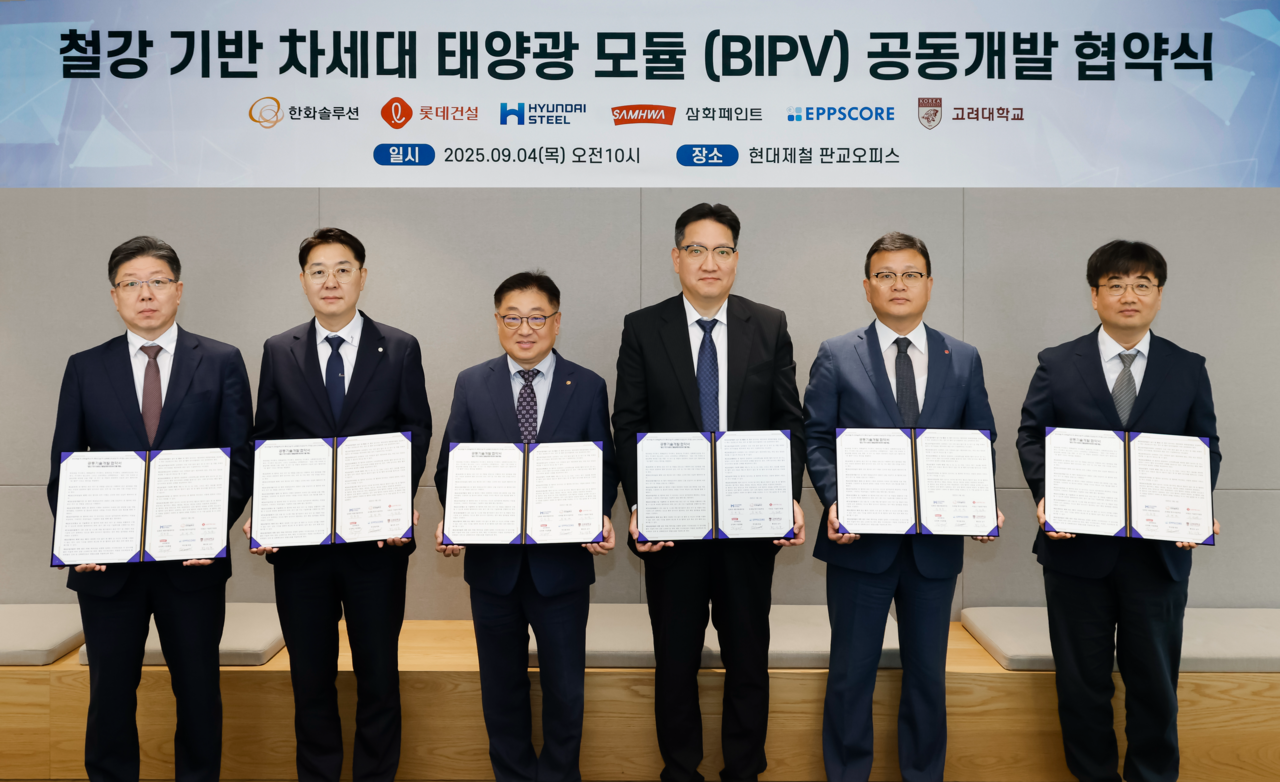
Hyundai Steel said Thursday that it has begun the joint development of next-generation building-integrated photovoltaic (BIPV) modules through a broad industry-academia collaboration.
On Sept. 4, the steelmaker signed an agreement with Hanwha Solutions, Lotte Construction, Samhwa Paints, Epscore and Korea University to co-develop BIPV modules using steel as the core material.
The partnership is designed to respond to Korea’s roadmap for carbon neutrality and the phased mandatory adoption of Zero Energy Buildings, which will extend from public projects to all new construction by 2050.
Traditionally, glass has been the material of choice for solar modules. By replacing it with steel, Hyundai Steel said durability can be improved and heat conductivity enhanced, leading to higher generation efficiency. The project will focus on maximizing these advantages to create high-performance BIPV modules that integrate seamlessly into architectural systems.
Under the agreement, Hyundai Steel and Samhwa Paints will jointly develop materials, while Epscore, a specialist in BIPV manufacturing, will play a central role in product development. Hanwha Solutions and Lotte Construction will contribute expertise in renewable energy and building systems, respectively, while Korea University will provide academic validation and technical advisory support.
The companies said they aim to connect the entire value chain — from materials to finished products to building integration — in an organic process that boosts performance and accelerates commercialization.
“This partnership is a representative case of industry and academia coming together to explore future energy solutions,” a Hyundai Steel official said. “We expect it will not only accelerate the commercialization of BIPV technology but also support global market entry. By combining the strengths of steel with solar technology, we aim to deliver building solutions that contribute to carbon neutrality.”
andreahaneu@heraldcorp.com