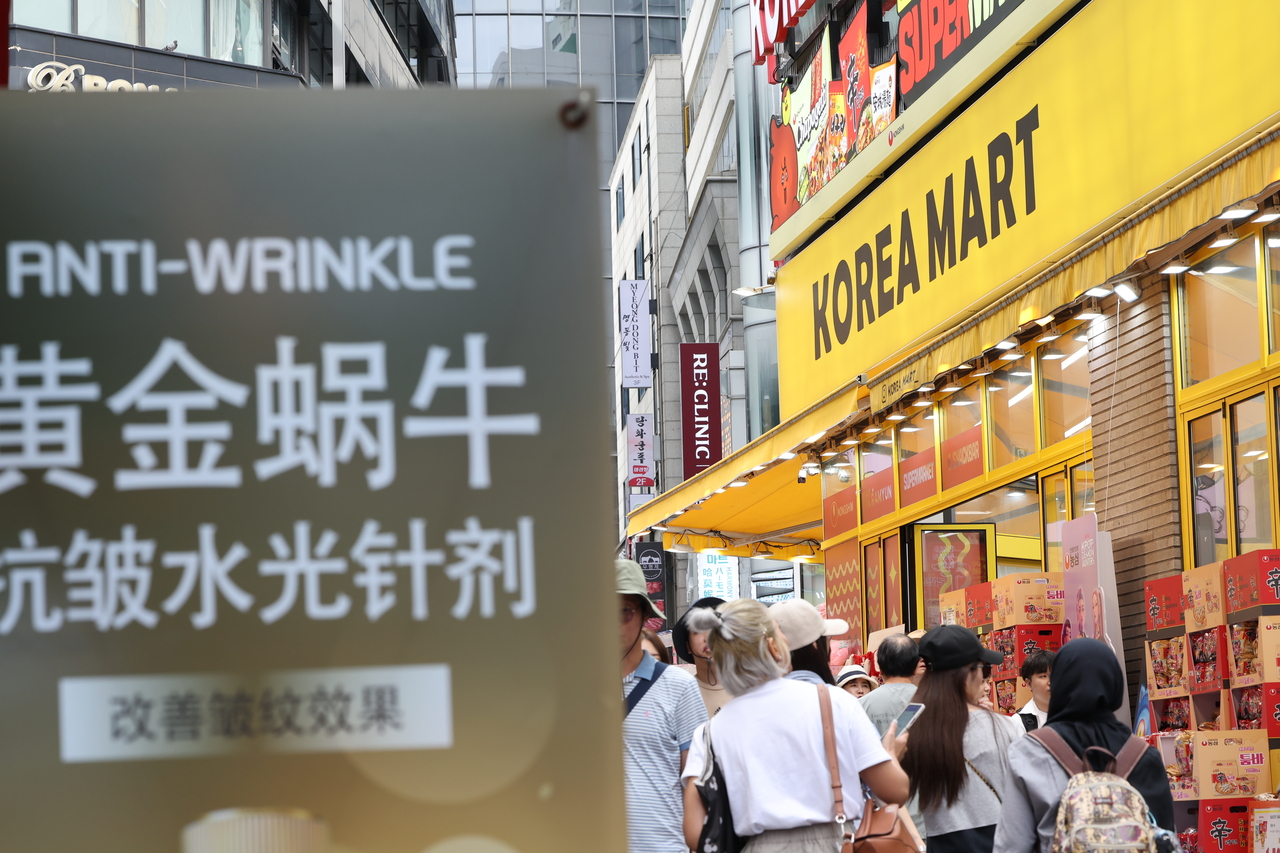
A group representing businesses in Myeong-dong, central Seoul, said Thursday it will request a police ban on protests being held in one of the most popular tourist spots in the country, many of which target Chinese visitors.
The representative council for the Myeong-dong tourism special zone claimed that the protests are violent and pose a serious threat to public safety. "(Participants in the protest) are verbally assaulting and threatening tourists from a particular country, which is undermining the dignity of Korea," it said, adding that hundreds of protesters passing through the narrow streets risk causing accidents.
The council comprises about 100 merchants and building owners in Myeong-dong, an area in Jung-gu, Seoul, designated by the city government as a special tourist zone. The area is routinely packed with people from other countries, including Chinese tourists, who accounted for 1.57 million of the 5.58 million foreign visitors who came to Korea between January and April, according to the Korea Tourism Organization.
Despite China being a crucial part of local tourism and the economy, anti-Chinese sentiment has been brewing here, particularly among younger people, for various social and political reasons. The antagonism has manifested in rallies against China in general, leading President Lee Jae Myung to order countermeasures in Tuesday's Cabinet meeting.
Article 5 of the Assembly and Demonstration Act bans any assembly or demonstration that "clearly poses a direct threat to public peace and order by inciting collective violence, threat, destruction, arson, etc." This is the clause the Myeong-dong merchants are accusing the anti-China protesters of violating.
Article 12 of the same act states that the head of the police may restrict demonstrations and assemblies on a main road of a major city for the purpose of maintaining a smooth flow of traffic.
Police are mulling measures against the protesters, such as restricting activities that can induce conflict with others.
minsikyoon@heraldcorp.com