Forum spotlights tree-planting campaign as key to tackling air pollution, climate change, regional energy security
ULAANBAATAR, Mongolia — The most frequently mentioned keyword at the Korea-Mongolia Future Strategy Forum last week was Mongolia's “Planting 1 Billion Trees” project.
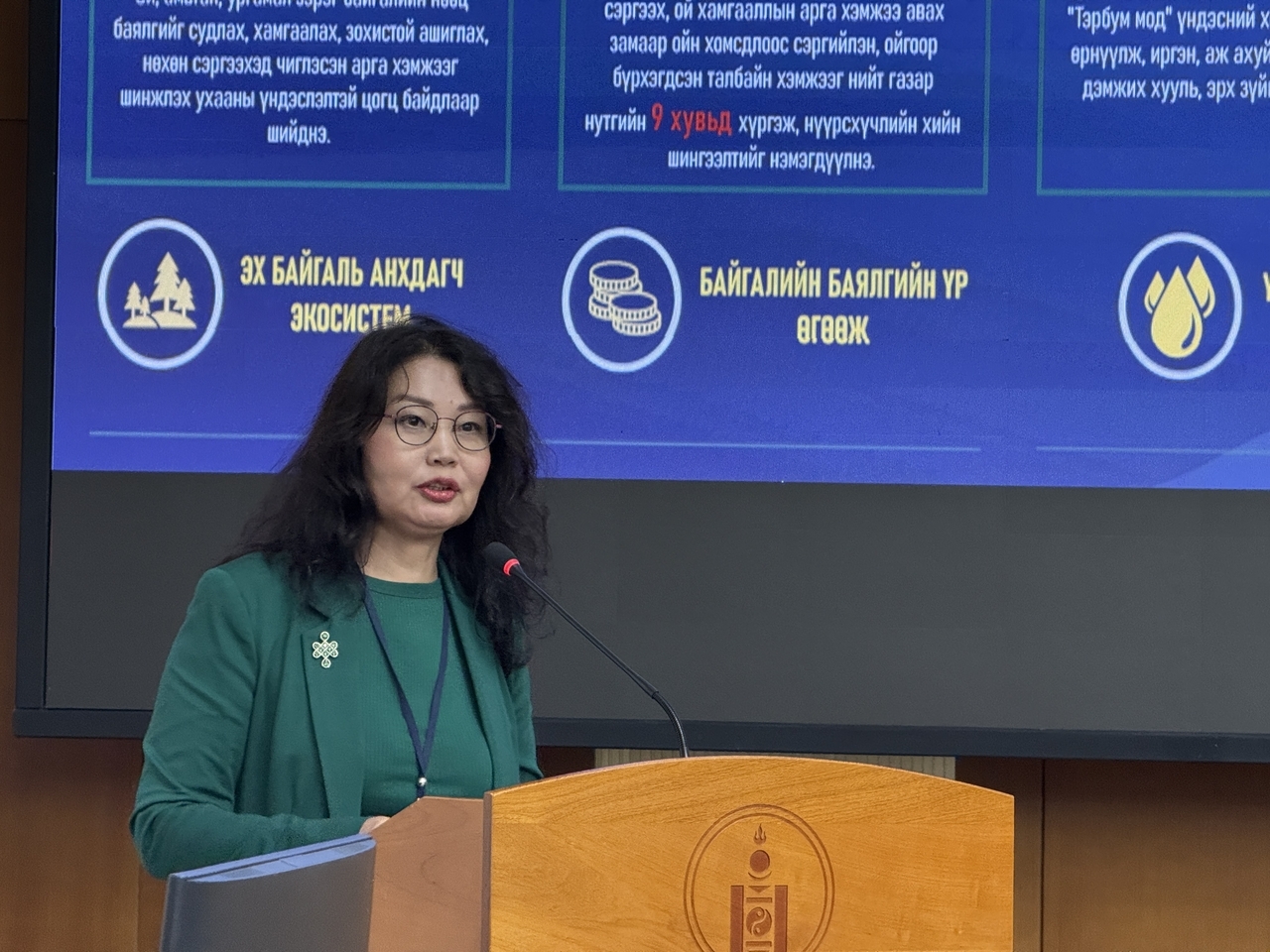
Tserendorj Uranchimeg, director general of Mongolia's Natural Resources Policy and Coordination Department at the Ministry of Environment and Climate Change, introduced the initiative during the forum, co-hosted by Herald Media Group and Anse Foundation, held at the Government Palace in Ulaanbaatar on Aug. 20.
“For Mongolians, the Earth is their mother,” she said while presenting the project.
Launched in 2021 when Mongolian President Ukhnaa Khurelsukh announced the campaign at the UN General Assembly, the project aims to plant 1 billion trees nationwide by 2030 to combat desertification and mitigate the climate crisis by expanding forest cover.
“The first goal is to plant trees in urban areas to create a stable ecological environment, and the second is to plant trees in desert areas to reduce yellow dust,” Uranchimeg explained.
“Among these are also fruit trees that can provide food. We are not just planting trees, but also working to protect them,” she added. “The government is also fostering cooperation with the private sector and implementing policies to support businesses in planting trees or investing in local communities.”
In June, the Korea Forest Service held a meeting in Bogant Soum, Selenge province, with Mongolia’s Ministry of Environment and Climate Change, the Korea-Mongolia Greenbelt Project team and local authorities.
The meeting reviewed achievements and future cooperation plans for the third phase of their joint project, commemorating the completion of key infrastructure such as the Selenge nursery farm, an afforestation training center and a forest fire response system.
The Selenge nursery farm, spanning 150,000 hectares, is a major seedling production facility. Its seedlings will be used to restore forest fire damage and support Mongolia’s “Planting 1 Billion Trees” campaign.
“It is important to establish an institutional framework so that NGOs and companies engaged in tree planting can benefit from the global carbon market. In this regard, we would like to ask the Korean side to consider the plan we are developing through this forum,” said Bat-Erdene Bat-Ulzii, head of the Mongolia-Republic of Korea Parliamentary Friendship Group. Republic of Korea is South Korea's official name.
“Ultimately, we want to create a system where individuals, organizations and institutions that plant trees can receive economic benefits in the global market,” he added.
Professor Jung Tae-yong of Yonsei University, who moderated the session, said, “Climate change is no longer an issue that any country can avoid. Mongolia must continue to face this challenge, and it is highly meaningful to explore solutions together through the forum.”
“Addressing climate change alone is not enough. The greatest challenges of the 21st century are climate change and digital transformation. Solutions that combine digital and green approaches will be the most suitable for Mongolia,” he added.
By Park Sang-hyun (pooh@heraldcorp.com)
Ha Neul-bit (andreahaneu@heraldcorp.com)
pooh@heraldcorp.com
andreahaneu@heraldcorp.com