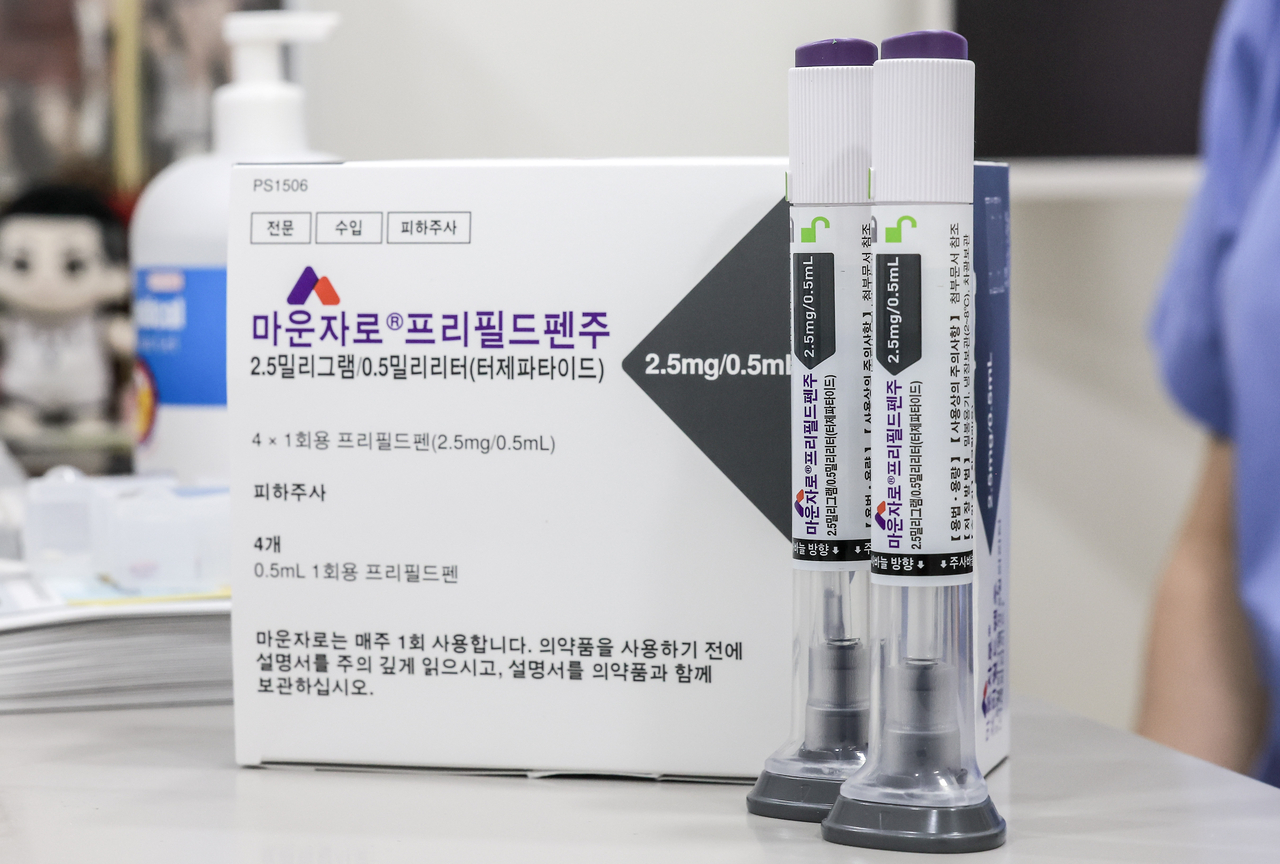
When 30-year-old office worker Choe Hee-sang heard that the antidiabetic medication Mounjaro was available for prescription from August, she contacted numerous clinics to see if she would be eligible for a prescription of her own.
Despite supply shortages, Choe managed to find a clinic that would prescribe it in Jongno-gu, central Seoul — a clinic dubbed by South Koreans as a “Wegovy sanctuary” for offering prescriptions at lower prices than most clinics.
“I had a colleague who lost a lot of weight after being prescribed Wegovy, and I wanted to see if I was eligible to be prescribed it too,” Choe told The Korea Herald. “I had heard more people were successful in losing weight with Mounjaro than Wegovy, so I wanted to give this drug a try.”
What surprised her, however, was how little actual medical screening the process involved.
“Because Mounjaro isn’t covered by insurance, the doctor said there was no need to measure my body mass index. They didn’t ask much about my medical history either,” Choe said. “When I asked about side effects, they only said there could be some, but brushed it off, adding that if anything happened, it would be my responsibility.”
“I had been curious about Wegovy and Mounjaro ever since I heard about how many people saw positive results, but the entire prescription process didn’t feel trustworthy to me,” she added.
A surge in demand
Originally developed as treatments for Type 2 diabetes and obesity, anti-obesity injections such as Wegovy and Mounjaro have become some of the most sought-after drugs in Korea, not for treating diabetes but for weight loss.
With Mounjaro’s official release in August, demand has skyrocketed to the point where pharmacies across the country frequently report being out of stock.
As stories like Choe’s show, the drugs are being prescribed outside their intended medical use, often without rigorous screening.
“I read online about a woman with a BMI of 21 who asked for the highest-level Wegovy prescription,” 28-year-old Park Jung-min told The Korea Herald. Wegovy is supposed to be prescribed to those with a BMI of 30 and above, those with high blood pressure, or those with diabetes with a BMI of 27 and above.
“The doctor supposedly warned her it could cause acute pancreatitis, but still seemed willing to prescribe it. In a society that’s as appearance-focused as Korea, there are a lot of people obsessed with dieting and losing weight even if they don’t necessarily need it,” Park added.
“Just giving vague warnings won’t work with people who are obsessed with losing weight. Doctors should firmly refuse inappropriate prescriptions.”
Lax oversight
On Monday, the Ministry of Food and Drug Safety issued a reminder that such drugs should only be prescribed to patients who meet the clinical definition of obesity and under strict medical supervision.
The ministry added that it would also crack down on illegal online sales and advertising the drugs as “weight-loss injections,” but offered no concrete measures on how it would curb indiscriminate prescribing at such clinics.
Medical experts stressed that the misuse of these medications “could carry lasting consequences.”
“Wegovy and Mounjaro are not simple appetite suppressants. They have clear prescription guidelines and require the dosage to be gradually increased under a physician’s supervision,” professor Huh Yang-im from the Korean Society for the Study of Obesity told The Korea Herald.
“If people start with high doses unnecessarily, they may quickly develop resistance. That can lead to rebound weight gain and, in some cases, treatment-resistant obesity.”
The expert added that the drugs’ side effects — which can include nausea, gallbladder issues, and in rare cases, pancreatitis — require close monitoring.
“Uncontrolled prescribing not only puts patients at risk, it also undermines the drugs’ effectiveness when they are truly needed. Stricter government oversight is urgently required for such reasons,” the professor added.
lee.jungjoo@heraldcorp.com