Critics argue Trump’s equity demand is no subsidy but an attempt at ownership of private companies
Washington is reviewing options to acquire equity stakes in foreign chipmakers such as Samsung Electronics and TSMC in return for the federal subsidies they are receiving to build factories in the US, industry sources said Wednesday.
The idea has rattled the industry, with analysts dismissing it as “unrealistic,” saying it reflects US President Donald Trump’s intent to walk back on grants pledged under the former Biden administration.
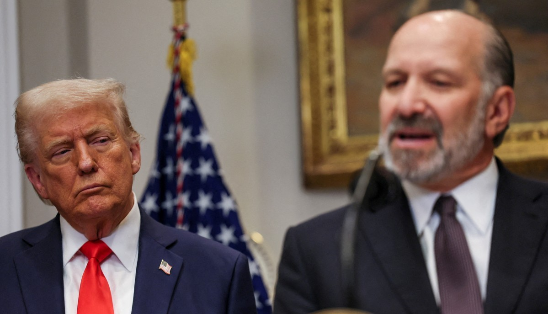
US Commerce Secretary Howard Lutnick on Tuesday openly floated the idea in reference to Intel, as the White House reportedly weighs options such as taking a 10 percent stake in the company.
“We should get an equity stake for our money,” Lutnick told CNBC, referring to Intel. “So we’ll deliver the money, which was already committed under the Biden administration, and we’ll get equity in return.”
Citing sources familiar with the matter, Reuters reported that Lutnick is exploring applying the same approach to other chipmakers, including Samsung.
Lutnick argued that the Biden administration “literally was giving Intel money for free, and giving TSMC money for free,” underscoring the Trump administration’s critical stance on federal grants. The CHIPS and Science Act, legislated under the Biden administration, pledged subsidies to global chipmakers building plants in the US as part of a wider effort to reshore semiconductor manufacturing.
“Donald Trump turns that into saying, ‘Hey, we want equity for the money. If we’re going to give you the money, we want a piece of the action,’” Lutnick said, adding that any potential arrangement would not give the government governance rights in Intel.
Intel has said it finalized a nearly $8 billion grant under the CHIPS and Science Act to build its factories, while TSMC was awarded $6.6 billion to expand chip production at its Arizona facilities. Samsung Electronics, which is building a $37 billion advanced chip plant in Taylor, Texas, secured a $4.75 billion subsidy package under the Biden administration last year. SK hynix is also set to begin construction of a $3.87 billion advanced packaging plant for AI memory in West Lafayette, Indiana, in the second half of this year.
“It’s an unreasonable idea. The US government is effectively demanding equity in private companies — not state-run firms or startups, but already well-established foreign businesses like Samsung and TSMC. That is not a subsidy anymore, it is ownership,” said Kim Yang-paeng, a senior researcher at the Korea Institute for Industrial Economics and Trade.
According to Kim, the plan reflects Trump’s long-standing view that subsidies are a “waste” and should not be handed out. “What Washington is really saying is it wants equity equal to the subsidies, which means it’s no longer a subsidy,” he said. “US firms might accept that since it is their own government, but Samsung or TSMC will not.”
In Intel’s case, the Trump administration’s plan to acquire a 10 percent stake is seen as roughly equivalent to the $7.86 billion in subsidies the company is set to receive, compared with its market capitalization of $110.8 billion.
If applied to Samsung, the approach would translate into about a 1.6 percent stake, based on the $4.75 billion subsidy against its 414 trillion won market capitalization as of Wednesday. As the Korean chip giant is listed on the domestic stock market, Washington may instead target stakes in its US subsidiaries, such as Samsung Semiconductor and Samsung Austin Semiconductor, industry experts said.
herim@heraldcorp.com