Workers thought to have been moving alongside the tracks when they were hit by train
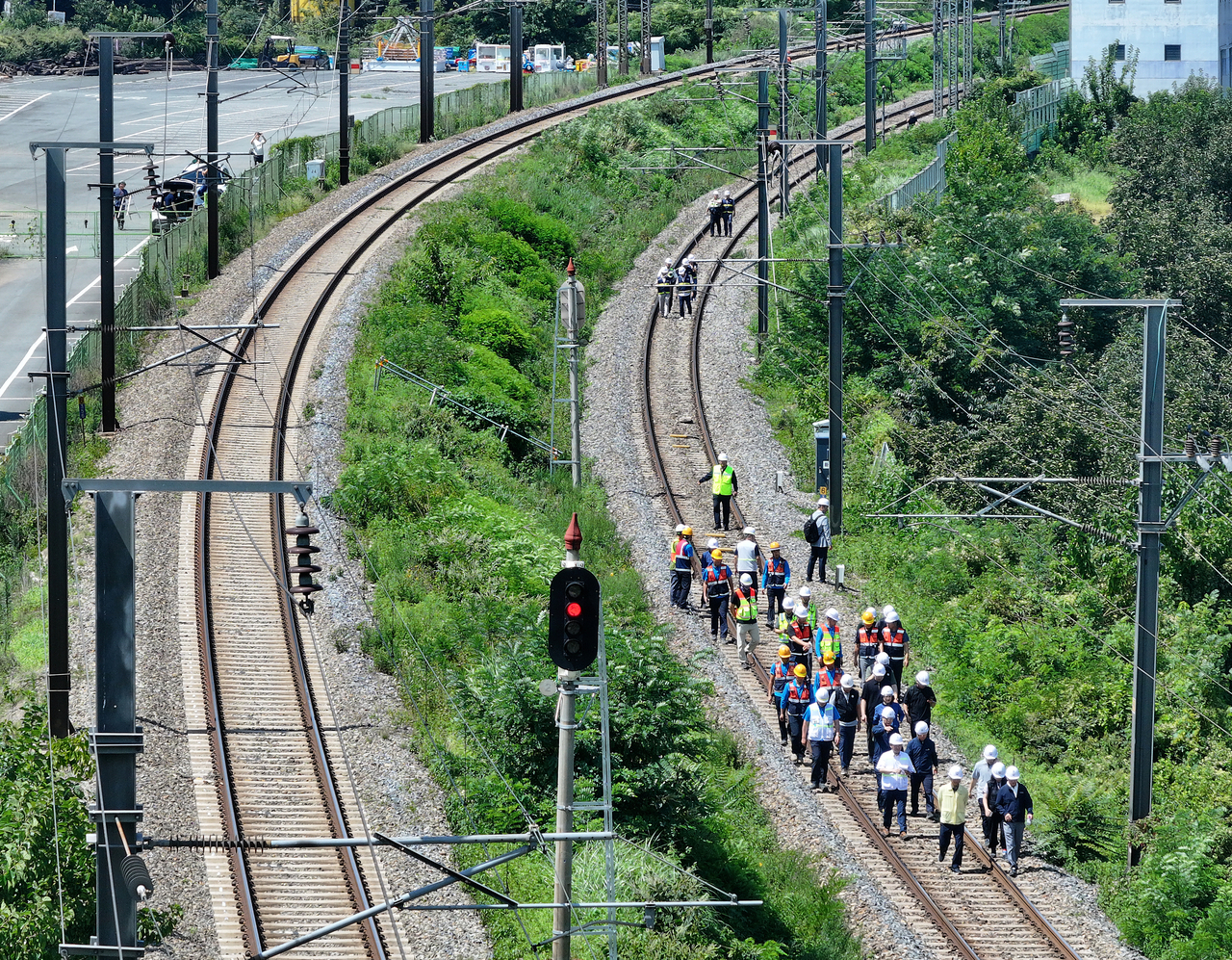
With the government probe underway into Tuesday's train accident that left two dead and five injured, officials on Wednesday are investigating why the victims were not a safe distance from the tracks.
The state-run Korea Railroad Corp. said the accident appears to have occurred when the southbound Mugunghwa train was turning a curve, blindsiding six workers and a Korail supervisor performing a routine safety inspection.
According to Korail, routine inspections are typically conducted without disrupting train operations and require only the station master's authorization. The regulation states that routine work must be done in a safe zone at least 2 meters away from risk factors. Workers are only to be on the exposed part of the track bed — the foundation where the railway track is laid, which is some distance away from the rails.
The initial investigation suggests that the workers were walking alongside the rails on the track ballast, presumably due to thick bushes that made it difficult to walk on the track bed. Officials are seeking to confirm if such measures were taken and why.
Korail said there were no procedural problems in terms of the train's operation prior to the incident.
Out of the seven victims, two sustained fatal injuries and died at the hospital, while four were severely injured, and one worker escaped with mild injuries. No passengers on the train were injured.
Why were they unable to avoid the accident?
The train was running at around 100 kilometers per hour when it approached the accident site about 120 meters from the curve. As such, the conductor would not have had time to stop the train to avoid a collision.
The train in question is operated by electricity, making its approach quieter and giving the workers less time to respond.
The workers were given mobile phones with an application that sounds an alarm when a train approaches, along with walkie-talkies. The Korail official was supervising the inspection, and one subcontractor was designated to monitor the surrounding areas for approaching trains.
One of the workers who sustained relatively lighter injuries told police that they heard the alarm, but thought it was a malfunction because they did not see the train. An investigation is being conducted as to whether radio communication and the warning app functioned properly at the time of the accident.
The Ministry of Land, Infrastructure and Transport said it will conduct a thorough investigation into any potential violations of the Road Safety Act, and vowed zero tolerance if that is the case.
minsikyoon@heraldcorp.com