Calls grow to require installation of sprinklers in old apartments
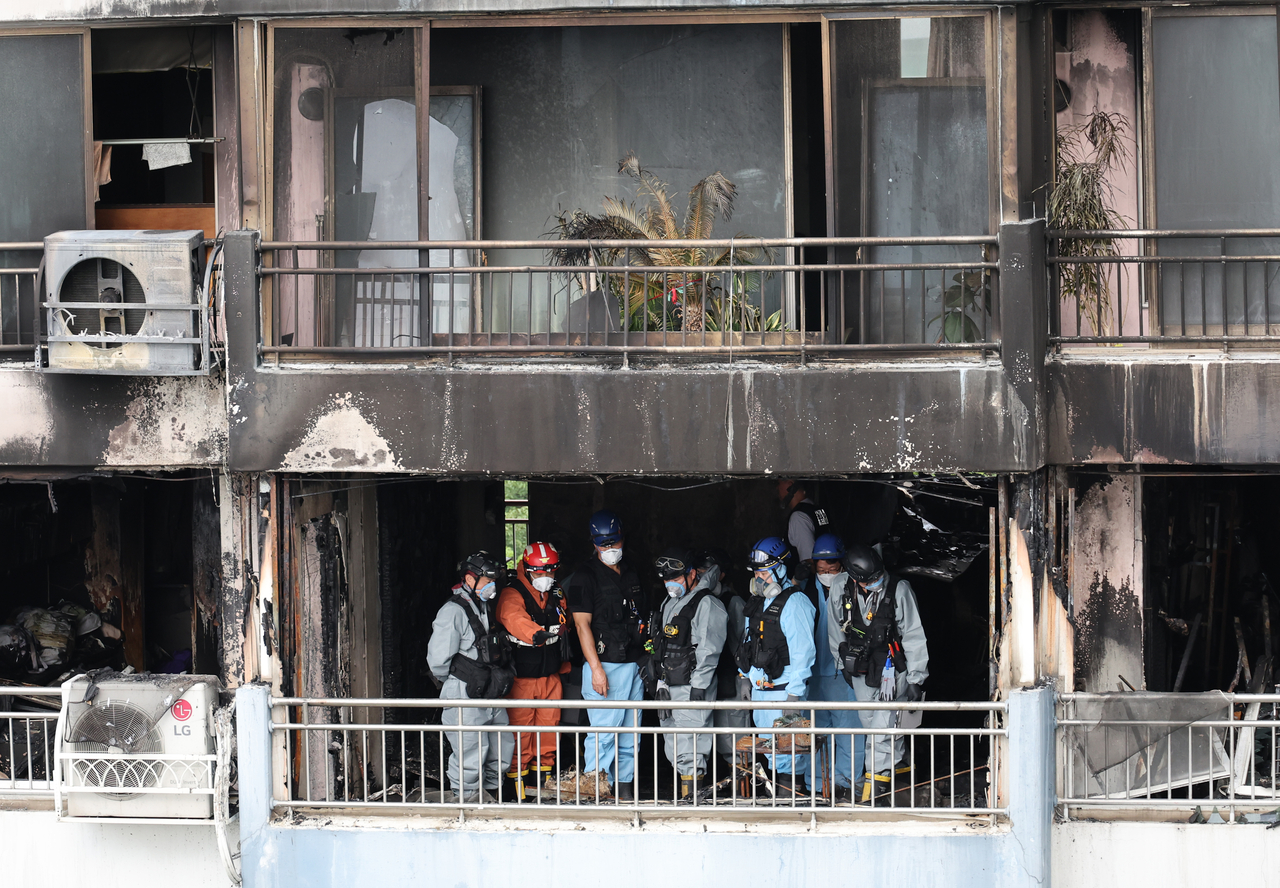
Police and fire authorities launched a joint investigation Monday into the cause of a fire at an apartment in Mapo-gu, western Seoul, on Sunday, and discovered a lithium-ion battery pack in the charred unit.
At 8:11 a.m., Sunday, a fire broke out on the 14th floor of a 20-story apartment building in western Seoul, leaving a man in his 20s and his mother in her 60s dead and 13 others injured. The husband and father in his 60s sustained severe burns but managed to escape and was taken to a hospital. The fire was declared completely extinguished at 10:42 a.m.
During an on-site press briefing, fire officials confirmed that a battery pack was recovered from the residence where the fire is believed to have ignited.
“The battery discovered at the site is presumed to be a lithium secondary battery used for an e-scooter,” said an official from Mapo Fire Station during Monday’s briefing.
According to the father of the man in his 20s, as quoted in local media reports, the man had an e-scooter of his own and often charged the battery pack used for the micromobility device in his room.
The father was quoted in local media reports saying that the battery was charging when the fire broke out and that both he and his wife had tried to “fight the fire with water and a fire extinguisher.”
“The flames surged like gasoline had been poured, and a series of explosions followed, spreading instantly,” the father reportedly said. Witnesses on site were also quoted as saying that they heard “multiple loud noises” followed by fire and thick, black smoke.
However, authorities stated that the battery pack cannot yet be directly listed as the cause of Sunday’s fire.
“In a fire of this scale, it is also possible that the battery could have exploded as a result of accumulated heat rather than the battery itself being an ignition source of its own,” fire authorities added.
Police officials on site were quoted as saying that Sunday's incident resembles a phenomenon known as a "thermal runaway," in which a chain reaction of heat builds up inside a lithium-ion battery and causes the device's temperature to rise as high as 1,000 degrees Celsius within seconds.
Joint forensics inspections began at 10 a.m., Monday, including representatives from Mapo Fire Station, Mapo Police Station, the Seoul Metropolitan Fire and Disaster Headquarters, the Seoul Metropolitan Police Agency, and the Korea Electrical Safety Corporation.
Fire authorities added that they would submit the lithium battery pack collected on site, as well as other materials, for forensic examination. The results are expected to clarify the exact cause of the blaze, but their release date has not been confirmed.
Meanwhile, Sunday’s fire also raised calls to make the installation of sprinklers mandatory in older residential buildings. Fire authorities on Sunday confirmed that no sprinklers were installed in the residence in accordance with the Fire Services Act from 27 years ago. Sprinklers were only required to be installed on floors 16 and above at the time of the apartment’s construction.
According to the National Fire Agency, only 35 percent of South Korea’s 44,208 residential complexes nationwide had sprinklers as of January 2024.
While the law currently mandates that all residential complexes install fire sprinklers, the law only applies to residential complexes built after 2018. Any apartments built prior are exempt from this law, drawing regulatory loopholes.
“We see fires that cause great damage yearly, which all create damage that could have been prevented with proper fire extinguishing equipment in place,” said Professor Gong Ha-seong from the Department of Fire and Disaster Prevention at Woosuk University.
“While sprinklers, for example, can be installed in occupied buildings, it does require significant cost and time. The government needs to consider measures such as providing support funds to encourage apartment complexes, especially the old ones, to voluntarily install sprinklers on all floors.”
lee.jungjoo@heraldcorp.com