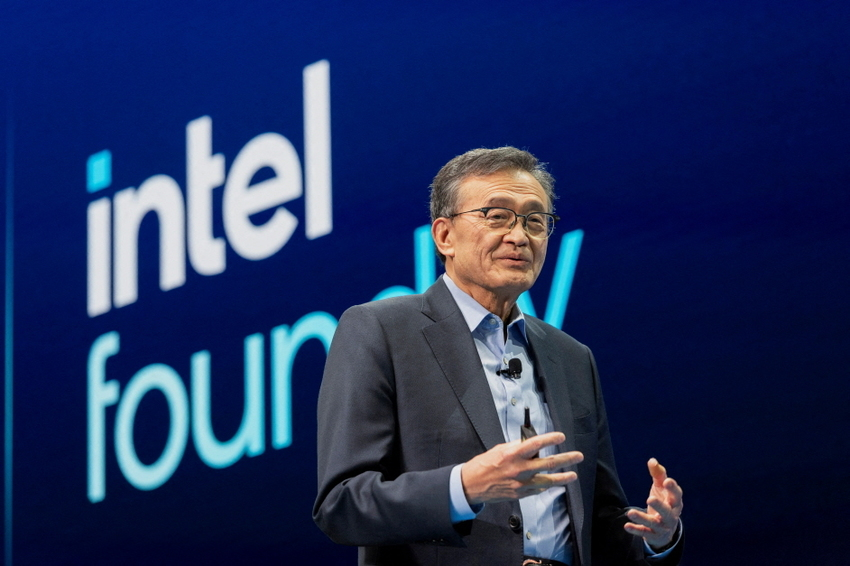
With reports emerging that Washington is weighing a stake purchase in Intel to shore up the struggling chipmaker, concerns are mounting that the move could pose challenges for rivals such as Samsung Electronics and TSMC.
Analysts warn that the government support is an apparent push to steer US big tech firms toward Intel, a shift that could erode the market presence of overseas competitors.
Industry sources said Monday that the US government is reviewing plans to acquire a stake in Intel following a recent White House meeting between US President Donald Trump and Intel CEO Lip-Bu Tan.
According to Bloomberg, the Trump administration is weighing the use of funds from the CHIPS Act to buy into Intel, aiming to bolster the ailing firm seen as America's last hope for domestic chip manufacturing. It remains unclear whether this would involve converting some or all of Intel's existing CHIPS Act grants into equity, the outlet added.
“(Trump) can go to these customers like Broadcom, Qualcomm, Apple and Nvidia and say now they (Intel) have the capability, and you need to move more of your orders and production to a domestic leading-edge company like Intel," Mizuho Securities USA Managing Director Jordan Klein said.
Lee Jong-hwan, a system semiconductor engineering professor at Sangmyung University, echoed the view, saying, "it could increase Intel's chances of securing orders from US big tech companies, and if its foundry business gets back on track with government support, that is obviously bad for Samsung's foundry business."
Washington’s move to go beyond subsidies and directly purchase equity in Intel highlights the growing extent of government intervention in the global semiconductor race — complicating the outlook for rivals such as Korea’s Samsung Electronics and SK hynix.
NH Investment & Securities analyst Ryu Young-ho said in a report Monday that "blatant US support for domestic firms is negative for competitors like TSMC and Samsung Electronics."
"No official announcement came (from Washington), but there are signs that the US government is intervening in companies critical to US industry," Ryu continued.
For example, the US Defense Department recently funded American miner MP Materials in a bid to shore up rare earth production, where it sees strategic weakness.
The Trump administration has also introduced a so-called "export tax," requiring US chipmakers like Nvidia and AMD to hand over 15 percent of revenue from sales to China.
For Intel, the government's intervention could offer critical relief from its financial troubles. Since early 2022, the chipmaker’s foundry business has been running at a loss every quarter, with total losses swelling to $19.6 billion as of the second quarter this year. To cope, Intel has been slashing costs and cutting jobs.
With the equity injection, Intel is expected to accelerate construction of its planned semiconductor plant in Ohio. The project, which broke ground in 2022 with a 2025 completion goal, has been pushed back to 2030 amid funding shortfalls.
Still, Intel must convince customers of its competitiveness, Klein said.
In the global contract chipmaking market, Intel holds virtually no share, while TSMC dominates with 67.6 percent of revenue in the first quarter of this year, followed by Samsung at 7.7 percent.
The Wall Street Journal also pointed out that it could weaken the overall competitiveness of the US semiconductor industry if the government pressures companies to use chips from Intel, which has lower yield and production capability when compared to TSMC.
herim@heraldcorp.com