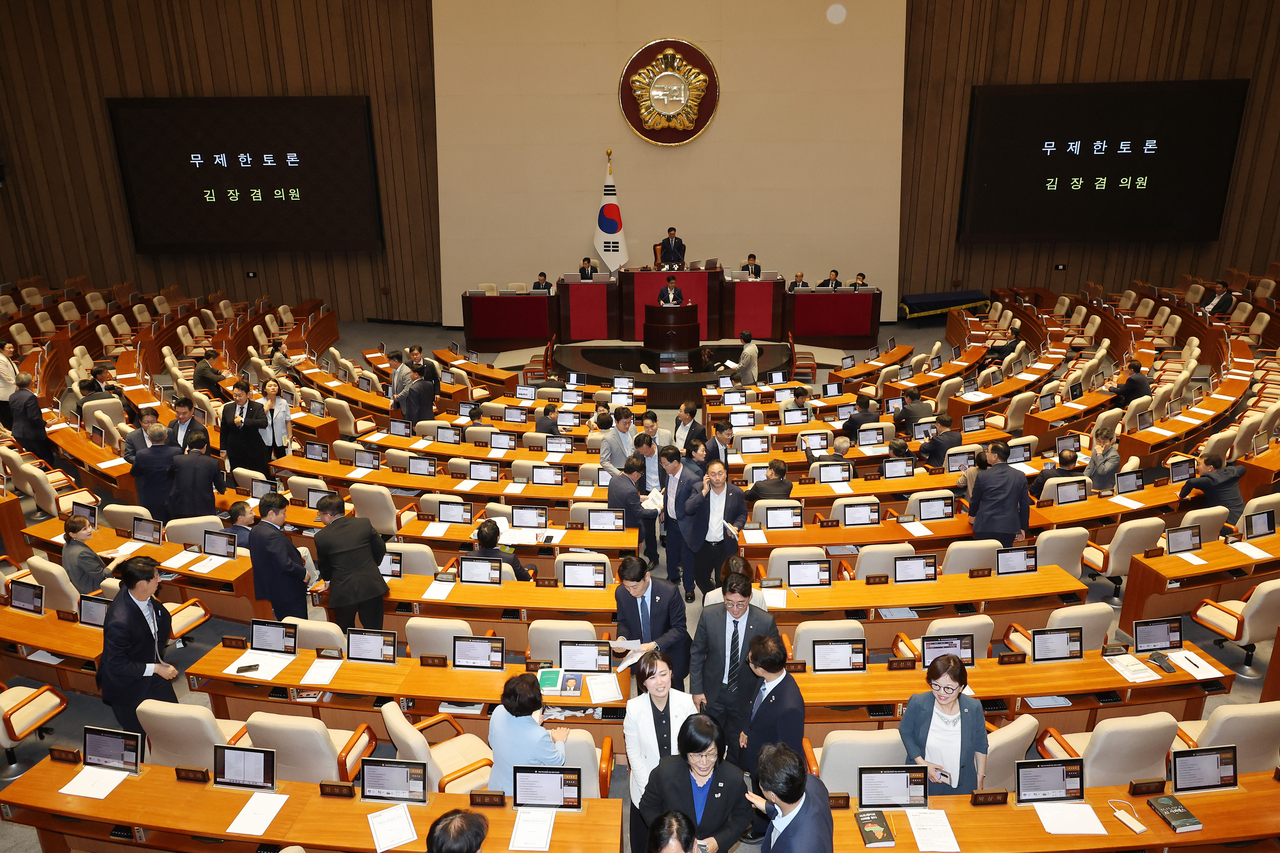
South Korea's parliament is expected to vote on contentious bills later this week at the National Assembly's plenary session, which may add to escalating bipartisan strife over a recent presidential pardon and a probe targeting the main opposition party.
This will only be the latest in a string of several recent events contributing to Korea's political polarization, which has continued to deepen in the wake of former President Yoon Suk Yeol's botched martial law imposition in December 2024.
The divide was especially noticeable when main opposition People Power Party figures did not attend President Lee Jae Myung's inauguration ceremony on Friday. The party has lambasted the presidential pardon of convicted liberal politicians, effective the same day, as well as the bills to be voted on this week.
From as early as Thursday, the National Assembly is poised to process contentious bills put to a vote in the parliamentary session that terminated on Aug. 6.
Earlier in August, the People Power Party hinted at filibustering five bills sponsored by the ruling Democratic Party of Korea. These comprised three bills to weaken an administration's power to organize the boardrooms of broadcasters KBS, MBC and EBS, respectively, the "Yellow Envelope" bill, which would ban companies from claiming damages incurred by striking labor unions, and a Commercial Act revision to enhance minority shareholders' rights to elect a corporate board director.
Before Aug. 6, only one of the five, regarding the boardroom organization of KBS, had passed the parliament, and no plenary session has taken place since.
Liberal-leaning parties at the National Assembly have enough seats, combined, to end a filibuster 24 hours after it is initiated, meaning a filibuster provides little bargaining power to the People Power Party, which has only 107 lawmakers at the 298-member parliament.
People Power Party spokesperson Kwon Dong-wook said in a statement Sunday that these bills sponsored by the liberal parties are "filled with ideological bias."
Although Lee pledged to "move beyond old ideological divisions toward dialogue, compromise and shared progress" in a Liberation Day address on Friday, the political divide remained visible later that night.
At Lee's "civic inauguration" ceremony, the main opposition party’s leadership was absent, as were prominent conservatives such as former Presidents Lee Myung-bak and Park Geun-hye as well as Seoul Mayor Oh Se-hoon.
The People Power Party lashed out at the ruling bloc for granting clemency to liberal-leaning politicians. Among them were Cho Kuk, former leader of the minor Rebuilding Korea Party, who was jailed for fabricating academic credentials for his children, and Youn Mee-hyang, a former liberal lawmaker who had been given a suspended sentence for embezzling donations intended for victims of Japan's wartime sex slavery.
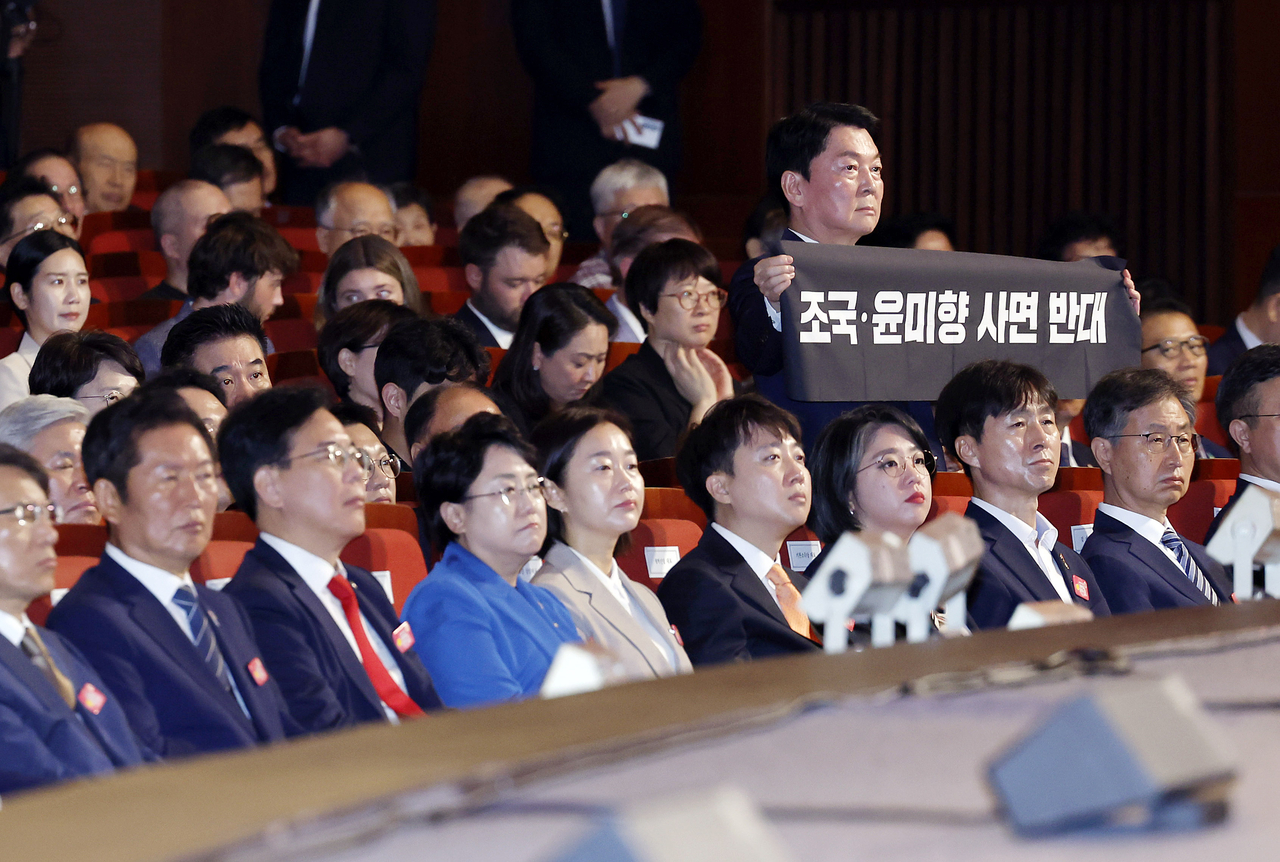
Also on Friday, Rep. Ahn Cheol-soo of the People Power Party was seen holding a placard denouncing the pardon of Cho and Youn during the Liberation Day ceremony.
Rep. Bak Seung-a of the Democratic Party on Saturday described Ahn's action as a publicity stunt with a political purpose, given that Ahn is one of the candidates vying to lead the People Power Party.
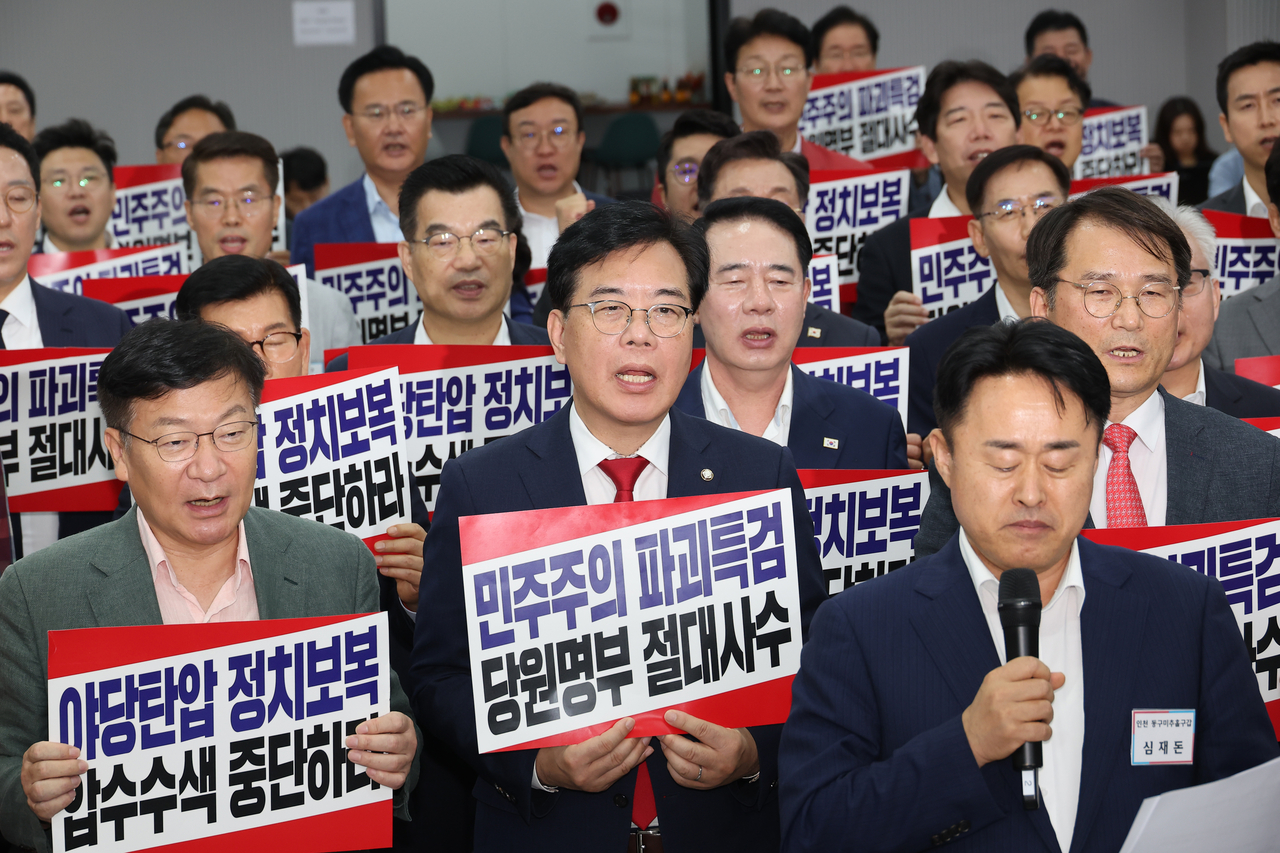
The People Power Party, in the meantime, is also bracing for a special counsel's renewed attempt to conduct a search operation at its headquarters in Seoul, as the special counsel seeks to obtain the personal information of some 5 million party members.
The first attempt, a surprise raid on Wednesday, followed speculation that religious sects, including the Unification Church, may have exerted influence on the party's elections by having its members join the party en masse.
A senior official of the Unification Church, surnamed Yoon, is accused of involvement in the former president and his wife's alleged crimes of influence-peddling in a party election, in return for help on projects in Cambodia in the church's interests.
Wednesday's raid ended in failure following a 15-hour standoff with party members. Following this, People Power Party chair candidate Kim Moon-soo said in the primary Friday that the special counsel's attempt to seize the list of all 5 million people affiliated with the party, "suppresses democracy" in South Korea.
Three special counsel teams have launched operations since legislation from the ruling Democratic Party passed in early June.
consnow@heraldcorp.com