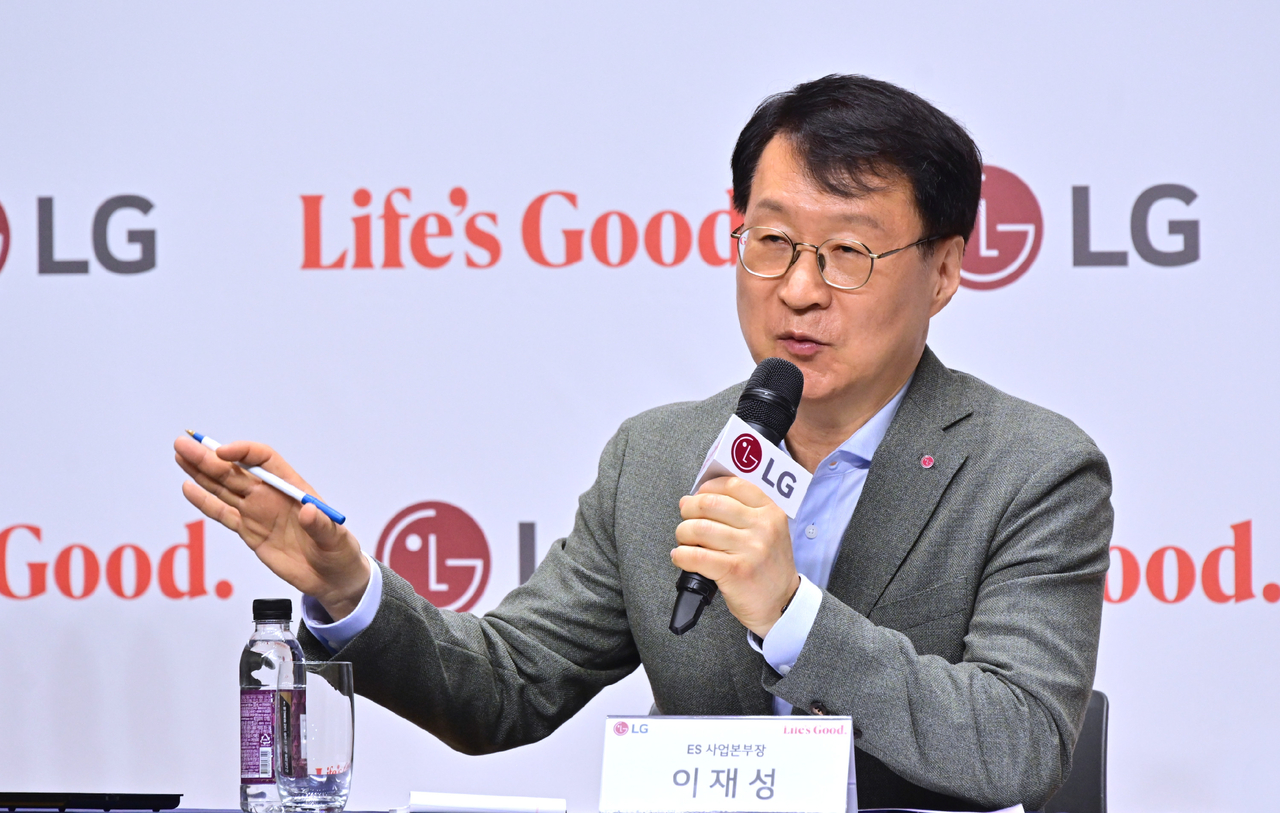
LG Electronics on Tuesday unveiled its ambitious plan to expand its heating, ventilation and air conditioning business to 20 trillion won ($14.6 billion) in annual sales by 2030, positioning it as a key growth driver in the business-to-business sector amid the accelerating rise of AI infrastructure.
"HVAC demand is skyrocketing in the AI era," Lee Jae-sung, president of the eco solution division at LG Electronics, said in a press briefing in Seoul. “Until now, we’ve focused on residential and commercial HVAC, but we’re now expanding into industrial and infrastructure applications — including hyperscale data centers — in line with the evolution of our technology and market."
As part of its short-term goal, LG aims to increase sales from its chiller business — large-scale cooling systems essential for industrial and data center operations — to 1 trillion won within two years. To support this, the company has designated HVAC as one of its seven key technologies and will intensify efforts to secure contracts for liquid-cooling solutions, a technology increasingly vital for data centers worldwide.
Lee pledged that LG will pursue “compressed growth at twice the market rate” by offering best-in-class HVAC solutions tailored to AI infrastructure needs.
To achieve this, LG plans to triple its order intake for data center HVAC solutions on-year, expand ultralarge chiller systems into data center applications, build localized, end-to-end value chains encompassing research and development, production, sales and maintenance, boost the revenue contribution of non-hardware services — such as subscriptions and maintenance — to 20 percent and enhance its portfolio through a series of targeted acquisitions.
“Considering the planned infrastructure investments, product development and R&D spending to drive market growth, we believe that if we grow at twice the market’s average annual growth rate, reaching 20 trillion won in sales by 2030 is well within reach,” Lee said with confidence.
LG is strengthening its presence in the data center industry with two key cooling technologies: a liquid cooling solution that directly cools semiconductor chips using a coolant distribution unit and an air cooling system that lowers internal temperatures via chillers.
Lee hinted that the tech giant is currently in discussions to supply coolant distribution units to US chip giant Nvidia.
“We are undergoing Nvidia’s certification process and are in talks regarding potential supply,” he said. “What’s crucial is not just working with Nvidia, but expanding into the entire ecosystem — including chipmakers and server manufacturers.”
LG is also pursuing technological collaborations with global tech giants such as Microsoft, highlighting its ambition to become a key player in the next-generation data center infrastructure market.
While LG signed a deal last month to acquire 100 percent of Norwegian hot water solutions firm OSO Hotwater, marking a strategic entry point for its expansion into the European HVAC market, the eco solution division head said the firm would continue its efforts to strengthen the business’ competitiveness by making such acquisition deals.
"Acquiring OSO was just the beginning,” he said. "Non-hardware services such as subscription-based maintenance will play a key role in driving qualitative growth, and we are committed to leading the transformation."
yeeun@heraldcorp.com