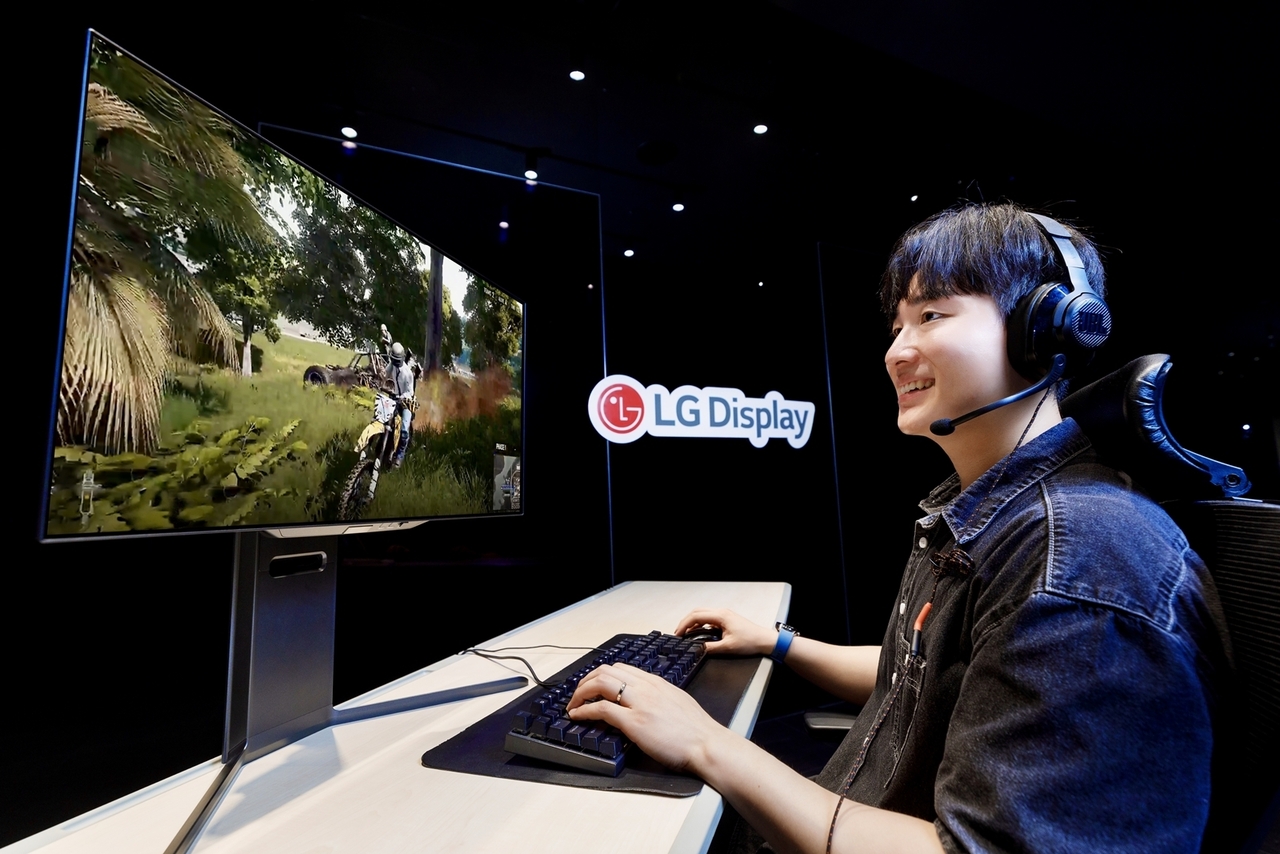
LG Display said Friday it has begun mass production of its new 27-inch OLED monitor panel, equipped with the company’s proprietary primary RGB tandem technology — a key advancement marking the arrival of fourth-generation OLED innovation.
The primary RGB tandem architecture stacks red, green and blue organic light-emitting layers independently across four tiers, allowing each color to emit light with greater intensity and precision. The unique structure enhances peak brightness and contrast ratio, offering users more vibrant and accurate visual output.
According to the company, the new OLED panel achieves the highest brightness level currently available for OLED monitors at 1,500 nits and supports an industry-leading 280-hertz refresh rate. The color reproduction rate also achieved a top-tier level among existing OLEDs, reaching 99.5 percent.
To address one of the persistent challenges in gaming monitors — glare and internal reflection — the display maker applied specialized films and structural enhancements to block 99 percent of both internal and external light reflection, ensuring an uninterrupted gaming experience.
LG Display said it has also successfully developed the world’s first OLED monitor panel that simultaneously supports a 540Hz refresh rate and QHD resolution. Major global OEMs have reportedly completed validation, with mass production slated for the second half of the year.
The 540Hz panel refreshes images 540 times per second, offering a decisive edge in high-speed gaming genres such as first-person shooters and racing games.
The company highlighted its dynamic frequency and resolution technology, developed last year, which enables up to 720Hz refresh rates when used in HD mode, pushing the boundaries of gaming display performance.
With the latest suite of innovations, LG Display says it holds the industry-leading position across all three key performance metrics for OLED monitors: brightness, refresh rate and response time. The company’s OLED monitor panels feature an ultra-fast response time of just 0.03 milliseconds, far outpacing the 1.0ms typically found in LCD monitors.
yeeun@heraldcorp.com