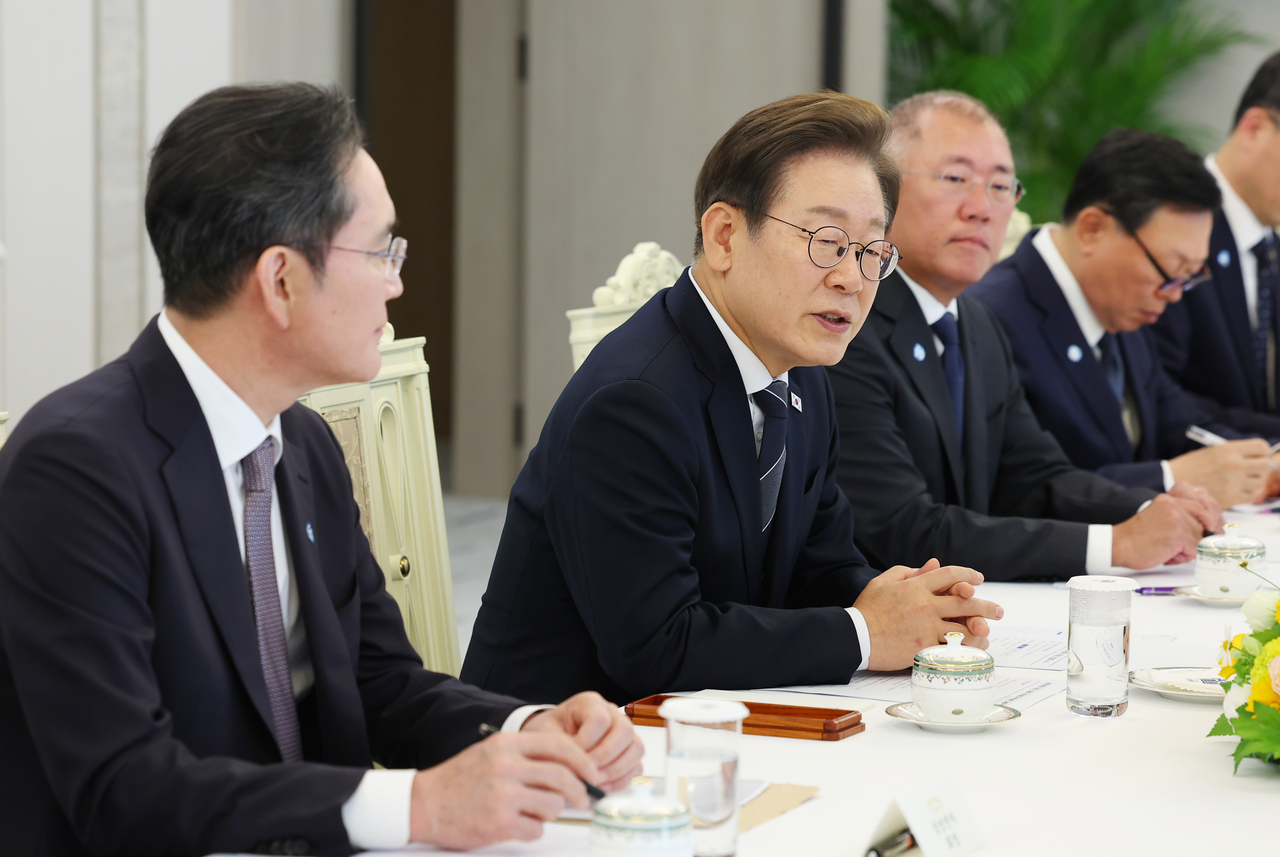
President Lee Jae-myung's trade policy will likely come with flexibility to cope with US President Donald Trump's tariff salvo against US trading partners, including South Korea, Lee told business leaders Friday ahead of his departure for the G7 Summit in Canada.
At a meeting with South Korean business leaders, Lee was quoted by his spokesperson Kang Yu-jung as saying that the advent of economic nationalism, trade protectionism and supply chain segmentation has "triggered a major shift in the global trade order." This, Lee said, has resulted in a trade war that "greatly undermined the competitive edge and exports of South Korean industry."
During a closed session of the meeting, Lee stressed a need to "go all out to overcome the crisis through practical and flexible trade policies," Kang added.
According to Kang, Lee also told business circles that he would advocate the stance of South Korean businesses to safeguard national interests on international stages as the nation's head of state, starting with the G7 Summit. Lee's itinerary for his time in Canada has yet to be disclosed.
The president's remarks came after Chey Tae-won, SK Group chair and head of the Korea Chamber of Commerce and Industry business lobby group, said to Lee that South Korean entrepreneurs were troubled by the lingering volatile tariff landscape, which posed challenges in making the right decision for their businesses.
Trump briefly imposed 25 percent tariffs on most South Korean imports to the United States in April as part of "reciprocal tariffs" against most trade partners that he said would improve the US trade balance. A few days later, Trump announced a 90-day pause on these tariffs, the deadline for which expires in early July.
Regaining public trust, reducing red tape
Also during the meeting, the liberal president, who was inaugurated last week, called for South Korea's business circles to mitigate public distrust toward them.
"I believe South Korea is no longer in a state where sustainable growth is impossible due to unfair competition, privileges to certain entities, or exploitations (of labor)," the president said during his opening speech at the meeting.
"But public distrust (toward South Korean businesses) remains. I think it would be great to tackle that public distrust."
Lee also promised to focus on pouring his administration's capacity into reducing red tape for business circles, while saying regulations related to fair business practices and public safety should stand.
It was the first meeting between Lee and representatives of business lobby groups since he assumed the presidency on June 4.
The meeting was attended by Chey of KCCI; Sohn Kyung-shik, chair of the Korea Enterprises Federation; Ryu Jin, chair of the Federation of Korean Industries; Yoon Jin-sik, chair of the Korea International Trade Association; Kim Ki-moon, chair of the Korea Federation of Small and Medium Enterprises and Choi Jin-shik, chief of the Federation of Middle Market Enterprises of Korea.
Also joining the event were heads of several major South Korean conglomerates, including Samsung Electronics Executive Chair Lee Jae-yong, Hyundai Motor Group Executive Chair Chung Euisun, LG Chair Koo Kwang-mo and Lotte Chair Shin Dong-bin.
consnow@heraldcorp.com