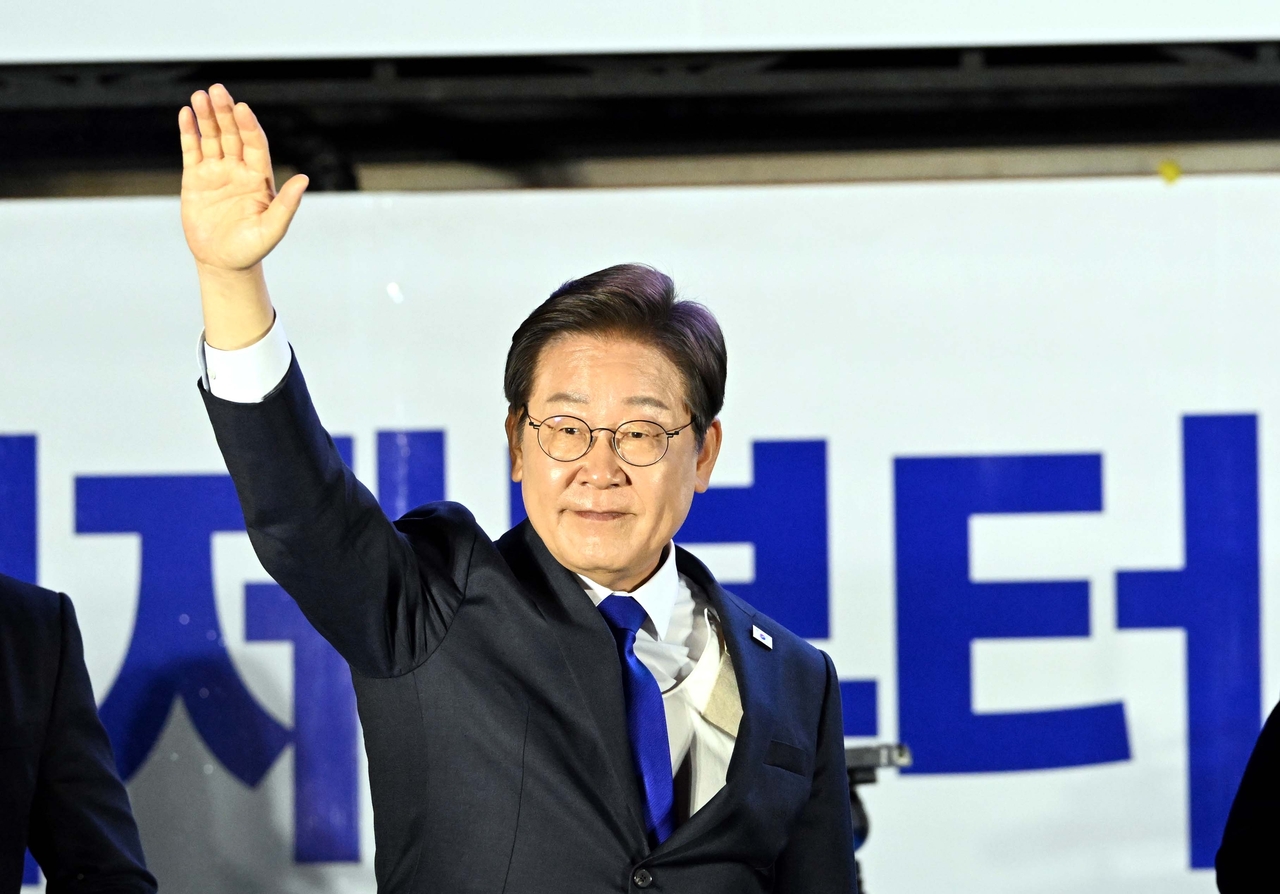
Lee Jae-myung's presidential victory on Wednesday did not defy any expectations, even those of many conservatives.
People Power Party rival Kim Moon-soo never once had a lead over Lee, even in the rosiest projections and polls.
The following is a breakdown of the factors that contributed to Lee's win.
Yoon Suk Yeol
The number one factor that contributed to Lee's victory is no doubt former President Yoon Suk Yeol, and his attempt to impose an abrupt martial law on Dec. 3, 2024.
Yoon's martial law debacle got him impeached, which ultimately led to the election.
Had it not been for Yoon, Lee most likely would have had to stand several criminal trials as scheduled.
Polls have consistently found that the majority of South Koreans disapprove of Yoon's martial law attempt and back his impeachment.
Naturally, ending Yoon's "insurrection" was Lee's campaign theme. Lee characterized his People Power Party rival Kim Moon-soo, who was Yoon's labor minister, as an "insurrection sympathizer."
Solid grip on party
Since his defeat to Yoon in 2022, Lee has been tightening his grip on the Democratic Party.
During the 2024 general election, many figures less closely aligned with Lee were sidelined during the nomination process.
Only those who "passed the loyalty test" for Lee were nominated by the party leadership, as one Democratic Party lawmaker recounted.
His hold on the Democratic Party was on vivid display at the party convention last year when lawmakers running to be on the leadership campaigned on how close they are to Lee.
Head start
Unlike the Democratic Party, which had been rallying behind Lee for the past three years, the People Power Party, having just lost Yoon as the party's president, scrambled to come up with a candidate.
The rift among People Power Party factions deepened over the primary for presidential nomination, with prominent conservatives like Hong Joon-pyo publicly breaking away from the party.
The transition to a presidential campaign was smooth for the Democratic Party, on the other hand, which had been operating under Lee's leadership.
When Kim won the People Power Party's prolonged primary, Lee had already been campaigning around the country for two weeks.
As the 2025 race was a by-election, Kim had only three weeks since being nominated to pull together a campaign and hit the road.
Three-way race
Conservative and centrist voters had a third-party alternative to Kim, the New Reform Party's Lee Jun-seok, who previously served as the People Power Party's chair.
The former People Power Party chair founded the new third party ahead of the general election last year, after his humiliating eviction as the main conservative party's chair over an alleged sexual bribery scandal.
The third-party conservative runner dropping out of the race to endorse Kim had been closely watched as a possible factor that could threaten the Democratic Party candidate's lead in the run-up to the election.
The final tally suggests conservatives might have stood a better chance, theoretically speaking.
The People Power Party's Kim and the New Reform Party's Lee had won 41.1 percent and 8.34 percent, respectively.
Combined, the votes earned by the two candidates surpass the Democratic Party candidate's 49.4 percent.
arin@heraldcorp.com