Proposal seeks to divide policy planning, budgeting to enhance parliamentary oversight
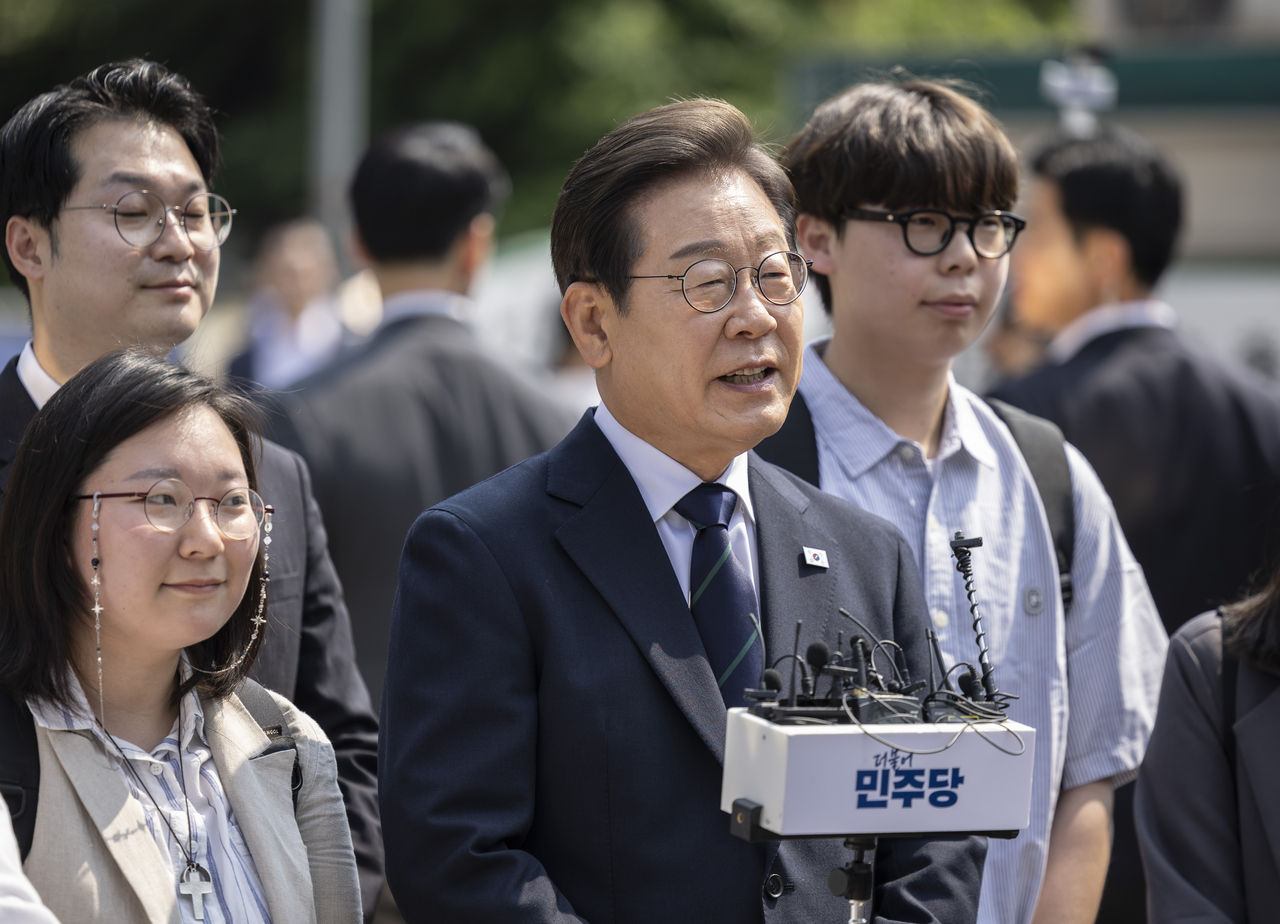
Presidential front-runner Rep. Lee Jae-myung of the Democratic Party of Korea has proposed a large-scale restructuring of the Ministry of Economy and Finance, advocating for the separation of the ministry's budget authority from its policy planning function in a bid to decentralize power and strengthen legislative oversight.
Speaking during a live YouTube broadcast on Wednesday, Lee argued that “splitting the Finance Ministry’s budget functions is necessary to break its monopoly over financial policy and budget formulation.”
He also highlighted the muddled situations in oversight, including that, “domestic financial policies are managed by the Financial Services Commission, while overseas policies are handled by the ministry.”
The Ministry of Economy and Finance is one of the country’s most powerful agencies, with its minister serving as deputy prime minister. It manages the government’s fiscal affairs, including budgeting, taxation and financial policy, and plays a central role in drafting and reviewing the national budget and shaping overall economic direction.
Lee’s proposal aligns with a broader party platform aimed at improving government efficiency. It envisions a comprehensive restructuring in which the Finance Ministry would focus solely on economic policy and planning, while budgetary oversight would be reinforced through enhanced parliamentary involvement.
The presidential hopeful has long championed this stance, criticizing the ministry’s “monarch-like” control over state finances — a refrain he has repeated since his previous presidential campaign.
The Democratic Party is reportedly reviewing options to divide the Finance Ministry into two entities, resembling the structure in place before 2008. Under the proposed plan, the Planning and Budget Office would be moved under either the Prime Minister’s Office or the President’s Office, while the remaining ministry would retain fiscal management duties.
Historically, Korea’s budget and fiscal planning functions have undergone several structural changes. They were originally housed in separate agencies following the establishment of the Korea Institute of Economic Planning in 1961. The functions were unified under President Kim Young-sam (1993–1998), split again under Presidents Kim Dae-jung and Roh Moo-hyun, and then reintegrated during President Lee Myung-bak’s administration in 2008 — where they remain combined to this day.
Momentum for change has been growing since early April, with key legislative proposals highlighting bipartisan frustration over what many view as excessive concentration of authority within the Finance Ministry.
Democratic lawmakers Rep. Huh Seong-moo and Rep. Oh Ki-hyeon recently introduced legislation aimed at dividing the ministry, echoing wider concern over its dominance in budget allocation and policy control.
The ministry has frequently clashed with progressive administrations, resisting policies such as COVID-19 relief payouts and asserting control over fiscal decisions. In 2020, then-Finance Minister Hong Nam-ki publicly opposed universal relief grants, prompting Prime Minister Chung Sye-kyun to question whether “this is the Finance Ministry’s country.”
Lee, who was Gyeonggi Province governor at the time, also criticized the ministry: “This country does not belong to the Finance Ministry. It belongs to the people.”
In a recent report on Korea's 2025 fiscal plan, the National Assembly Budget Office highlighted persistent limitations in the current budget allocation system. It called for reforms to strengthen legislative oversight and improve fiscal transparency.
While the government has implemented a top-down “total expenditure allocation system” — setting overall spending limits before allocating funds by sector and project — the Finance Ministry continues to review detailed budget requests from individual departments, which limits those agencies’ financial autonomy.
The report also noted that the ministry does not report departmental expenditure limits to the National Assembly’s Special Committee on Budget and Accounts, thereby constraining lawmakers’ ability to oversee the total fiscal framework.
hnpark@heraldcorp.com











