SK On said Tuesday that its major advances in solid-state battery technology have recently earned recognition from leading international academic journals.
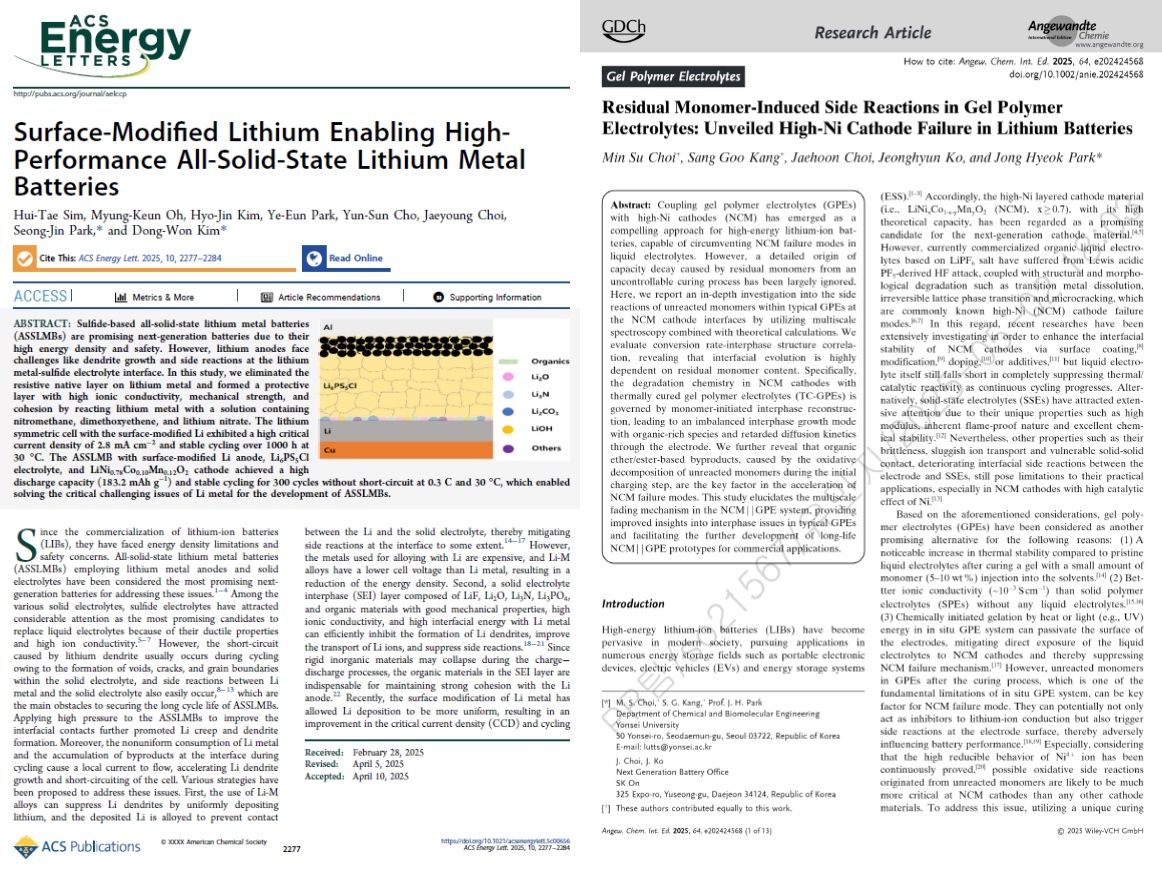
In partnership with a research team at Hanyang University led by professor Kim Dong-won of the Electrochemical Materials Laboratory, SK On developed a method to extend the lifespan of sulfide-based all-solid-state lithium metal batteries.
The study, published in ACS Energy Letters, a top journal in energy and electrochemical science, introduces a new method for forming a protective layer on lithium metal anodes using a specialized solution. This layer, composed of lithium nitride and lithium oxide, enhances interfacial stability and battery durability, enabling over 300 charge-discharge cycles at room temperature — tripling the lifespan of existing technologies.
In a separate study with Yonsei University chemical engineering professor Park Jong-hyeok’s team, SK On investigated how thermal curing time affects the performance of gel polymer electrolytes (GPEs). Published in top-ranked Angewandte Chemie, a chemistry journal, the research found that longer curing times significantly reduce capacity loss. Batteries cured for 60 minutes saw a 9.1 percent capacity drop, while those cured for only 20 minutes experienced a 34 percent decrease.
In addition, density functional theory calculations further revealed that inadequate curing leads to the decomposition of protective cathode layers, shortening battery life.
“These achievements are the result of SK On’s continued R&D efforts and technological prowess, enabled through collaboration with academia,” said Park Ki-soo, head of R&D at SK On. “They will serve as a key foundation for overcoming the technological challenges of solid-state batteries.”
SK On is currently developing both polymer-oxide and sulfide-based solid-state batteries, with commercialization planned for 2028 and 2030, respectively.
hyelimchung@heraldcorp.com