Will acting President Han Duck-soo appoint justice nominee Ma Eun-hyuk?
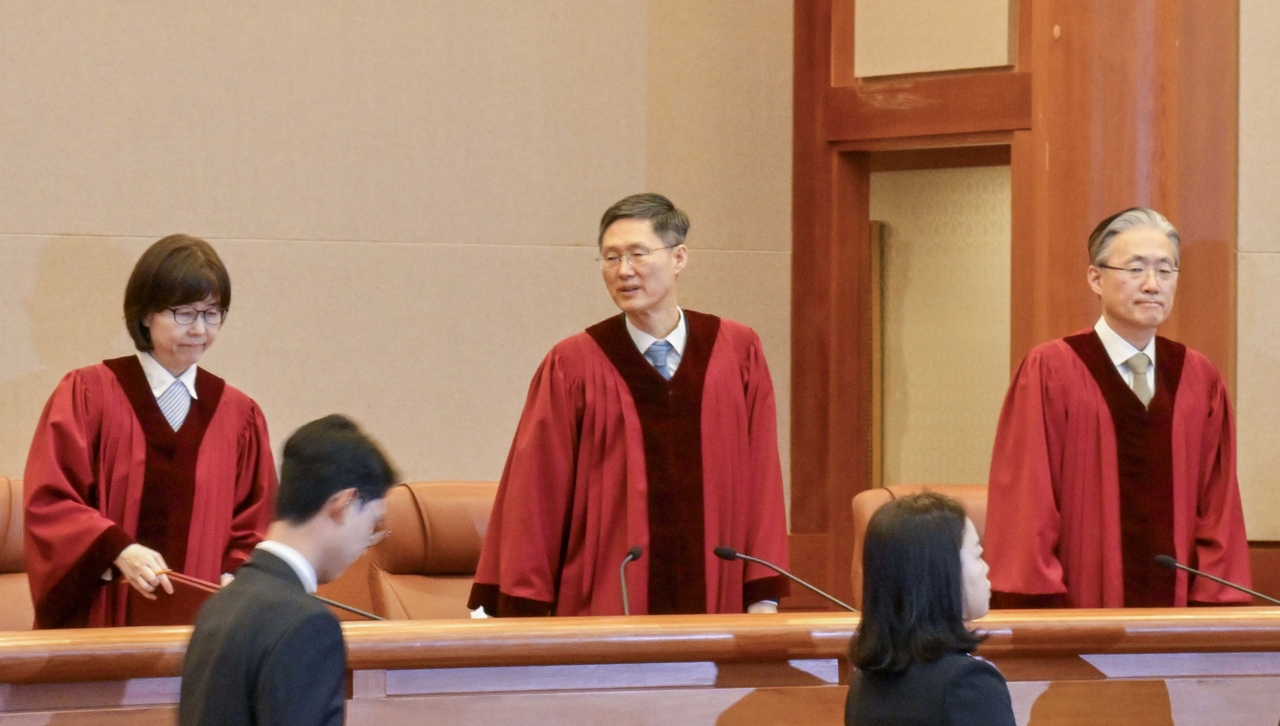
With the terms of two of the current eight justices at South Korea’s Constitutional Court set to expire April 18, concerns are growing over the court’s ability to function effectively, as only six out of the total nine positions on the bench will be filled.
According to legal experts, acting Chief Justice Moon Hyung-bae and Justice Lee Mi-son will conclude their six-year terms next week. Both were appointed by former President Moon Jae-in under the presidential quota in which the president chooses three of the court’s nine justices. The remaining six are chosen three by the National Assembly and three by the Supreme Court.
Theoretically, the court can still deliberate on cases and deliver rulings with just six justices, as in October last year, when the court temporarily suspended a provision of the Constitutional Court Act that requires at least seven justices to be present for deliberations to proceed.
That suspension occurred after a unanimous decision by the court to grant an injunction request filed by Korea Communications Commission Chair Lee Jin-sook. Lee had challenged Article 23, Paragraph 1 of the Constitutional Court Act, which mandates a minimum of seven justices for a case to be heard. Lee's impeachment was dismissed in a 4-4 decision on Jan. 23.
However, legal observers are skeptical about the court’s ability to issue meaningful rulings with just six members. From October to December last year, the court was unable to deliver a single ruling until Justices Chung Kye-sun and Cho Han-chang were appointed by then-acting President Choi Sang-mok on Jan. 1.
Attention now turns to whether current acting President Han Duck-soo will proceed with the appointment of Ma Eun-hyuk, the remaining nominee to fill the bench. Ma’s confirmation was initially blocked by Han's argument that it lacked bipartisan agreement in the National Assembly. After Han was voted impeached by the Assembly, then acting President Choi Sang-mok cited the same reason for not appointing the justice.
However, the Constitutional Court ruled unanimously on March 4 that Choi had a constitutional duty to appoint Ma.
Since then, the Constitutional Court also issued a divided ruling in which the majority voted to dismiss the motion to impeach Han. He was reinstated as prime minister and acting president on March 24.
The Constitutional Court has not yet commented on the successors to Justices Moon and Lee, whose replacements require direct presidential appointment, raising the question of whether acting President Han must now make these appointments.
If Han postpones the appointments until after a new president is elected, the earliest the Constitutional Court's bench would be filled with all nine justices would likely be around July. This timeline assumes the new president will appoint Ma, who has already been nominated by the Assembly, along with two additional nominees of the new president's choice. The confirmation and appointment process typically takes about a month.
Meanwhile, several high-profile cases are pending at the court, including those related to the Severe Disaster Punishment Act and same-sex marriage, as well as a number of jurisdictional disputes, and the impeachment trials of suspended Korean National Police Agency chief Cho Ji-ho and prosecutor Son Joon-seong, which haven't even started the deliberations yet.
ddd@heraldcorp.com