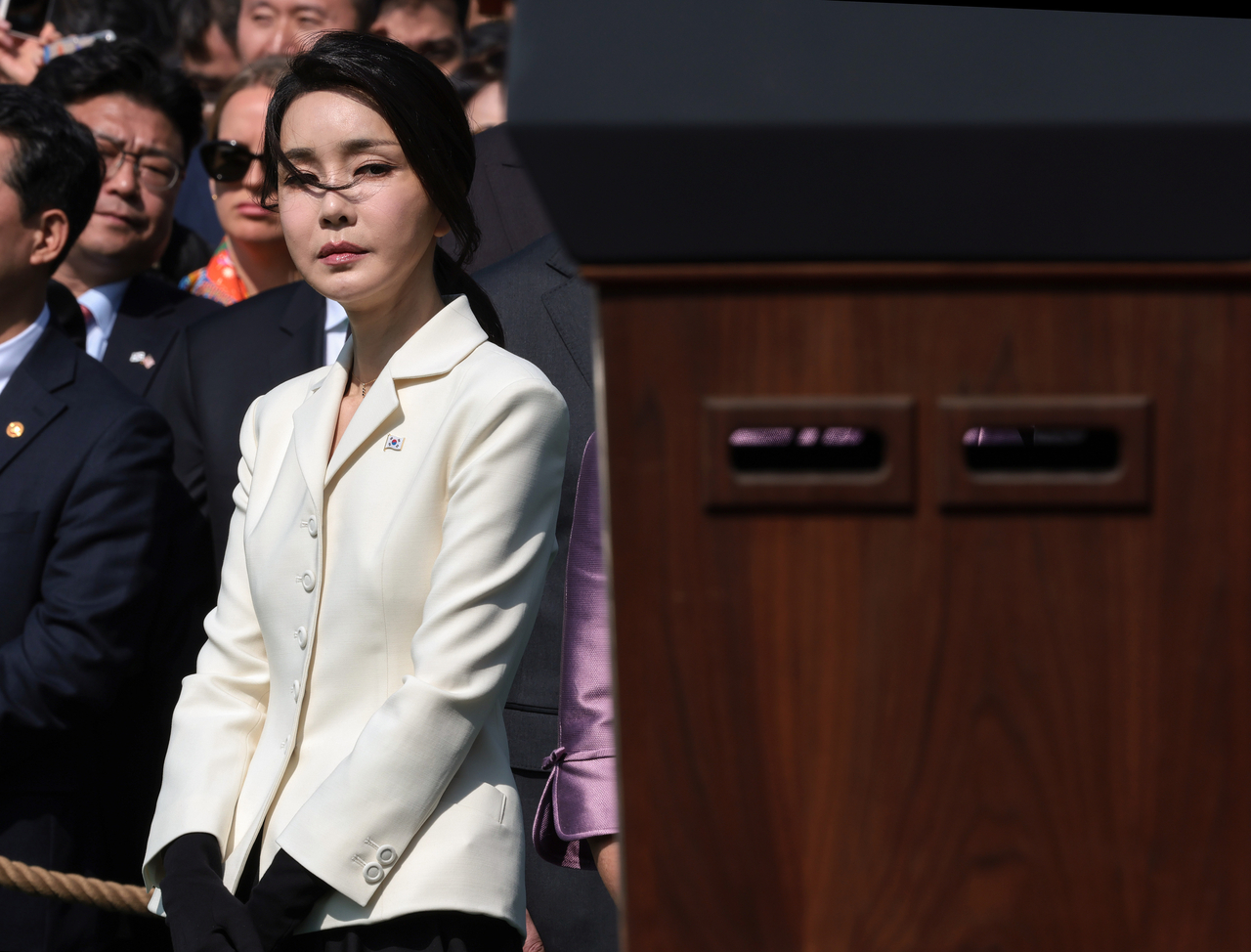
After the Constitutional Court upheld the impeachment of South Korean President Yoon Suk Yeol on Friday, attention turns to potential criminal proceedings against not just Yoon but also his wife.
The now former first lady Kim Keon Hee has faced a numerous allegations in connection with a slew of scandals, including the Deutsch Motors stock manipulation case and her acceptance of a luxury gift from a pastor.
Though opposition lawmakers have made multiple attempts to mandate a special probe into Kim’s allegations in the past, they were all vetoed either by Yoon himself, or by acting Presidents Han Duck-soo and Choi Sang-mok.
However, on March 20, the opposition-led National Assembly passed a bill mandating a permanent special counsel to probe into allegations surrounding the now ex-first lady, which — unlike a regular special counsel probe — cannot be vetoed by the president under South Korean law.
With Yoon now removed from power and the presidency left vacant, it raises the question: what’s going to happen to his wife?
Even after Yoon’s removal, some believe it is still technically possible for acting President Han Duck-soo to delay an investigation into Kim. This is because even if the president or the acting president cannot veto a permanent special probe counsel by law, they may still attempt to delay the appointment of the counsel itself.
For example, a permanent special counsel probe to investigate insurrection charges against Yoon, was passed by the National Assembly on Dec. 10. However, this probe has indefinitely been put on hold for four months, as both Prime Minister Han Duck-soo and Finance Minister Choi Sang-mok — who have both held the position of acting president — have delayed appointing the special counsel.
“Indefinite delays could still be seen in conducting criminal investigations into (Kim’s) allegations as the ruling party may try to protect Yoon’s legacy, especially if the People Power Party hopes to avoid more political division within the party and to manage damage control heading into the next upcoming elections,” Lee Jun-han, political science professor at Incheon National University, told The Korea Herald. “Even if the president is out of the picture, the political system still bends toward executive power when it comes to special counsel probes.”
A strict deadline is also not set by law, specifying when the president or the acting president must appoint the special counsel after a bill has been passed.
“Korea’s special counsel law has a gray zone and it’s currently evident in the case with (the Kim Keon Hee) special counsel probe bill,” Lee continued. “Special counsel bills do not have a formal expiration date and could be brought up by the next administration. However, that also holds risks, as the special counsel bill may be politically irrelevant then as public interest in the issue fades.”
Once Han appoints the special counsel
If Han appoints the special counsel, investigations can begin immediately, including summoning relevant witnesses, gathering evidence and potentially indicting individuals.
Once appointed, the special counsel also operates independently of the Ministry of Justice and the presidential office, meaning they can pursue charges with relevant warrants.
Whether Han will cooperate remains unclear, however, political commentator Park Sang-byung told The Korea Herald that he believes it is “close to unlikely” that he will do so, at least not anytime soon.
“Han has already faced the risk of impeachment for his alleged role in Yoon's martial law plan as well as his refusal to back special counsel bills targeting Yoon and Kim. Based on this, some could say Han could work to appoint the special counsel to avoid further criticism, accusing him of obstruction and choosing to protect Yoon,” said Park.
“However, with the utmost focus of the current administration being placed on maintaining stable diplomatic ties with the newly established Trump administration, it seems unlikely that Han will appoint a special counsel anytime soon.”
According to Park, Han might view investigating Kim Keon Hee “as a measure that could escalate political tensions further."
Since his reinstatement on March 24 — Han has called for “national unity” that helps to advance Korea further.
lee.jungjoo@heraldcorp.com