Legal final touches, tight security prepared as Korea awaits historic, potentially divisive moment
A day before the Constitutional Court delivers its historic ruling on whether it will uphold suspended President Yoon Suk Yeol’s impeachment, South Korea braces for an intense and unprecedented moment in its modern political history. Final preparations are underway at the highest levels of government, law enforcement and society as a whole ahead of what is expected to be an emotionally charged and deeply divided day.
On Thursday, the Constitutional Court entered the final stage of its preparations. According to legal sources, the eight justices convened both in the morning and afternoon on Wednesday to deliberate on the wording and delivery process of the decision. The justices are said to have reached a general consensus on the ruling —whether to uphold, vote down or dismiss the National Assembly’s impeachment motion — before its announcement Tuesday that the ruling will be held on Friday, and are now working on refining the legal rationale and final text of the decision.
Justice Jeong Hyeong-sik, who is serving as the presiding judge on the case, is expected to deliver the court’s majority opinion. Should Jeong be in the minority, another justice from the majority will take over as author of the decision. In the event of any dissenting, separate or concurring minority opinions, any justice with such an opinion is also expected to draft it, based on the preliminary majority opinion, to be recorded also in the final ruling.
The court’s main task is to determine whether any of the five impeachment charges Yoon faces — ranging from the alleged illegal declaration of martial law to ordering martial law troops and police to blockade and storm the National Assembly as well as arrest a list of political leaders and dissidents — constitute “grave violations” of the Constitution or law, thus justifying the president’s removal. At least six of the eight justices must vote in favor of impeachment for it to be upheld. If the motion is voted down or dismissed entirely, Yoon will immediately resume his official duties.
Heightened security for judges, public facilities
The court has been taking unprecedented security precautions. Initially, it had decided to prohibit all media coverage of the justices’ arrival at the court on ruling day. However, following internal deliberations and media pressure, the court has allowed limited press access — only journalists with credentials within designated areas will be permitted to film or report on the justices’ entrance.
Security around the court building has also been significantly tightened, with access restricted to essential personnel. Curtains have been drawn in all the windows of the main building housing the justices’ chambers, and all external movement is being closely monitored. Police officers and court staff have been stationed at all entrances to verify the identity of everyone entering.
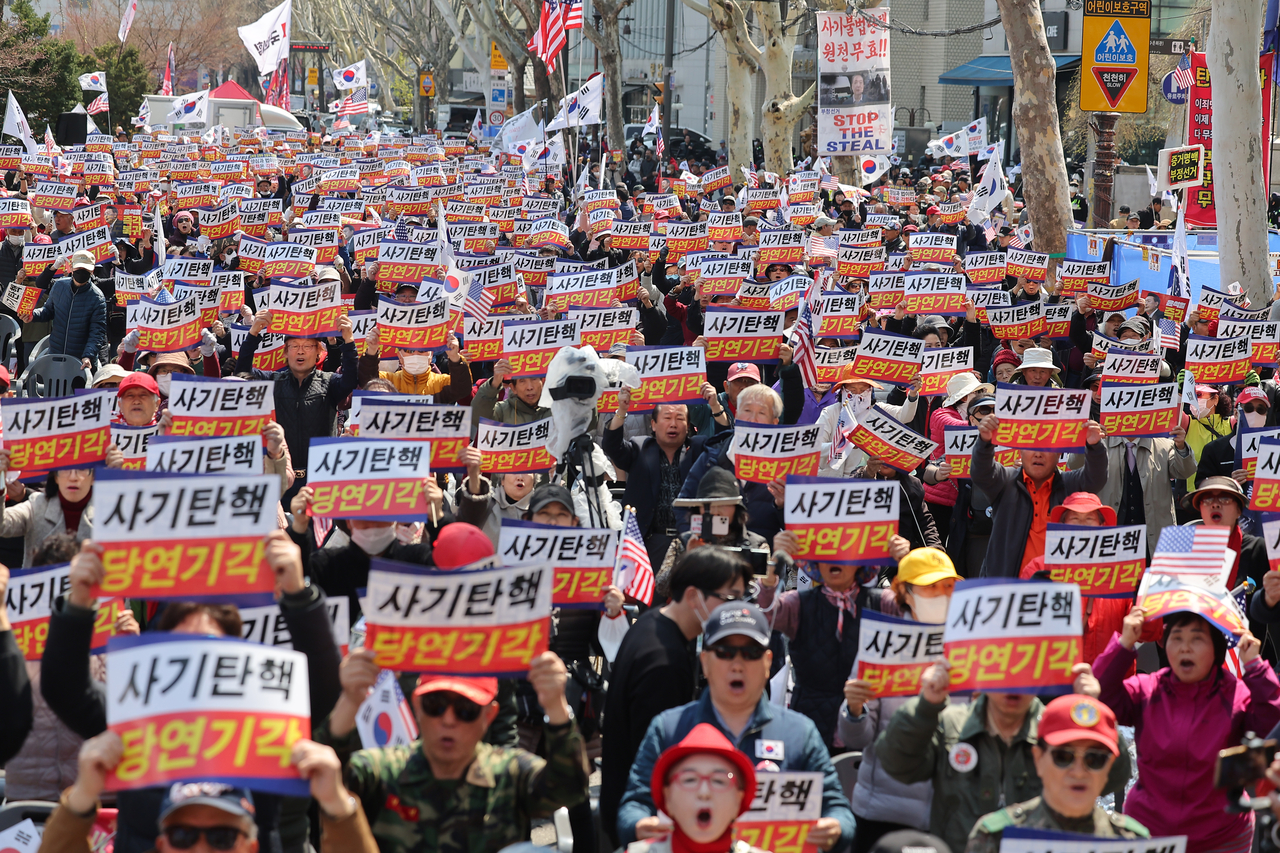
The enhanced security measures reflect growing concern over the possibility of unrest. The court’s decision to limit access came after violent protests that erupted earlier this year at another court following the issuance of an arrest warrant for Yoon. With pro- and anti-impeachment rallies planned near the Constitutional Court and in Gwanghwamun on Friday, authorities estimate that more than 100,000 people may take to the streets.
In response, police have increased personal security for the justices and boosted intelligence-gathering operations to prevent any potential threats against court officials or facilities.
To ensure safety, the National Police Agency issued a Level 2 emergency response alert for the Seoul area on Thursday morning, authorizing the deployment of up to 50 percent of the police force. On Friday, the day of the ruling, the alert level will be elevated to the highest level — a Level 1 emergency — mandating full deployment of all available police officers nationwide.
More than 210 mobile police units comprising approximately 14,000 officers, along with special operations units and negotiators, will be dispatched across Seoul. Areas receiving concentrated deployments include the Constitutional Court, presidential office in Yongsan, presidential residence in Hannam-dong, the National Assembly, government complexes and major foreign embassies.
Tactical units will also be on standby to respond to potential drone attacks or terrorist threats, reflecting heightened sensitivity to potential disruptions on a day of national importance.
Some schools advised to watch ruling
Adding to the controversy, nine provincial education offices — including Gwangju, Ulsan and Incheon — issued advisories to schools, allowing students to watch the televised impeachment ruling as part of civic education. The move, however, has sparked some debate over the issue of political neutrality in the classroom.
The guidelines encouraged teachers to use the ruling as a real-time teaching opportunity to educate students on constitutional processes and democratic principles. Education offices advised schools to decide autonomously whether to stream the proceedings but emphasized that any political bias should be avoided.
The Seoul Metropolitan Office of Education, however, argued the approach was inconsistent and potentially divisive. “Some schools are facing security concerns, while others are being encouraged to view the ruling live. That’s a contradiction,” said Jung Keun-sik, the superintendent of the education office. The city’s education office declined to issue similar guidance.
A total of 16 schools in Seoul, including the 11 schools located near the Constitutional Court, have decided to close for the ruling. Banks and offices near Gwanghwamun also declared closures while some companies advised employees to work from home.
Meanwhile, public interest in witnessing the historic ruling firsthand has surged to unprecedented levels.
As of Thursday morning, more than 90,000 citizens had applied online for one of only 20 public seats at the Constitutional Court — a staggering 4,500-to-1 competition ratio, far surpassing previous presidential impeachment cases.
During the 2017 impeachment of then President Park Geun-hye, the court saw 796 applicants per available seat. During the 2004 ruling on then President Roh Moo-hyun, the figure was a modest 20-to-1.
jychoi@heraldcorp.com