South Korean firms with businesses in Canada and Mexico are bracing for US President Donald Trump's plan to impose tariffs on goods from the two neighboring countries starting this week, industry observers noted Tuesday.
On Monday, Trump said his administration will start imposing 25 percent tariffs on Canadian and Mexican goods starting Tuesday, as he pointed out there is no room for the two countries to delay the planned duties.
South Korea's bilateral trade with Canada and Mexico was tallied at $14.62 billion and $19.8 billion, respectively, in 2023, according to data from Seoul's foreign ministry.
According to local corporate data firm Korea CXO Institute, 25 South Korean conglomerates had operated a combined 201 subsidiaries in the two countries as of the end of 2024.
Of them, 110 subsidiaries are located in Canada and 91 in Mexico, with Samsung Group leading with 50 entities in Canada and 18 in Mexico. Hyundai Motor Group operates 16 and 12 subsidiaries in Mexico and Canada, respectively.
Among the two countries, Mexico, in particular, has served as an ideal export hub for targeting the North American market due to its low labor costs and the benefits of a US-Mexico-Canada free trade agreement, called the US-Mexico-Canada Agreement, or USMCA.
In 2023, South Korea ranked 11th in foreign direct investments made in Mexico.
Samsung Electronics Co. operates a home appliance factory in Queretaro and a TV factory in Tijuana. LG Electronics Inc. runs production facilities in Reynosa, Monterrey and Ramos Arizpe.
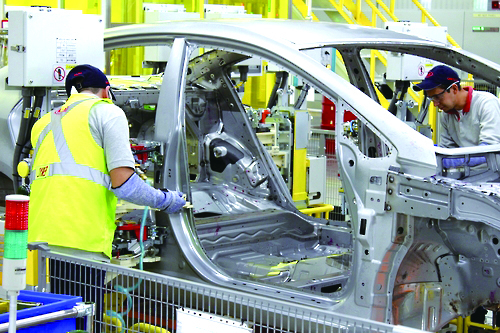
In the automotive industry, Kia Corp. operates a production plant in Mexico, producing 250,000 vehicles annually in Monterrey. Of these, approximately 150,000 units are exported to the United States.
Auto parts makers Hyundai Mobis Co. and Hyundai Transys Inc. also operate manufacturing plants in Mexico.
The Korea CXO Institute expected Korean companies that produce vehicles, car batteries and home appliances in the two countries could lose their price competitiveness in the US market when the higher tariffs are adopted.
"It will not be easy for the companies to move their plants to the US in a short period of time to avoid higher tariffs. They need to increase production in their US plants or diversify markets," an official at the Korea CXO Institute said.
Also worsening the situation is Trump's intention to impose separate sectoral tariffs on automobiles and semiconductors starting in April, which would further burden Samsung Electronics and Hyundai Motor Group with duties in their US businesses.
An official at Kia's Mexican unit told Yonhap News Agency the company "plans to respond by aligning with the policies of both the US and Mexican governments to minimize risks."
In his recent visit to Washington, Seoul's Industry Minister Ahn Duk-geun asked the US government to exclude South Korea from its new tariff plans while discussing expanding bilateral cooperation in various fields.
Ahn made the request as he met with US Secretary of Commerce Howard Lutnick, US Trade Representative Jamieson Greer, US Secretary of Interior and National Energy Dominance Council Chairman Doug Burgum and other officials in Washington last week.
Seoul is said to have underscored its position to the US that it aims to secure tariff exemptions first and foremost, and that if it is unable to do so, it hopes to at least ensure that South Korea is not put at a disadvantage compared with other countries. (Yonhap)










