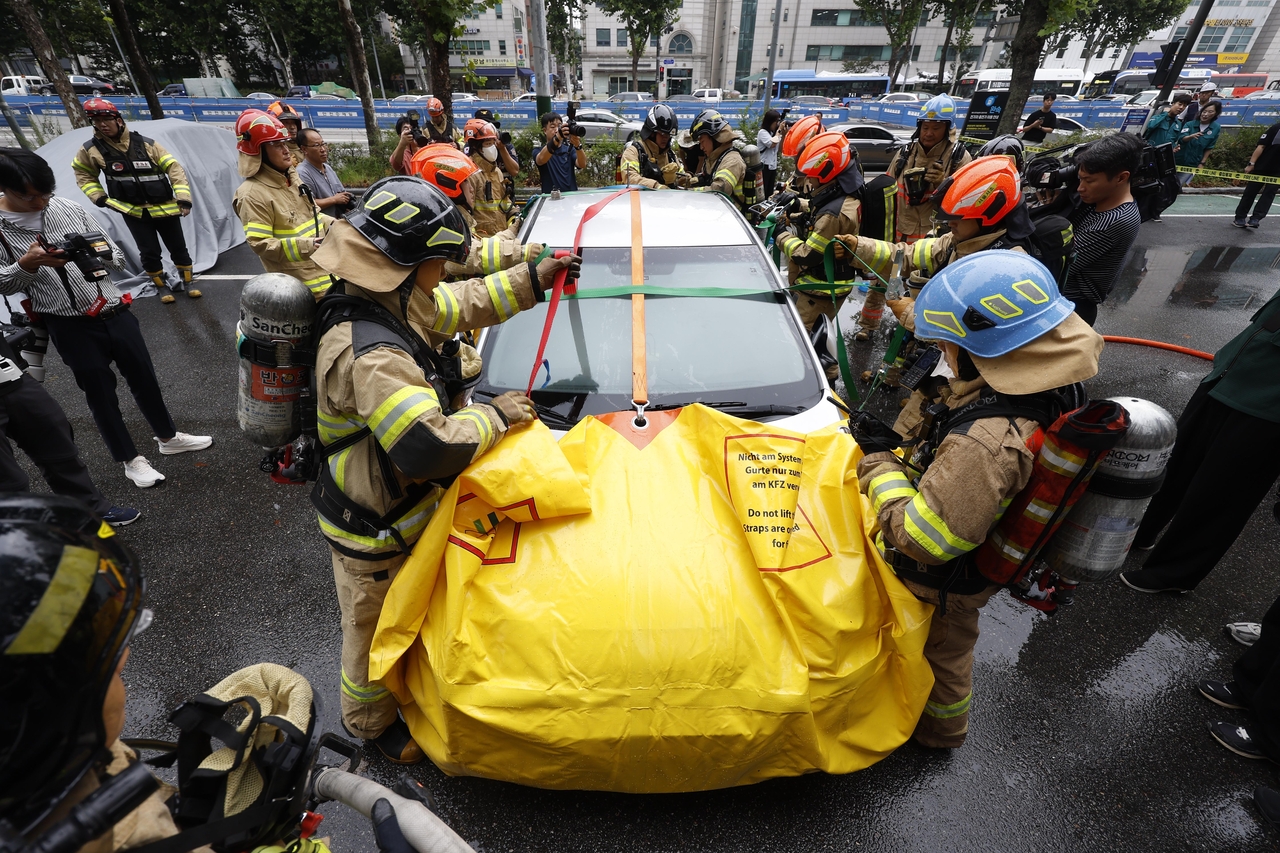
Fire agency to work with Hyundai Motor to develop uncrewed firefighting vehicle
Wet-pipe sprinkler systems and analog smoke detectors will be required in underground parking lots to counter fires potentially starting from EVs, according to the National Fire Agency, Thursday.
This decision comes six months after a Mercedes-Benz EV caught fire in an underground parking lot in Incheon, damaging 140 vehicles.
The fire sparked debate about fires starting from EVs or their batteries being potentially more intense and spreading faster than other car fires, and prompted the government to form a task force led by the National Fire Agency to come up with preventative measures.
All underground parking lots except those considered "small," will now be required to be equipped with rapid fire extinguishing and alarm systems that are more effective in countering rapidly spreading EV fires, namely wet pipe sprinkler systems and analog smoke detectors.
Wet-pipe sprinkler systems have pipes filled with water, ready to discharge when the sprinkler head is triggered by heat. As EV fires involving lithium-ion batteries can burn at extremely high temperatures, such sprinkler systems can help to cool the area surrounding the fire and prevent the fire from spreading.
Since analog smoke detectors can sense smoke particles in the air and provide early warnings, they give occupants more time to evacuate and allow fire response systems to activate before it is too late.
However, for small parking lots -- those with approximately eight or fewer spaces -- the National Fire Agency stated that such spaces will be allowed to install preaction sprinkler systems as well as standalone fire alarms as an exception.
The fire agency will also allow properties that are prone to pipes freezing over winter -- such as those above ground, halfway above ground or with open structures -- to install preaction sprinkler systems, filled with air instead of water. Water would then be supplied only if a fire occurs.
It added that it will also conduct unannounced inspections regularly to ensure that such fire protection systems function properly.
To prevent fires from spreading due to combustibles in ceilings of underground parking lots, fire suppression pipelines will be insulated with flame-resistant materials, while the fire resistance capabilities of the underground parking lot ceilings, walls and columns will be reinforced to prevent fires from spreading faster.
As firefighters and firefighting vehicles often face difficulties when entering underground parking lots when a fire breaks out inside, the fire agency added that it is working with Hyundai Motor Co. to develop an uncrewed firefighting vehicle to help extinguish underground fires.
The National Fire Agency will also pursue six research and development projects worth 24.8 billion won ($17.2 million) to respond specifically to EV fires while also investing 31.3 billion won in developing sensors and robots that support firefighters in extinguishing fires and conducting search and rescue missions.
According to the fire agency, the number of EV fires has increased in recent years, from seven in 2019 to 73 in 2024, along with EVs' growing popularity. Property damage caused by EV fires was valued at 9.4 billion won over the six-year period.
lee.jungjoo@heraldcorp.com