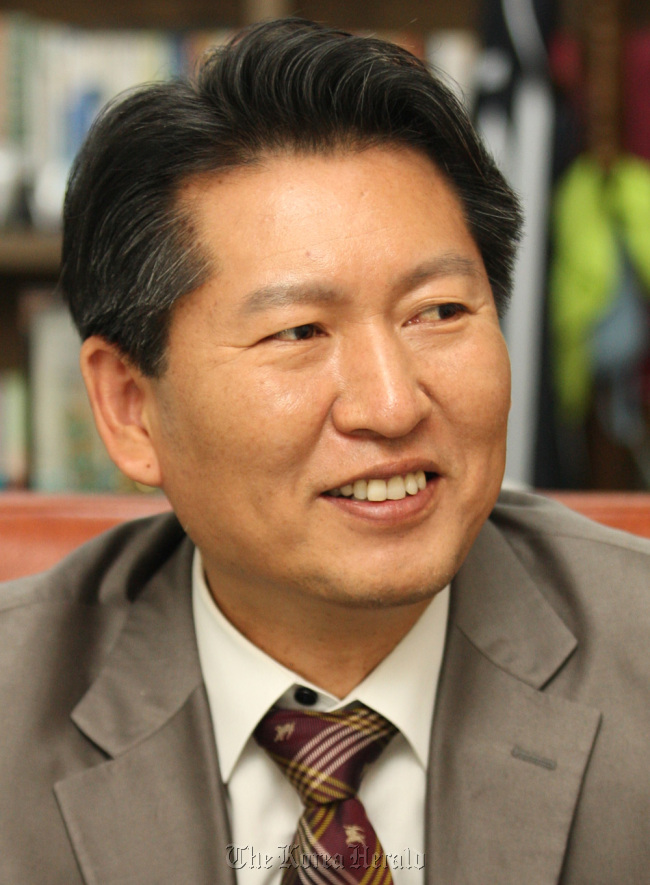
Jung Cheong-rae
The Korea-U.S. Free Trade Agreement, especially its Investor-State Dispute Settlement clause, needs urgent revision as it could strike a critical blow against Korea, said Rep. Jung Cheong-rae of the main opposition Democratic United Party.
“Under the ISDS system, the decision of the International Centre for the Settlement of Investment Disputes may take precedence over that of the Constitutional Court,” said the second-term representative.
The ISDS is intended to offer impartial reparative measures to investors but also risks infringing the judicial sovereignty of the defendant state, according to ISDS dissenters.
He stressed that he is not suggesting revising or annulling the entire trade pact, but fixing the so-called “poisonous” ISDS clause.
“We do not deny the binding force of the KORUS FTA but insist that these specific clauses should be scrapped.”
Rep. Jung was among a few members of the National Assembly foreign affairs committee who brought up the issue during its audit of the administrative branches in October.
“Lawmakers are usually preoccupied with more pressing issues, especially ahead of the upcoming presidential election. Though it is no longer a priority concern to the public, the Korea-U.S. FTA is nevertheless a critical factor in terms of national interest,” said the second-term representative.
Jung drew a line between his party and other far-left groups, such as the minority Unified Progressive Party, which claimed that the very existence of the trade pact threatened the rights and interests of local industries.
The DUP’s presidential candidate Rep. Moon Jae-in, too, earlier pledged to maintain the FTA as it has already been ratified as a valid inter-state agreement.
While the ISDS clause remained at the center of dispute, Jung held the president responsible for dodging his promises and neglecting the renegotiations.
“President Lee Myung-bak promised last year to seek the ISDS revision, on condition that the parliament ratifies the FTA,” he said.
“The president’s term clearly connoted his consent to abolish the corresponding clause, as that was the one and foremost prerequisite put up by the opposition.”
Lee should be seen as having betrayed his own words, should he speak otherwise on the issue now that the FTA has taken effect, the lawmaker added.
Jung also expressed his regrets over the complacency within the left-wing camp.
“Even DUP lawmakers will not take the issue seriously until the actual damage hits them in the face,” he said.
“As responsible members of the legislative, however, we have to foresee the potential dangers and take preventive measures.”
Another pressing reason to resume the ISDS debate is Lone Star Funds’ initiation of the ISDS process, setting a precedent based on the Korea-U.S. FTA, according to Jung.
The U.S.-based firm filed for the legal steps back in May and is now subject to the settlement process, as its six-month cooling-off period ended this week.
“Once the Lone Star case reignites, it shall then be too late and the financial damages may also be irrevocable,” he said.
The lawmaker admitted that investors’ interests should be protected by all possible means, but only within the framework of the Constitution.
“The Republic of Korea is a sovereign state and none of its international pacts or affiliated clauses should stand above the Constitution,” he said.
By the same logic, some U.S. legislators issued a joint statement earlier this year to demand the abolishment of the ISDS clause, he added.
“There is, of course, only a slight chance that a Korean firm may rely on the given process and win the case in a U.S. court,” Chung said.
“The U.S. congress members were nevertheless concerned about this possibility and made the claim for the sake of their country.”
The DUP member thus accused the ruling conservative Saenuri Party of placing politics above national interest.
“Parties should be able to speak in one voice when it comes to protecting the country’s judicial sovereignty and the people’s rights,” he said.
koreaherald@heraldcorp.com











