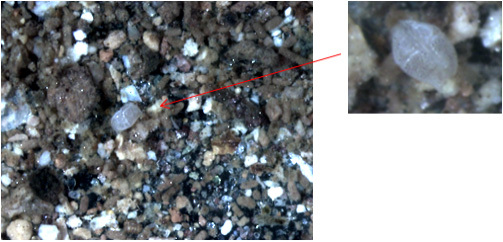
Frambocythere replicta, a new species of ostracod discovered in a pond inside Uljin Cave, North Gyeongsang Province. (The National Institute of Biological Resources)
A species of ostracods believed to have been extinct for over 40 million years has been found living in a pond inside a cave in Korea.
According to the state-run National Institute of Biological Resources on Tuesday, the tiny seed shrimp found in Uljin Cave belong to a genus called Frambocythere, whose existence on earth was evidenced only by fossil records, mostly from Europe, dating back as far as 135 million years.
They were thought to have gone extinct about 40 million years ago as no fossil after that point has been found.
The NIBR researchers assume that the ostracods may have moved east from their original home in the western end of the Eurasia continent to avoid extinction.
“A change in habitat from surface water to ground water may also have helped them to survive all those years,” they said in a press release.
The discovery is to be published in the Journal of Micropalaeontology.
Some 65,000 species of ostracoda have been identified, of them 13,000 still extant.
About 1 millimeter in size, the body of an ostracod is encased by two shells that resemble those of a clam.
koreaherald@heraldcorp.com











