President’s move comes as political parties churn out ‘populist’ pledges ahead of elections
President Lee Myung-bak on Monday put the brakes on what critics call a “populist move” to enact a special law on compensating customers of 18 suspended savings banks for their lost deposits.
His move comes as the ruling and opposition parties alike have churned out policy plans such as a hefty pay increase for military draftees, which critics argue are designed only to court voters ahead of the April 11 general elections.
“I instruct you to review whether the legislation runs afoul of the Constitution in any way and what side-effects could be brought about should it be implemented,” Lee was quoted by his spokesperson as saying during a meeting of his senior secretaries.
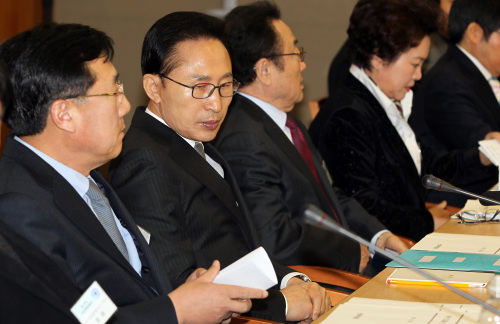
Political observers said that Lee could exercise his presidential right to veto the legislation. A constitutional provision stipulates that the president can request that the National Assembly reconsider a proposed law if he or she is opposed to it.
(Yonhap News)
Cheong Wa Dae did not rule out the possibility of his exercising the right.
“There are yet many parliamentary procedures left (before the legislation is finalized). Let’s wait and see how things will turn out,” Lee’s spokesperson Park Jeong-ha told The Korea Herald.
Last Thursday, the National Assembly’s National Policy Committee passed the special compensation bill, drawing sharp criticism from those arguing that the legislation would wrongly signal that the state would step in to save victims of the failed secondary banks.
On Wednesday, the Assembly’s Legislation and Judiciary Committee will review the legitimacy of the bill before it is sent to the plenary session for a final floor vote on Thursday.
Under the bill, a state depositor protection fund to compensate customers and subordinated bond investors of the local 18 savings ― suspended since September 2008 ― for part of the losses exceeding 50 million won ($44,500) each.
The current law stipulates only deposits of up to 50 million won can be guaranteed in case a bank is driven into insolvency.
Should the controversial bill be passed, nearly 82,400 people are expected to be reimbursed. The total compensation amount is likely to be around 102.5 billion won.
The state financial regulators argue that the bill could undermine the financial market order and the crucial investment principle ― an investor takes responsibility for whatever investment decision he or she makes. They also point out that it could spark an “equity” issue given there are many other victims of similar financial cases.
Other opponents say that it is inappropriate to use a big chunk of the depositor protection fund ― amassed by a variety of financial clients ― only to compensate the victims of the suspended secondary banks.
Political analysts pointed out that many members of the parliamentary policy committee represent constituencies in Busan and Gwangju where the suspended banks are mostly headquartered.
The committee chairman Rep. Huh Tae-yeol of the ruling Saenuri Party represents the Buk-Gangseo-eul district of Busan while Rep. Cho Young-teck of the main opposition Democratic Unified Party, who leads the DUP lawmakers at the committee, represent the Seo-gap district of Gwangju.
By Song Sang-ho (sshluck@heraldm.com)
koreaherald@heraldcorp.com











