Italian retailers had the worst Christmas in 10 years, consumer group Codacons said, as austerity measures to combat the sovereign debt crisis prompted households to cut spending.
Italians spent 48 euros ($62.75) less per person this holiday season than the average of the past five years, Rome- based Codacons said in a statement on its website. The shoe and clothing sector was hit the most, with sales dropping 30 percent from previous years, it said, adding retailers won’t recover the decline during seasonal promotions that start in January.
The discount period “will be a flop,” with sales declining as much as 40 percent compared with 2010, Carlo Rienzi, the head of Codacons, said in the statement.
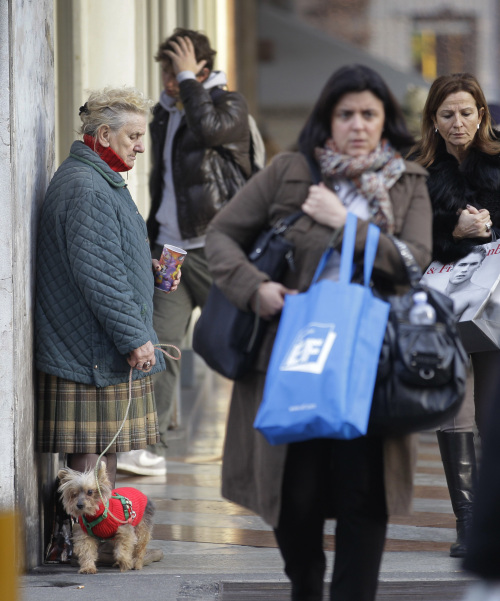
An elderly woman begs in downtown Milan. (Bloomberg)
Prime Minister Mario Monti secured final passage last week for 30 billion euros of austerity and growth measures as he seeks to cut the euro region’s second-biggest debt. The measures, including a tax on luxury goods, a levy on primary residences and higher gasoline prices, may further sap consumer spending and push the euro area’s third-biggest economy deeper into recession.
The austerity plan will cost every Italian family 1,129 euros, according to consumer group Federconsumatori. Italians spent 4.4 billion euros in the holiday season, 400 million euros less than Federconsumatori’s forecast, the group said.
Stocks Gain
While the euro area’s debt crisis is threatening to tip the 17-nation economy into recession, European stocks gained for a third day before data forecast to show the U.S. economic recovery is strengthening. The Stoxx Europe 600 Index rose 0.2 percent at 10 a.m. in London. The MSCI Asia Pacific Index lost 0.3 percent after the Bank of Japan said risks to the economy have increased.
A “few” Bank of Japan board members “pointed to the possibility that downside risks to the economy had increased somewhat since the previous meeting” held in October, according to minutes of the bank’s Nov. 15-16 gathering published Tuesday.
In the U.S., the Conference Board’s consumer confidence index may increase to 58.6 in December, according to the median of 61 estimates ahead of a release Tuesday.
Elsewhere in Europe, consumer confidence fell to the lowest in almost three years in Finland. The consumer confidence index sank to 0.4 in December, the lowest since March 2009, from 1.5 in November, Statistics Finland said in Helsinki. Business confidence was unchanged at minus 10, the Confederation of Finnish Industries said in a separate report.
Consumer Confidence Dutch producer confidence improved to minus 1.3 in December from minus 4.8 the previous month, national statistics bureau CBS said in The Hague.
In South Korea, consumer confidence fell to a three-month low in December as concern the political outlook in the North will worsen in the wake of Kim Jong-il ‘s death compounds the risk from Europe’s debt crisis.
Italian consumer confidence this month fell to the lowest in 16 years and the economy shrank in the third quarter. The government forecasts a further contraction in the current three- month period, meaning Italy is in its fourth recession since 2001.
Italy won’t return to growth until the second half of next year, employers’ lobby Confindustria said in a Dec. 15 report. The $2.3 trillion economy will contract 1.6 percent in 2012 after growing 0.5 percent this year, the lobby said.
(Bloomberg)
koreaherald@heraldcorp.com











