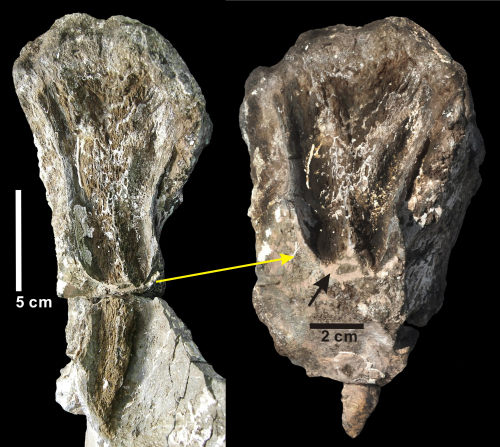
A South Korean team of scholars said they have found the world’s longest and deepest carnivorous dinosaur tooth-marks ever documented in Hadong, South Gyeongsang Province.
The tooth-marks found on a bone of a herbivorous dinosaur from the early Cretaceous period (left) and an enlarged image of part of the bone. (Pukyong National University)
Led by Paik In-sung, professor of sedimentary geology at the Department of Environmental Geosciences at Pukyong National University, the team recently published a paper in a scientific journal which revealed unusual tooth-marks on a tail bone of a herbivorous dinosaur Pukyongosaurus, left by a carnivorous dinosaur from the early Cretaceous period of the Mesozoic era.
The tooth-marks are 17 centimeters long, 2 centimeters wide and 1.5 centimeters deep, which is the longest and deepest ever found, Paik said.
The team speculated that the teeth-marks were left by a carnivorous dinosaur while it was scavenging the body of the herbivorous dinosaur.
The team’s paper was published in the online version of scientific journal Palaeogeography, Palaeoclimatology, Palaeoecology on Wednesday.
“We found the tooth-marks in December 2008 and submitted the paper in November,” Paik told The Korea Herald.
“These tooth-marks provide insight into the feeding behavior of dinosaurs that scavenged the bodies of large, adult dinosaurs.”
By Kim Yoon-mi (yoonmi@heraldm.com)










