BEIJING (AFP) ― In stews, as pets or adorning shop windows, rabbits are ubiquitous as millions of Chinese mark the Lunar New Year, hoping for a more tranquil time ahead as the old Year of the Tiger roars its last.
The nation’s 1.3 billion inhabitants will welcome the Year of the Rabbit on the night of Feb. 2-3 in a hugely important family event marked by feasts and a blaze of fireworks.
Occupying the fourth position in the Chinese zodiac, the rabbit is closely linked to the moon and symbolizes happiness and good fortune.
Many ― including brokerages ― are banking on the calm and sensitive rabbit to usher in a calm 12 months after the tiger brought a spate of deadly natural disasters to China such as earthquakes and mudslides.
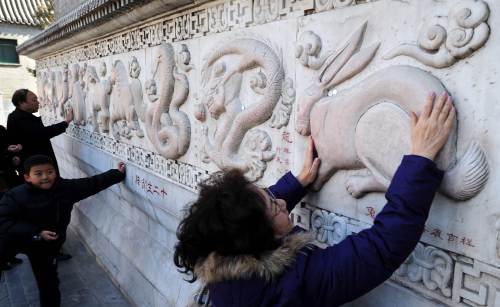
A woman rubs her hands across a bas-relief sculpture of a rabbit for good luck at the White Cloud Temple in Beijing ahead of the arrival of the “Year of the Rabbit” on Feb. 3. (AFP-Yonhap News)
CLSA, a brokerage and investment group, predicted in its latest “Feng Shui Index” that the rabbit would have a positive influence on stock markets.
“A reputedly placid, personable and prescient white rabbit will wrest the reins from the decidedly unpleasant and erratic tiger that’s been tossing and turning the markets over the past 12 months,” it said.
The bunnies in a video cartoon that went viral recently on the Chinese Internet were anything but tranquil.
Their revolt against brutal tiger overlords ― a thinly veiled swipe at China’s communist rulers ― was a huge hit before the video was yanked by online censors.
And while some attribute calming qualities to the rabbit, it may not be such a good year for the animal itself in China.
Restaurants around the country are offering rabbit delicacies as part of their lavish New Year banquets, and animal rights group PETA has urged actress Gong Li to stop wearing rabbit fur.
People are also rushing to buy bunnies as pets, sparking concern among animal rights activists that the cuddly creatures could suffer from neglect or be abandoned once the novelty has worn off.
But for people like Zhao Jizhang, who sells tiny caged bunnies near an outdoor market in Beijing, this New Year is a boon.
“People are buying them thanks to the Year of the Rabbit,” said Zhao, who charges 30 yuan ($4.60) per bunny, compared to 150 yuan in regular pet shops for larger specimens.
But one bunny costs even more ― the white Hotot, which has a black eye ring, leading some to call it the “panda rabbit”, a marketing dream in a country where the giant pandas are a beloved national symbol.
Still, pet or no pet, people will put their hands together according to custom on New Year’s Eve to wish their loved ones success and happiness. But this time, those in the know will lift their thumbs up to imitate rabbit ears.
This mimic is described as very “geili” ― a new expression that has gone viral on the web which literally translates as “to give power” and more loosely means “cool”.
The Internet is driving the Chinese New Year spending frenzy, with thousands of online discounts offered for everything from alcohol to food and trips.
One popular destination is the ice and snow sculpture festival in the northeastern city of Harbin, dubbed the world’s largest, where tourists can see giant rabbits in temperatures as low as -28 degrees Celsius.
And on Apple’s iTunes website, a variety of festive iPhone applications are available ― virtual firecrackers that go off when the phone is shaken, a kit to customize photos with rabbit ears, or horoscopes for the new lunar year.
Even China’s postal system has jumped on the rabbit bandwagon, releasing a series of special stamps in early January that sold out in the space of just a few hours.
Stamps with rabbit illustrations released in 1987 and 1999, the last two years of the rabbit, go for up to 125 times more than their original value.










