Park Wan-suh, a well-known South Korean novelist and essayist who delved into post-Korean War realities of everyday people, died of gallbladder cancer on Saturday. She was 80.
Park had been suffering the disease in recent years and died earlier in the morning, leaving behind four daughters, according to her acquaintances.
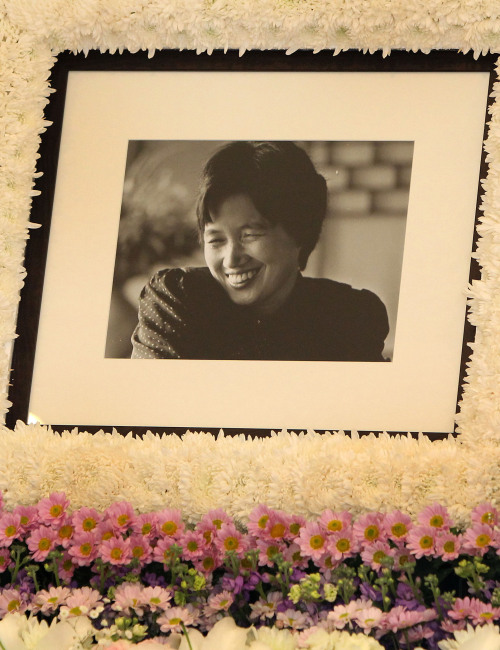
The memorial photo of late writer Park Wan-suh is placed at a funeral room of Samsung Seoul Hospital on Saturday. (Yonhap News)
Born in what is now a North Korean village bordering the South in 1931, Park became a housewife-turned-novelist at the age of 40 when her long story “Namok,” or “Bare Tree,” won a contest organized by a female magazine run by the Donga daily newspaper. Park has been a prolific writer, steadily floating stories that brought the public back to the bumpy lives that ordinary families and women led in the aftermath of the Korean War that broke out in 1950 and separated the country into two. She also sought to portray female struggles and women’s coming-of-age stories.
The novelist herself had to drop out of the Korean literature department at Seoul National University after the Korean War broke out and found employment at a military base for U.S. forces stationed here to assist in the war effort.
She clinched the country’s prominent literature awards for her pieces, mostly self-portraits in which families’ and women’s lives were entangled in social changes triggered by the war.
Park celebrated last year her 40th anniversary as a novelist.
Her last book was an essay on her life as an old-aged writer, named “Roads Not Taken Are More Beautiful,” published the same year. (Yonhap News)










