WASHINGTON -- The United States and China Wednesday called on North Korea to stop provocations and abide by its denuclearization pledge.
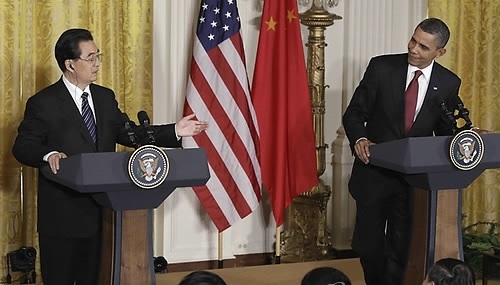
U.S. President Obama (right) and Chinese President Hu Jintao attend a joint news conference at the White House after summit talks on Wednesday. (AP-Yonhap)
Speaking at a joint press conference at the White House with Chinese President Hu Jintao, U.S. President Barack Obama said, "I told President Hu that we appreciated China's role in reducing tensions on the Korean Peninsula. And we agreed that North Korea must avoid further provocations. We agreed that the paramount goal must be complete denuclearization of the peninsula."
Obama made his remarks after an intensive dialogue with Hu in the morning, following an official arrival ceremony that included a 21-gun salute on the White House South Lawn.
The dialogue extensively touched upon North Korea, Iran's nuclear ambitions, the Chinese currency yuan's revaluation, human rights and climate change, the leaders said.
Hu later attended a luncheon at the State Department hosted by Vice President Joe Biden and Secretary Hillary Clinton, and visited a new Chinese embassy complex before attending a state dinner at the White House. On Thursday, Hu will visit congressional leaders on Capitol Hill and give a speech at a luncheon meeting with business leaders before leaving for Chicago later in the day.
"North Korea's nuclear and ballistic missile program is increasingly a direct threat to the security of the United States and our allies," Obama said.
Obama was apparently referring to remarks by U.S. Defense Secretary Robert Gates, who said last week that North Korea's missiles and nuclear weapons will pose a threat to the U.S. within five years and urged the North to impose a moratorium on nuclear and missile testing to help revive the six-party nuclear talks.
The six-party talks on North Korea's nuclear dismantlement have been deadlocked for more than two years over the North's nuclear and missile tests and the shelling of a South Korean front-line island and the torpedoing of a South Korean warship last year that killed 50 people, including two civilians.
The six-party deal, signed in 2005 by the two Koreas, the U.S., China, Japan and Russia, calls for the North's nuclear dismantlement in return for massive economic aid and diplomatic and political benefits.
Hu, for his part, said that he and the U.S. president had agree to strengthen cooperation for North Korea's denuclearization.
"President Obama and I exchanged views on major international and regional issues, including the situation on the Korean Peninsula, the Iranian nuclear issue, climate change and others," Hu said. "China and the United States will enhance coordination and cooperation and work with the relevant parties to maintain peace and stability on the peninsula, promote denuclearization of the peninsula, and achieve lasting peace and security in Northeast Asia."
Obama singled out North Korea's uranium enrichment program. "The international community must continue to state clearly that North Korea's uranium enrichment program is in violation of North Korea's commitments and international obligations," he said.
North Korea revealed in November a uranium enrichment plant that could serve as a second way of building nuclear bombs in addition to its existing plutonium program. Pyongyang insists the facility is producing fuel for power generation.
South Korean President Lee Myung-bak has called for the U.N. Security Council to discuss the North's uranium program, although China is reluctant to acknowledge the existence of such a program citing a lack of first-hand information.
Beijing, a veto power in the U.N. Security Council, has greatly diluted a council statement on the Cheonan's sinking -- blamed on North Korea by an international investigation team, and has not yet denounced Pyongyang for the sinking and the artillery attack on Yeonpyeong.
Seoul and Washington insist that Pyongyang apologize for the shelling of Yeonpyeong Island and the sinking of the Cheonan before any resumption of bilateral or multilateral talks.
China has called for the reopening of the six-party talks without any conditions attached.
In an interview Sunday, Hu called for an early resumption of the six-party talks, expressing hope that "the relevant parties will seize the opportunity to engage in active interactions, resume the process of dialogue and consultation as soon as possible, and ensure that the situation on the peninsula will move forward in a positive direction."
North Korea is under U.N. sanctions imposed after its nuclear and missile tests in 2009.
Despite international pressure to rein in North Korea, China has been reluctant to sanction the country as any instability could result in a massive influx of North Korean refugees across their shared border or a unified Korean Peninsula under the control of South Korea, supported by the U.S.
Clinton last week called on China to do more to restrain North Korea, heavily dependent on its communist neighbor for energy, food and other necessities, but backed away Tuesday when she said, "When it comes to North Korea, we know that that's a particularly sensitive issue because North Korea is China's neighbor, and we are working intensely to find a way that we can change the behavior of North Korea."
Pyongyang in recent weeks has proposed unconditional inter-Korean dialogue. Seoul and Washington dismissed the North's proposals as traditional brinkmanship and insisted that the North's rapprochement with South Korea should precede any resumption of bilateral or multilateral talks.
Appearing Wednesday on NBC's "Today," Clinton called for closer cooperation between the U.S. and China in North Korea.
"We want to see more cooperation dealing with the very thorny problem of North Korea, its nuclear ambitions, its provocative behavior that is destabilizing Northeast Asia," she said.
The top U.S. diplomat also told CBS's "Early Show" that Washington has been closely consulting with other members of the six-party talks to rein in North Korea.
"We are engaged in an ongoing discussion with the Chinese, as well as the South Koreans and the Japanese and the Russians, all who are members of the so-called six-party talks, about what we must do in order to restrain North Korea's nuclear program and its provocative behavior," she said. "We're going to continue to work with our Chinese counterparts. The fact is that a stable, nuclear-free Korean Peninsula is in both Chinese and American interests." (Yonhap News)
shinyb@heraldcorp.com











