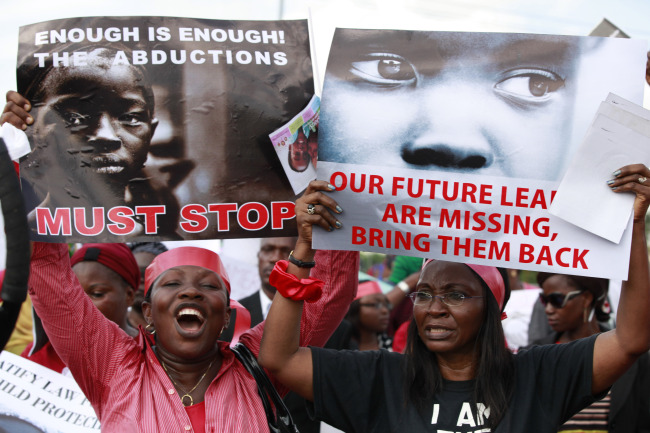
WASHINGTON (AFP) ― Forensic DNA technology could help identify and reunite with their families the more than 200 Nigerian girls who were kidnapped by Islamist militants, scientists told AFP Tuesday.
Software already exists to match missing people with their relatives, and it has been used worldwide to identify and return more than 700 children who were trafficked, some across international borders.
Most of all, forensic scientists in the United States and Spain say they are ready to help, free of charge. All they need to get started are DNA samples from family members of the lost schoolgirls.
“We would do this absolutely for nothing,” said Arthur Eisenberg, chairman of the department of molecular and medical genetics at the University of North Texas.
“This is clearly a humanitarian effort,” said Eisenberg, who heads the UNT Center for Human Identification, the laboratory that works with a 10-year-old international program called DNA-Prokids, which aims to reunite families and deter human trafficking.
First, the girls’ family members ― mother, father or another close relative ― could provide a DNA sample by swabbing the inside of their mouths with a cotton tip or giving a blood sample.
Then, Eisenberg said, he and colleagues establish DNA profiles of the families using a software system called M-FISys (pronounced “emphasis”).
The software was developed in the aftermath of the Sept. 11, 2001, attacks to help forensic scientists in New York City meet the enormous challenge of matching nearly 20,000 pieces of human remains to the more than 2,700 people who died in the Twin Towers.
Prior to 9/11, no such software existed. Forensic experts were overwhelmed by the scale of the identification effort, and quickly learned that Excel spreadsheets were not sophisticated enough.
M-FISys also protects the identities of the missing by encrypting unidentified DNA profiles, thereby avoiding potential diplomatic conflicts when cases cross borders.
“No one is giving up any confidential information that they might not be able to under their local statutes,” M-FISys developer Howard Cash told AFP.
That capability is important because the group that took responsibility for the Nigerian kidnapping, an Islamist faction called Boko Haram that is opposed to Western education, has threatened to “sell them in the market.”
The U.S. State Department has said there were indications that the girls, taken from Chibok on April 14, had been moved into neighboring countries. Local leaders have said the hostages, aged 16 to 18, were sold as brides to Islamist fighters in Cameroon and Chad.
If true, that means a key part of the identification process may come down to the actions of good Samaritans.
Anyone who encountered a girl they suspected was one of those kidnapped, could take a DNA sample from her mouth, blood or hair, and provide it to authorities so it could be analyzed to see if it matched any of the missing girls.
Even if Nigeria does not have a forensic lab ready to handle such a task, Eisenberg and DNA-Prokids founder Jose Lorente said they could work with saliva, blood or hair samples if they were shipped to their labs in either the United States or Spain.
koreaherald@heraldcorp.com











