[THE INVESTOR] South Korea and the U.S.’ decision to deploy the advanced missile defense system here is touching off concerns of destabilizing safety and security in the Northeast Asia region, with neighboring China and Russia openly berating the move.
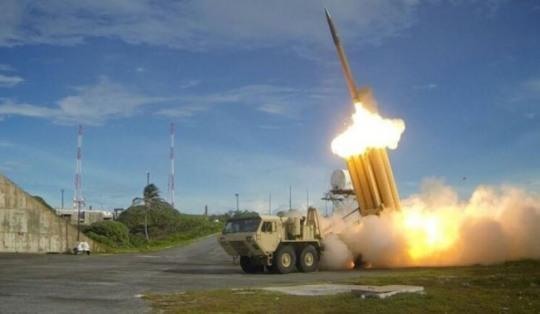
The allies announced last week that they will station here the Terminal High Altitude Area Defense system against North Korea’s growing nuclear and missile threats.
“As I’ve said several times, THAAD will not target any other country besides North Korea or infringe upon the security interests of the said country, nor is there any reason to. The international society is well aware that South Korea has no intention to threaten any other country,” said President Park Geun-hye on July 11.
The comment addressed wide-spread concern that installing THAAD here will effectively result in Seoul’s inclusion in the U.S.’ missile defense system.
China has said that deploying THAAD here will threaten its strategic interests, particularly raising concern over the system’s radar system that extends to as much as 2,000 kilometers, well beyond the North Korea-China border.
South Korea has repeatedly said that the system and THAAD are two different matters, with Deputy Defense Minister Yoo Jeh-seung saying that the system will be used exclusively as defensive measures against the North Korea’s ballistic missiles.
Under orders from its leader Kim Jong-un, the North has been upping efforts to acquire nuclear strike capacity that can potentially reach the U.S. mainland.
Despite the Seoul government’s insistence, there have been concerns over the potential risks of stationing the U.S.’ advanced weapon system in the peninsula, particularly at a stone’s throw away from Washington’s biggest rival.
China has blatantly accused the allies of a “hidden agenda” behind THAAD, saying that the system reaches beyond the security necessities of the peninsula.
Russia has indicated possible military actions, saying that it might move its missile launchers eastward to put the THAAD under its range.
Local observers and opposition politicians have suggested that with THAAD, a new form of conflict and tension can break out in the Far East.
Rep. Kim Jong-dae of the minor opposition Justice Party, raised concern about the possible united front by China, Russia and North Korea against the South Korea-U.S.-Japan alliance.
He argued that this could result in Pyongyang evading the solitude enforced by the U.N. Security Council resolution 2270, adopted in March and encompassing the strongest economic sanctions against the communist country to date.
“If the international trend shifts from sanctions against the North to a ‘new Cold War,’ it would be the best scenario possible for Kim Jong-un,” said, Kim, a former military advisor in both the public and civil sector.
As the reclusive state’s sole trading partner, cooperation of China has been considered key to pressure on Pyongyang’s economy.
Cheong Seong-chang, a senior researcher at Sejong Institute, said that head-butting with China over THAAD may effectively nullify a considerable portion of the anti-Pyongyang sanctions.
Kim Yong-hyun, a professor of North Korean studies from Dongguk University, pointed out that the inherent nature of the “U.S.” defense system is prompting China and Russia to reject THAAD.
“If (THAAD) was an independent system operated by Seoul they would not have the justification to oppose it, but they are concerned because it is a U.S.-run weapons system,” he wrote in his recent column.
Under the Seoul-Washington Status of Forces Agreement, South Korea is to provide the relevant facilities and land to host the system, while the U.S. will cover expenses for its deployment and operation.
As the Wartime Operational Control of South Korean troops currently is held by the U.S. military, the commander of U.S. Forces Korea would have the right to fire the weapon system.
Professor Kim Dong-yup of the Institute for Far Eastern Studies criticized Defense Minister Han Min-koo’s claims of “military sovereignty” in adopting THAAD.
“It is a U.S. strategic weapon run by the U.S. What sense does it make to even mention the word sovereignty?” he said.
Kim addressed the rising geopolitical risks of the Far East, with possibility of an arms race lurking behind deployment of THAAD.
“Technically it will not be as bad as the Cold War, but (the term New Cold War) would not be that far off from the truth.”
“China and Russia are both trying to expand -- Russia westward and China toward the Pacific region -- while the U.S. is looking to contain them. The Korean Peninsula can be a point of their confrontation,” he said.
Despite the tough rhetoric by Russia, Kim said that the possibility of an immediate military action is low.
But he added that this conflict will make the peninsula an even more unstable region, adding to the risk of North Korea and it will also likely affect both the economy and the market related to South Korea.
By Yoon Min-sik ()











