President Moon Jae-in on Wednesday called for efforts to further improve the country's relations with four global powers surrounding the Korean Peninsula, calling them the foundation of the country's foreign policy that seeks to peacefully end North Korea's nuclear ambitions.
"First of all, relations with (the United States, Japan, China and Russia) is the basis of our foreign relations. While we must diversify our foreign relations to the EU, the Association of Southeast Asian Nations and India, I believe our relations with the four countries cannot but be the basis of our foreign relations policies," the president said.
"Also, relations with the four countries are especially important now for the peaceful resolution of the North Korean nuclear issue, establishment of a peace regime on the Korean Peninsula and in the entire Northeast Asia as the North Korean nuclear and missile issues are so serious."
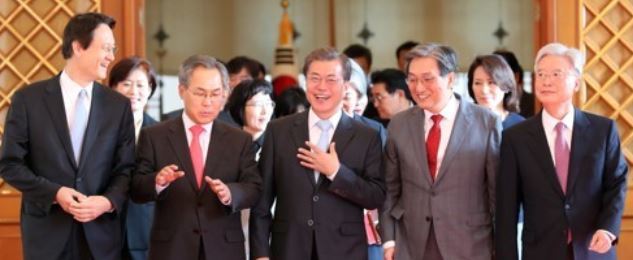
Moon's remarks came in a ceremony to present credentials to new chiefs of diplomatic missions to the four countries. They are new Ambassador to China Noh Young-min, Ambassador to Japan Lee Su-hoon, Ambassador to Russia Woo Yoon-keun and Cho Yoon-je, new ambassador to the United States.
To Cho, the president underscored the need to further enhance the alliance to denuclearize the communist North but noted there also existed a number of thorny issues that need to be addressed, such as upcoming discussions on how to share the cost of 28,500 US troops stationed here.
Seoul and Washington have also recently launched talks aimed at revising the Korea-US free trade agreement following a US claim that the bilateral free trade pact has greatly boosted the US' trade deficit with South Korea since going into effect in early 2012.
Moon also highlighted the need to improve the country's ties with China, which have been deteriorating over Beijing's apparent economic and trade sanctions against South Korea for the deployment of the US THAAD missile defense system here.
"In the case of China, we must overcome the THAAD issue and greatly develop the diplomatic relationship between the two countries to be on par with their economic and trade relations," he said.
Despite China's apparent trade ban on a range of South Korean products, the country remains the world's single largest importer of South Korean goods, according to earlier government reports.
Improved relations with Tokyo and Moscow are equally important to help resolve the North Korean nuclear issue but also to ensure regional cooperation and peace once the nuclear issue is resolved, he noted. (Yonhap)










