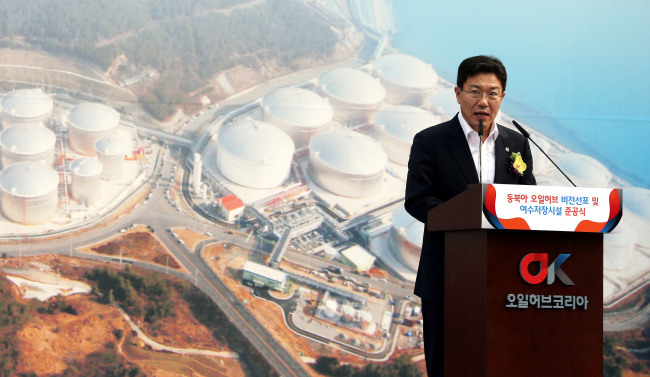
Korea completed the construction of the nation’s largest oil tank terminal in Yeosu, South Jeolla Province, on Monday, as part of its goal to become a Northeast Asian oil hub.
As part of the goal, the state-run Korea National Oil Corp. has led oil tank terminal construction projects in Yeosu and Ulsan since 2008, both of which have leading petrochemical industrial complexes near the tank terminal sites.
“The Yeosu tank terminal completed the construction in March this year of 36 tanks whose crude oil and oil product storage capacity reaches 8.2 million barrels,” Oilhub Korea Yeosu CEO Baik Moon-hyun said, adding that 80 percent of the terminal was already in operation.
Oilhub Korea Yeosu is composed of seven local and foreign stakeholders, including KNOC, China Aviation Oil, GS Caltex, SK Energy and Samsung C&T.
Baik predicted that the operation rate of the Yeosu oil tank terminal would reach 100 percent within this year given the lack of oil storage space in Northeast Asia.
“As demand for oil continues to rise in Northeast Asia, mainly due to the rising Chinese economy, Korea, armed with geographical advantage, can lead the oil storage and trading market in the region, if it jumpstarts the market,” Baik said.
To scale up storage capacity, the KNOC plans to build a second oil tank terminal in Ulsan with a capacity of 28.4 million barrels by 2017.
While the KNOC develops the oil storage facilities, the Ministry of Trade, Industry and Energy will be responsible for easing regulations and improving the business environment for oil and oil product trading.
“Ultimately, the government aims to transform Korea into the world’s fourth oil storage and trading regional hub equivalent to Jurong Island in Singapore, the Gulf Coast of the U.S. and Amsterdam-Rotterdam-Antwerp,” Trade, Industry and Energy Minister Yoon Sang-jick said during the completion ceremony.
The government has been working on the oil hub project since 2008 as a growth engine to create new jobs and to enhance the nation’s energy security. Korea is the fifth-largest oil importer and seventh-largest oil consumer in the world.










