Korea’s priciest retail district reclaims top spot as tourist boom and shifting retail trends fuel revival
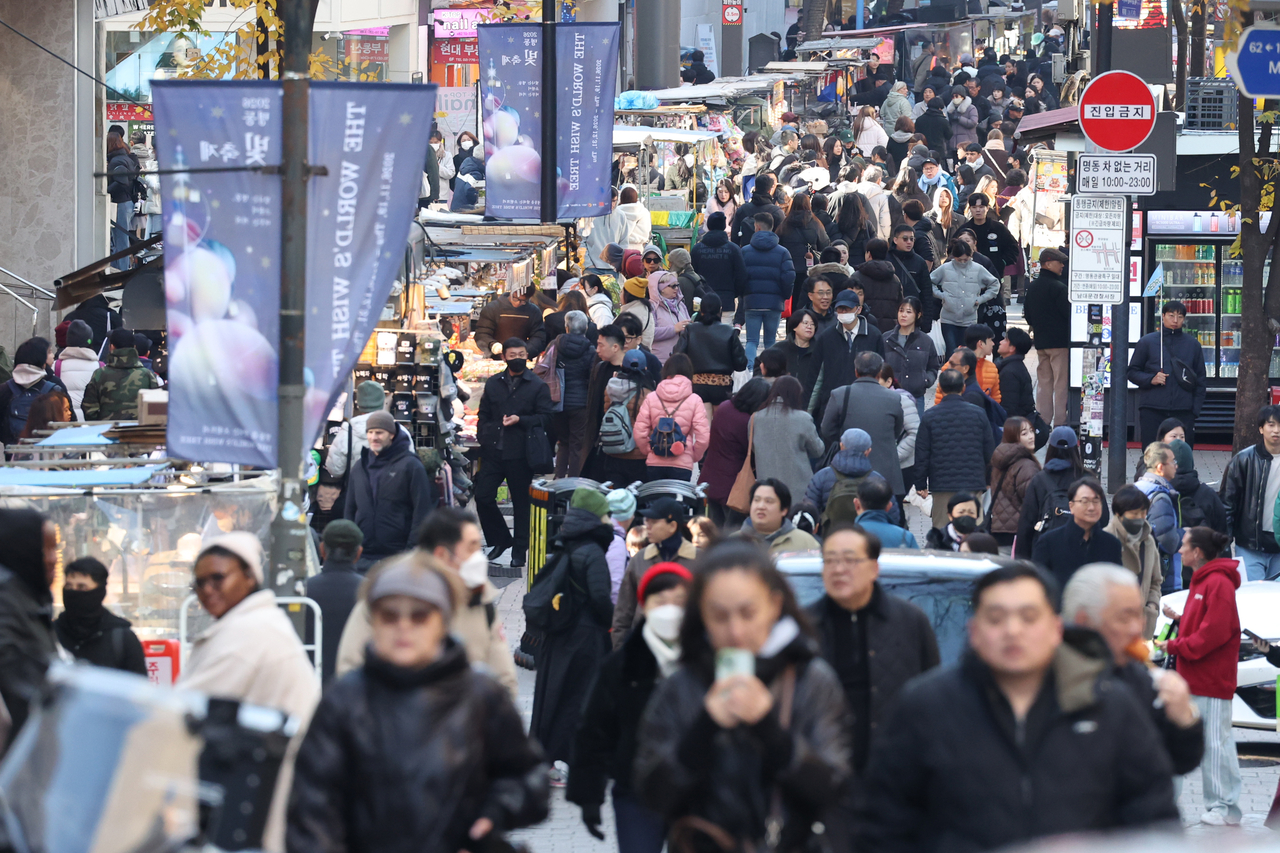
Myeong-dong, once a symbol of Seoul's retail decline, has cemented its status as one of the world's priciest shopping districts, buoyed by a strong recovery in foreign tourist arrivals and a changing retail landscape.
The district ranked as the world's ninth-most expensive retail location for the second consecutive year, retaining its place among 147 major shopping districts worldwide while climbing two spots to seventh in the Asia-Pacific region, according to a Cushman & Wakefield report released earlier this month.
Rents have also surged, reflecting growing demand for prime retail space amid the district's commercial revival. Annual retail rents in Myeong-dong reached $739 per square foot, up 9 percent from a year earlier.
The increase was three times the global average, highlighting Myeong-dong's relatively strong rental growth compared with other major shopping destinations worldwide, according to Cushman & Wakefield.
The district's appeal is also reflected in its exceptionally tight retail market. Just 3.9 percent of retail space in Myeong-dong stood vacant, giving it the second-lowest vacancy rate among Seoul's six major shopping districts.
A new retail playbook
Myeong-dong's turnaround reflects a combination of rising foreign tourist arrivals and intensifying competition among global brands for prime retail locations.
The influx of foreign visitors has breathed new life into commercial districts, accelerating their transformation, and Myeong-dong is a key beneficiary.
According to the Korea Tourism Organization, Korea welcomed approximately 6.4 million foreign visitors in the third quarter, putting the country on track to attract a record 20 million international tourists for the first time this year.
At the same time, global brands are increasingly seeking prime locations for their stores, adding to Myeong-dong's appeal as a retail destination.
"The rules of retail have fundamentally changed. Offline commerce is increasingly driven by international visitors and experience-oriented shopping. Myeong-dong is gaining renewed attention because it is both a must-visit destination for foreign tourists and easily accessible to domestic consumers," an official from a local real estate asset manager said.
This shift in retail dynamics is also reshaping how commercial spaces are designed and used.
For instance, a consortium led by Goldman Sachs and Igis Asset Management has been named the preferred bidder for Timewalk Myeong-dong, a mixed-use commercial property in the district.
The prospective buyers are reportedly considering reducing the property's office space while expanding its medical facilities, reflecting changing demand. The move makes commercial sense, as dermatology and plastic surgery clinics typically command rents 20 to 30 percent higher than conventional office tenants.
"Myeongdong’s rise to No. 7 in Asia Pacific while holding steady at No. 9 globally with 9 percent annual rental growth, reflects how strongly international visitor demand and tourist-oriented tenant repositioning are sustaining prime street performance even as domestic consumption recovers gradually," said Jason Yun, head of Retail Leasing Group at Cushman & Wakefield Korea, said.
"In Myeongdong, near-zero vacancy means new demand is largely absorbed through store turnover," he said, explaining that brands are competing for high-visibility locations that connect global narratives with physical experiences.
silverstar@heraldcorp.com