AI education to become mandatory for all incoming students from 2028 as university embraces campuswide transformation
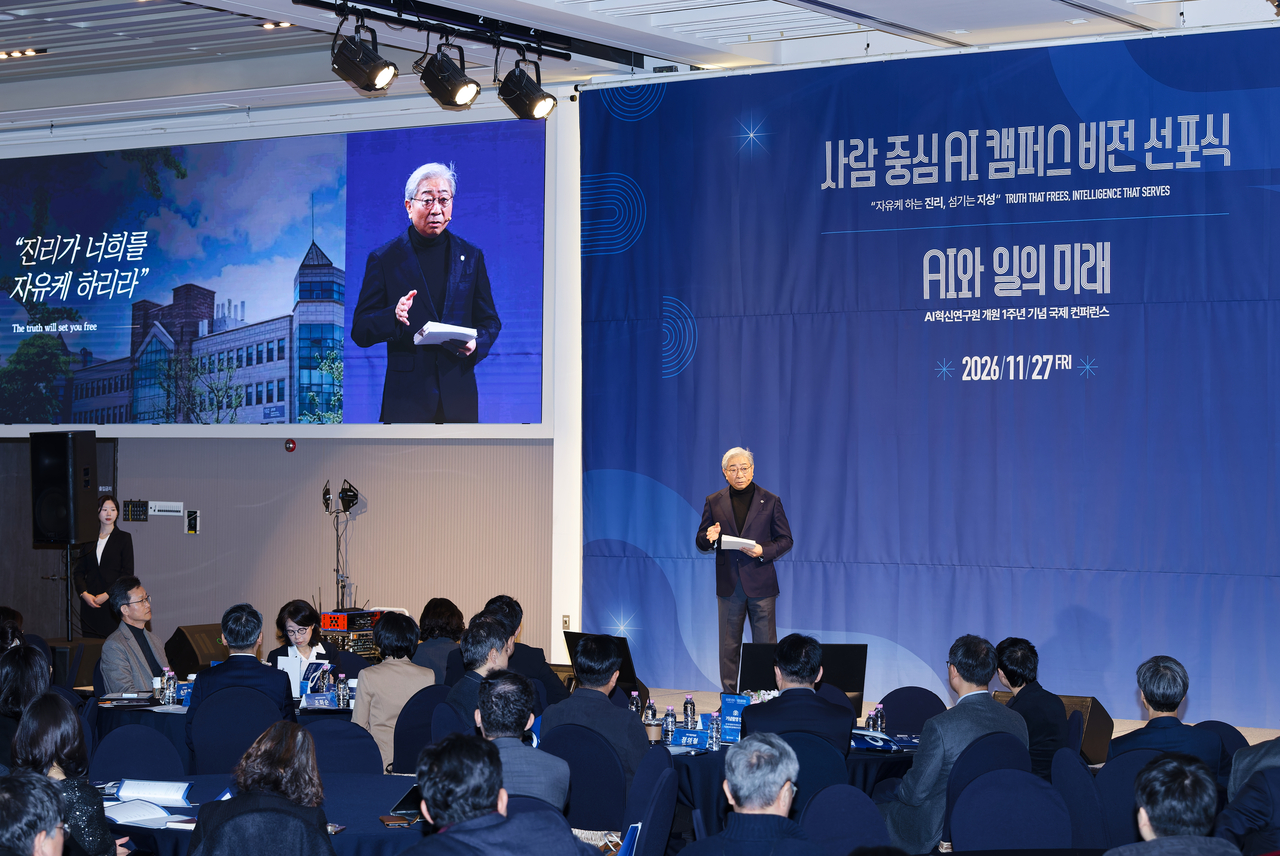
Yonsei University on Friday announced plans to invest 130 billion won ($97 million) over eight years to overhaul its education, research and administrative systems around artificial intelligence, as part of its efforts to redifine the role of universities in the AI era.
Under its vision of a "human-centered AI campus," the university will make AI education mandatory for all incoming students from 2028, expand interdisciplinary research and integrate AI into university administration.
Unveiling the plan at the university's main campus in Sinchon, Seoul, Yonsei University President Yoon Dong-sup stressed that universities must move beyond delivering knowledge and give students the skills to critically evaluating information and taking responsibility for their decisions.
"AI now provides answers to most questions almost instantaneously. The world has begun asking universities: If AI provides the answers, why do we need universities?" Yoon said during the ceremony.
"Those who uncritically accept answers generated by AI cannot be free. Only when they can verify those answers, question their reasoning and discover new knowledge can they truly be free."
Starting in 2027, Yonsei will introduce a liberal arts course tentatively titled, "AI and Modern Society," which will become mandatory for all incoming students starting in 2028, regardless of major.
The 16-week course will cover the principles of generative AI, its social risks and ethical implications, as well as how students can collaborate with AI and critically verify its outputs.
Rather than assessing student based on their knowledge or the quality of their final submissions, the university will evaluate the process through which students identify problems, develop solution and improve AI-genrated outputs, according to the university.
The university will also expand its existing interdiscipinary AI education program, which currently involves some 60 academic majors and as recorded 17,000 cumulative course enrollments.
Graduate students will also be offered a common course on AI-assisted research, designed to foster their ability to incorporate AI into academic research while critically verifying its results.
To support the initiative, Yonsei will provide students with access to an integrated platform offering multiple large language models. Students will receive university-provided credits, allowing them to access various generative AI models without having to pay for individual subscriptions.
In research, the university plans to further dismantle barriers between academic disciplines and expand its computing infrastructure.
Its AI innovation institute, established a year ago, is currently conducting 87 interdisciplinary research projects selected from 293 proposals spanning fields from the humanities to medicine. It has also established partnerships with 23 institutions.
Severance Hospital, which is affiliated with Yonsei, has opened a medical data platform containing clinical data from 70,000 patients to external researchers to facilitate AI-powered medical research.
Yonsei currently operates four AI data centers at its Sinchon campus and plans to establish another next year, in addition to a separate data center operated by its medical center.
The university is also developing hybrid quantum-AI computing infrastructure to address complex scientific problems in areas such as drug discovery, biotechnology and advanced materials.
In administration, Yonsei plans to integrate data scattered across its administrative systems, automate repetitive tasks and increasingly utilize AI in institutional decision-making.
From 2029, the university plans to use AI-powered forecasting and simulations to assess the potential effects of university policies and optimize resource allocation.
Yoon emphasized that the university's transformation was not simply about adopting emerging technologies, but fundamentally restructuring how universities educate students, conduct research and operate.
"Knowledge can now be obtained anywhere. But the experience of people coming face to face, making judgments together and taking responsibility for one another is not something that can be obtained anywhere," Yoon said.
"In the AI era, Yonsei's campus will move beyond the delivery of knowledge to become a place where people from different backgrounds come together to solve societal problems and test those solutions."
seungku99@heraldcorp.com