Apartment prices rise in traditionally cheaper districts as rental costs climb, keeping housing affordability under pressure
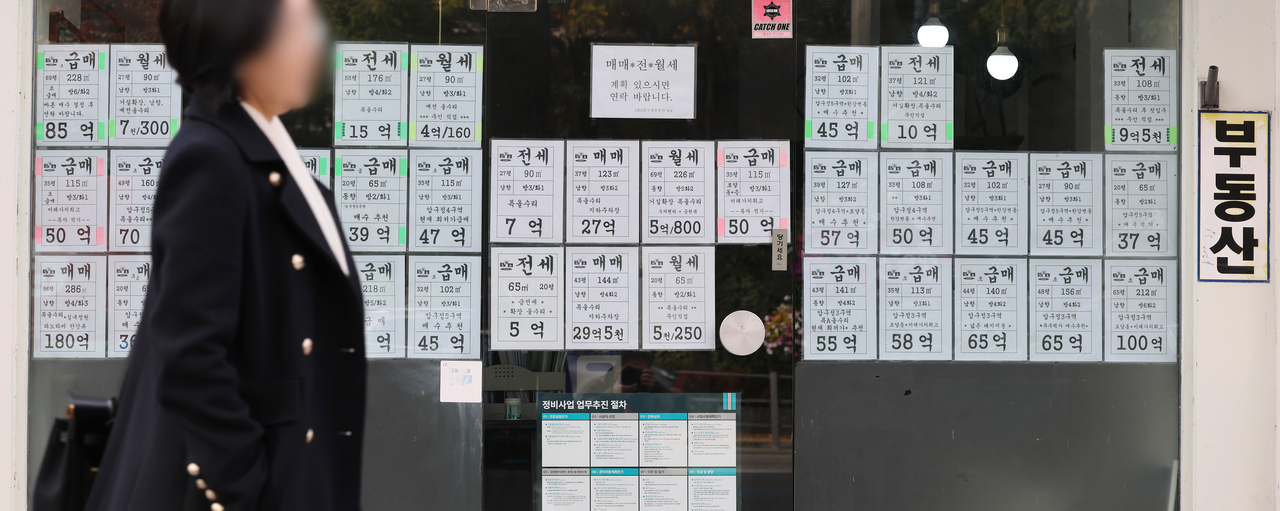
Apartment prices in Seoul's affluent southern districts are falling, while those in traditionally cheaper neighborhoods continue to rise, highlighting an uneven housing market where homeownership remains out of reach for many households.
Gangnam-gu and Seocho-gu recorded their steepest monthly apartment price declines since December 2022 in October, falling 1.79 percent and 1.37 percent, respectively, according to the Korea Real Estate Board's monthly price index. Gangnam-gu saw a cumulative 3.82 percent decline between July and October.
In contrast, prices in northeastern Seoul's more affordable districts continued to climb, rising 1.44 percent in Nowon-gu and 1.4 percent in Dobong-gu in October.
The contrasting trends underscore the uneven nature of Seoul's housing market.
Despite recent declines in affluent neighborhoods, substantial price disparities persist, while rising prices in cheaper districts add pressure on prospective first-time buyers.
Meanwhile, a shortage of rental properties is driving up housing costs for tenants.
"A shortage of jeonse and monthly rental listings continues to put upward pressure on rents in Seoul," said Kim Hyo-seon, a senior real estate specialist at KB Financial Group. Jeonse is a unique Korean rental system. Instead of monthly rent, tenants make a large deposit that is returned when the lease ends.
She cited owner-occupancy requirements that reduce rental supply, along with lease renewals and expected relocations from major reconstruction and redevelopment projects.
Some real estate professionals argue that government housing policies should better distinguish speculative investment from genuine demand for homeownership.
"Heavier taxes on multiple-home owners are necessary, but people trying to buy their first home need more support," a Gangnam-gu real estate agent told The Korea Herald.
"The current approach is like spraying a herbicide so strong that it kills the crops along with the weeds."
Controversial levies on profits from reconstruction projects are also putting downward pressure on asking prices in Gangnam.
Some owners at Eunma Apartment, a landmark aging complex, have lowered their asking prices amid concerns over the financial burden, according to local real estate agents.
The levies are provisionally estimated at 463 million won ($344,000) per owner, on top of construction costs, according to Gangnam-gu Office.
Prices remain elevated
Despite the recent correction and the government's assessment that the market is stabilizing, Seoul apartment prices remain substantially higher than three years ago.
Seoul ranked fifth among 23 cities in UBS' 2026 Global Real Estate Bubble Index, released in September, placing it in the "elevated" risk category.
The report noted that Seoul recorded annual inflation-adjusted house price growth exceeding 10 percent over the preceding four quarters.
Buying an apartment in Seoul costs the equivalent of roughly 25 years of rent for a comparable property, according to UBS.
Over the three years through October, Seoul apartment prices rose 24.2 percent, including an 8.9 percent increase in the first 10 months of this year, according to calculations based on Korea Real Estate Board data.
The figures show that recent declines in high-end neighborhoods have yet to translate into broader housing affordability gains.
yunapark@heraldcorp.com