Authorities prepare to activate fund for first time since 2008 global financial crisis;
Experts say it may signal policy support rather than reverse market decline
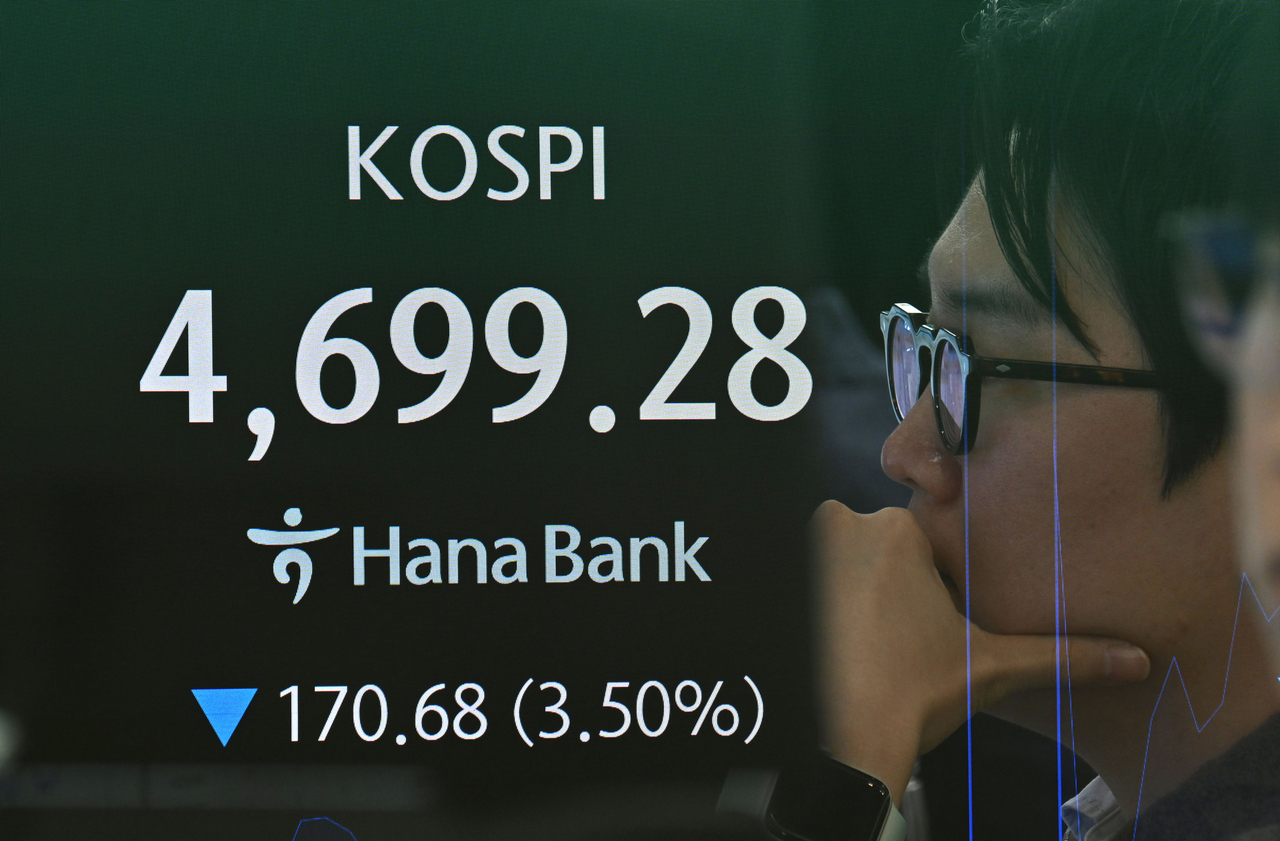
South Korean financial authorities are preparing to activate the stock market stabilization fund, as markets reel from a sharp sell-off in US semiconductor shares that sent the Kospi tumbling for a second consecutive session Monday.
The Kospi closed 3.31 percent lower at 4,708.54 on Monday, while the Kosdaq fell 1.58 percent to 635.45 points, according to the Korea Exchange. A sell-side sidecar was triggered for the second consecutive session, following a similar measure Friday.
The Kospi has fallen nearly 47 percent from its June peak, fueling concerns over a prolonged market downturn. Authorities said Sunday they had begun preparations to activate the Securities Market Stabilization Fund after the Philadelphia Semiconductor Index plunged more than 10 percent in Friday's US trading session.
If deployed, it would mark the fund's first actual intervention in the stock market since the 2008 global financial crisis.
The preparations followed a Sunday meeting of the "F4," comprising the finance minister, Bank of Korea governor, Financial Services Commission chairman and Financial Supervisory Service governor.
Authorities said they would improve the fund's activation framework and operational effectiveness so it could be deployed whenever market conditions require.
The fund pools capital from state-run banks, the country's five major financial holding companies and other financial institutions. Under its "capital call" structure, participating institutions provide their committed funds once the FSC decides to activate it. Authorities are currently preparing for a possible deployment, not committing funds to the market.
South Korea has established the fund five times, but deployed it only three times. It was first set up in 1990 and subsequently used in 2003 and 2008. A 10.76 trillion won ($8 billion) fund created during the 2020 COVID-19 market turmoil was never deployed, while preparations to reactivate it in 2022 did not lead to actual purchases.
The last deployment came in 2008, when approximately 515 billion won was raised and injected into the market between November 2008 and March 2009. According to contemporaneous media reports, the Kospi rose 5.8 percent on the day the fund began purchasing shares.
The government is also easing restrictions on daily share buyback orders by listed companies for three months from Tuesday, allowing larger orders. The FSC is expected to finalize the details following a resolution on Monday. The FSS and the Korea Exchange will also step up monitoring of illegal short selling for three months.
Can fund stem market rout?
Market watchers question whether the fund can meaningfully counter the sell-off while foreign investors continue to offload Korean equities.
"The fund cannot be a driver of a market rally, but I think it can be read as a signal that authorities are defending against further declines," said Yoon Sok-mo, head of the Samsung Securities Research Center.
The Korea Institute of Finance has also assessed that the fund's past effects were limited and difficult to distinguish from those of other policy measures implemented at the time.
An official at a financial investment firm said the fund could end up absorbing foreign selling rather than reversing the market's downward trend.
"With foreign investors continuing to sell, the fund could end up merely absorbing their sell orders," the official said.
Some market participants also question whether easing restrictions on corporate share buybacks will do much to offset foreign selling, as companies ultimately decide whether and when to repurchase their own shares.
Some analysts have warned the Kospi could fall further to the 4,200-4,300 range.
"At this point, it is necessary to leave open the possibility of the index falling to 4,200-4,300 to prepare for the worst-case scenario," said Han Ji-young, a researcher at Kiwoom Securities. The estimate is based on a 12-month forward price-to-book ratio of around 0.8, comparable to the level reached during the global financial crisis.
Yoon, however, expects the 4,300 level to provide a relatively firm floor, saying there are no signs of an impending US or global recession.
He cited potential recovery catalysts including confirmation that hyperscalers retain ample investment capacity, disinflation and lower market interest rates after the first quarter of next year, and greater political predictability following the US midterm elections.
ch0221@heraldcorp.com