The ruling Democratic Party of Korea said Sunday it would seek to pass an impeachment motion against Chief Justice Jo Hee-de by the end of the year, raising the prospect of the country's first-ever impeachment trial for a sitting chief justice.
The move comes amid a broader political battle over criminal cases involving President Lee Jae Myung. A separate law authorizing an investigation into alleged prosecutorial misconduct has fueled opposition accusations that Lee’s allies are seeking to control the judiciary and shield him from prosecution.
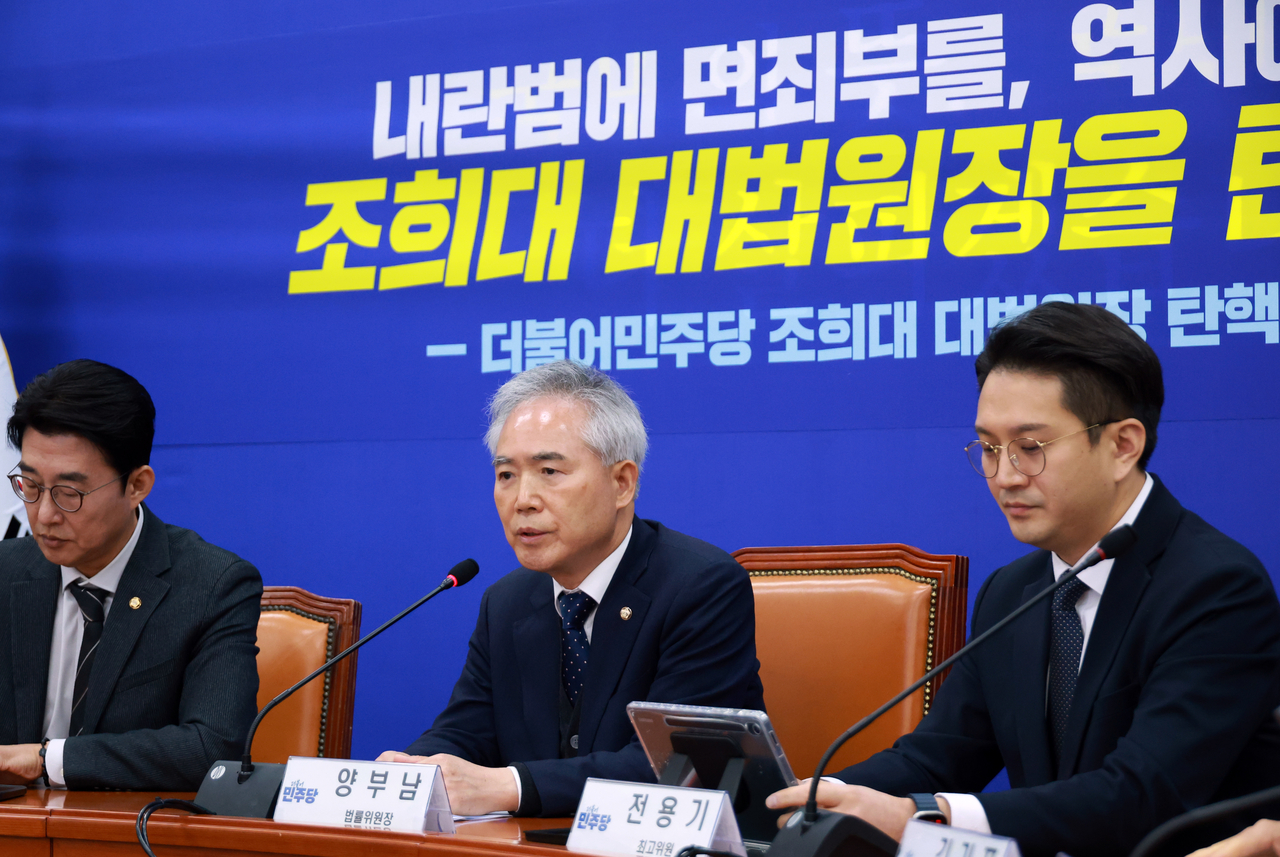
Rep. Yang Bu-nam, who leads the Democratic Party’s impeachment task force, accused Jo of “disregarding and violating the Constitution and the law” since former President Yoon Suk Yeol declared martial law on Dec. 3, 2024.
Yang also accused Jo of “repeatedly committing unconstitutional and unlawful acts, including engaging in political activity through judicial rulings.”
“We in the Democratic Party have patiently endured Chief Justice Jo Hee-de’s unconstitutional and unlawful actions,” Yang said at the task force’s first news briefing at the National Assembly on Sunday. “But the latest ruling involving Han Duck-soo has brought our patience to its limit.”
The Democratic Party formally adopted the impeachment push on Friday, a day after the Supreme Court partially overturned a ruling sentencing former Prime Minister Han Duck-soo to 15 years in prison over his role in the martial-law crisis.
The court rejected a finding that Han’s arrangement of a Cabinet meeting before the martial law declaration amounted to participation in an insurrection, while leaving other findings against him intact. It sent the case back to a lower court.
Yang said, “We fundamentally respect judicial decisions and will not use the substance of the ruling as grounds for impeachment.”
Instead, Yang pointed to allegations of “several serious procedural flaws” in the Supreme Court’s deliberations in Han’s case, arguing that such violations could constitute “sufficient grounds for impeachment.”
Under South Korea’s Constitution, an impeachment motion against the chief justice requires the support of at least one-third of National Assembly members to be introduced and a majority to pass. With 161 of the Assembly’s 299 seats, the Democratic Party has enough votes to approve the motion.
If passed, the motion would immediately suspend Jo from his duties, making him the first sitting chief justice to face an impeachment trial before the Constitutional Court.
A previous attempt in 1985 to impeach then-Chief Justice Yoo Tai-heung over allegations of unfair personnel decisions affecting lower-court judges failed in a National Assembly plenary vote.
To remove Jo from office, at least six of the Constitutional Court’s nine justices must find that he committed serious violations of the Constitution or law. The court is supposed to rule within 180 days, but the deadline is not legally binding, leaving open whether it would reach a decision before Jo’s term expires in June 2027.
Conservative politicians sharply condemned the impeachment push on Sunday, accusing the Democratic Party of using the Supreme Court’s ruling in Han’s case as a pretext to seize control of the judiciary and influence President Lee’s criminal trials.
“Stop the Democratic Party now. Otherwise, President Lee Jae Myung will be remembered not merely as a failed president, but as one the people can never forgive,” Seoul Mayor Oh Se-hoon wrote on Facebook on Sunday.
“The day the impeachment motion against the chief justice is acted upon, a train of public judgment against President Lee Jae Myung will depart, and that train will be unstoppable.”
Rep. Choi Bo-yoon, a senior spokesperson for the main opposition People Power Party, challenged the legal basis for impeachment, saying the Constitution requires a violation of the law or Constitution in the performance of official duties.
“Court rulings can be criticized. But impeachment must not become a means of forcing through objections to a ruling,” Choi said Sunday, warning that suspending Jo amid Supreme Court vacancies would further strain the judiciary.
“The harm will fall on people awaiting trial,” she added.
The move has also drawn reservations from within the Democratic Party. Rep. Kwak Sang-eon, a son-in-law of former President Roh Moo-hyun, has cautioned against removing Jo simply because of the disagreement with the Supreme Court’s ruling in Han’s case.
The confrontation comes as a special counsel law took effect on Thursday, authorizing investigations into allegations that prosecutors and other state agencies manipulated investigations and indictments under Yoon.
The law covers criminal cases involving Lee before he became president and allows him to appoint the special counsel from candidates recommended by political parties, raising opposition concerns about a potential conflict of interest.
The Democratic Party and the minor progressive Rebuilding Korea Party are seeking candidates to lead the investigation, while the People Power Party has refused to nominate one, arguing that the law could undermine the criminal cases against Lee.
At a rally in Daegu on Saturday, opposition leader Rep. Jang Dong-hyeok accused the Democratic Party of using the special counsel law and the chief justice’s impeachment to shield Lee from criminal trials.
“Pushing through the so-called ‘Lee Jae Myung jailbreak law’ while clamoring to impeach the chief justice — that is the real insurrection,” Jang said. “Now is the time for us to rise up, defend Chief Justice Jo Hee-de and push for the judiciary to resume Lee’s trials.”
dagyumji@heraldcorp.com