Seoul study suggests policies to help small agencies survive, not just launch new groups
Nearly 90 percent of K-pop idol groups debuted under small and midsized entertainment agencies over the past 30 years, but groups from major agencies remained active for more than twice as long on average, according to a study released Monday.

Of the 1,159 K-pop idol groups that debuted between 1996 and 2025, 1,042 groups, or 89.9 percent, came from small and midsized agencies, while 117 groups, or 10.1 percent, debuted under major agencies, according to the study led by Kim Jung-seop, a professor at Sungshin Women's University in Seoul.
Despite accounting for just 10.1 percent of debuts, groups from major agencies remained active for an average of 7.4 years, compared with 3.6 years for those from smaller agencies.
The gap was also evident in long-term survival rates. Five years after their debut, 65.2 percent of groups from major agencies were still active, compared with just 28.7 percent of those from smaller agencies.
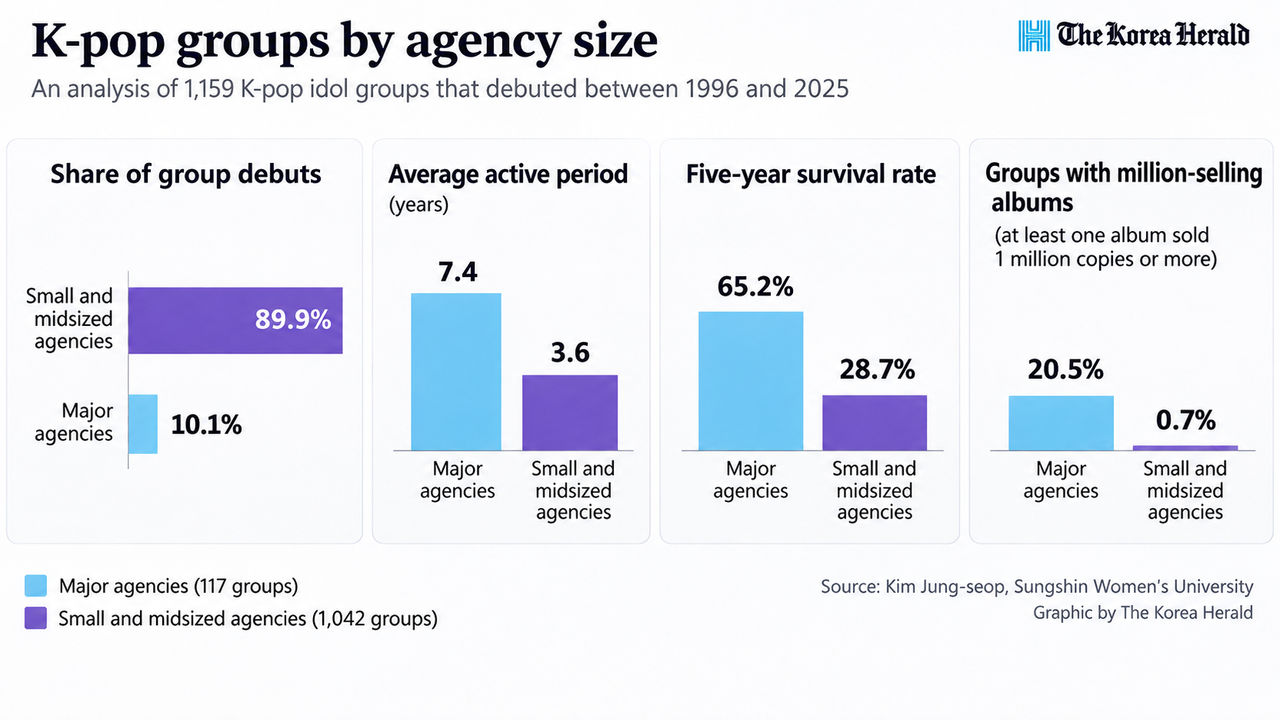
Album sales revealed an even wider disparity. Among groups from major agencies, 20.5 percent had released at least one album that sold 1 million copies or more, compared with just 0.7 percent of groups from smaller agencies.
To address the imbalance, Kim proposed 10 policy measures to support smaller entertainment agencies, including investment funds linked to intellectual property rights, digital marketing support and assistance for overseas showcases.
He emphasized that government policies should focus on helping smaller agencies achieve sustainable growth rather than simply covering debut and production costs.
The study was published in the Journal of the Korea Entertainment Industry Association.
terry3538@heraldcorp.com