Potential meeting with Rubio would come as Seoul expands naval operations toward Oman while seeking progress on nuclear-powered submarine cooperation
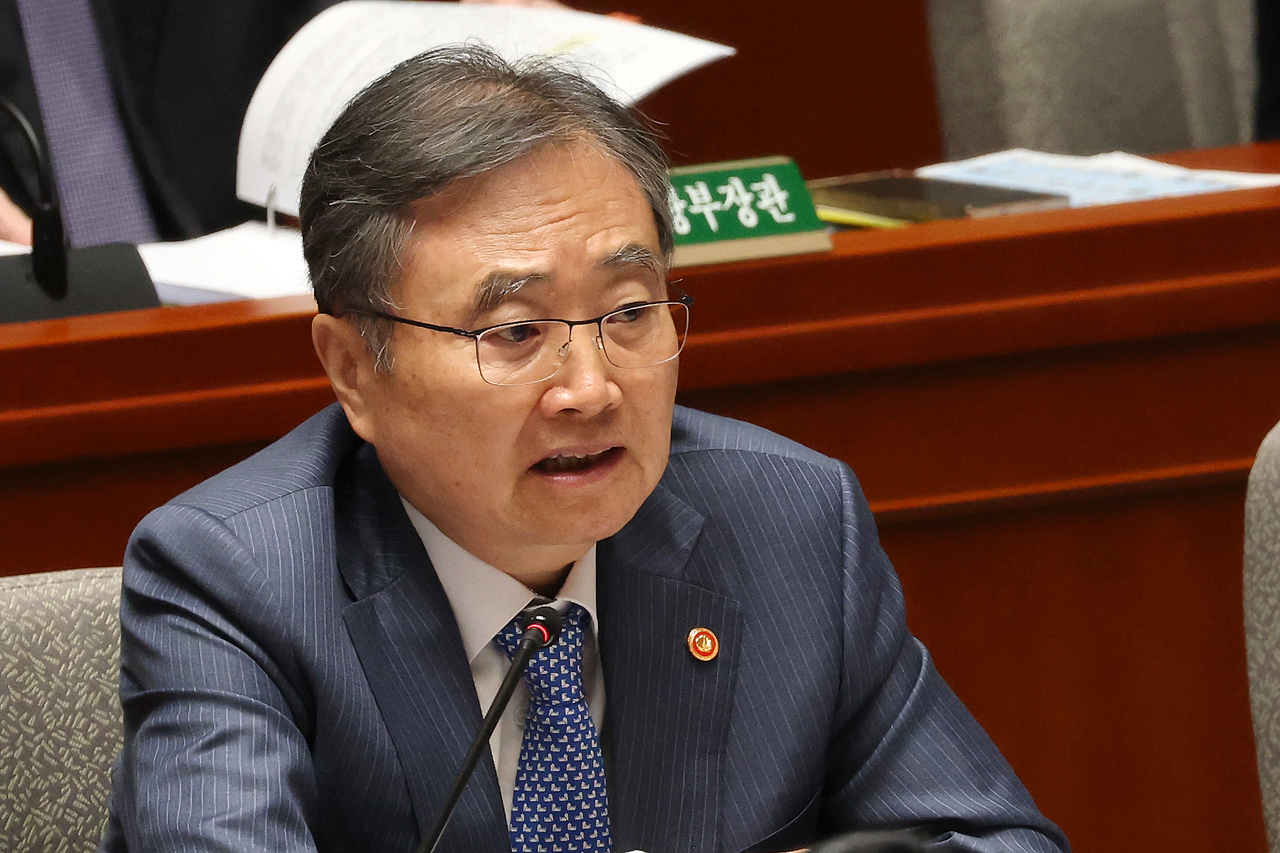
Foreign Minister Cho Hyun departed for France on Sunday to attend a Group of Seven foreign ministers' meeting, with attention turning to whether he will meet US Secretary of State Marco Rubio to discuss South Korea's expanded naval mission near the Strait of Hormuz and stalled bilateral security consultations.
A meeting between the two top diplomats would come just days after Seoul moved to expand the operational area of its Cheonghae Unit, a naval contingent traditionally tasked with anti-piracy operations in the Gulf of Aden, toward waters south of Oman, amid mounting pressure from Washington for greater international contributions to maritime security near Iran.
The decision marks a significant expansion of the unit's geographical reach, potentially allowing South Korea to contribute to maritime surveillance and mine-clearing operations closer to the strategically vital Strait of Hormuz, while maintaining its position against direct involvement in the ongoing US-Iran conflict.
According to Seoul's Foreign Ministry, Cho will visit France from Sunday to Wednesday to participate in the G7 foreign ministers' meeting scheduled for Monday and Tuesday in Marseille, where discussions are expected to cover developments in the Middle East, energy supply diversification and artificial intelligence safety.
South Korea is attending at the invitation of France, which holds this year's G7 presidency, after participating in the first ministerial meeting in March.
Foreign Ministry spokesperson Park Doo-soon said Thursday that Seoul's participation was intended to deepen cooperation with G7 members and reinforce South Korea's role as a responsible member of the international community.
Cho also plans to hold separate bilateral talks with his counterparts from participating countries to discuss bilateral relations, practical cooperation and regional security issues.
The US State Department confirmed Friday, US time, that Rubio would visit France from Sunday to Tuesday, raising the possibility of the two ministers holding their first bilateral meeting since the US midterm elections, in which Republicans suffered significant losses in both chambers of Congress.
However, neither government has announced a schedule or format for a separate meeting as of Sunday noon.
The two diplomats last met on Oct. 30 on the sidelines of the Group of 20 foreign ministers' meeting in Atlanta, where they discussed bilateral relations, high-level exchanges, visa-related concerns and other outstanding alliance issues.
Should Cho and Rubio meet, Seoul's recent decision to broaden the Cheonghae Unit's operational mandate is expected to feature prominently in their discussions, particularly as Washington continues to press allies and partners to help safeguard maritime routes near Iran.
The South Korean government has decided to extend the unit's operational area from the Gulf of Aden to offshore waters south of Oman, near the Port of Duqm, approximately 650 kilometers from the Strait of Hormuz.
A revised motion extending the unit's overseas deployment, which cleared a vice-ministerial meeting Thursday, also includes plans to reinforce the contingent with a maritime patrol aircraft, explosive ordnance disposal personnel and unmanned mine-clearing equipment.
The additional assets would expand the unit's capabilities beyond its traditional anti-piracy mission, enabling it to undertake a broader range of maritime security operations, including surveillance and responses to potential mine threats.
The move comes against the backdrop of escalating military tensions between Washington and Tehran, with the Strait of Hormuz emerging as a critical flashpoint.
In March, US President Donald Trump specifically called on South Korea and other countries to dispatch naval vessels to help secure the waterway, through which a substantial share of global oil shipments passes.
Trump has maintained pressure on Iran despite the Republican Party's setbacks in the midterm elections. On Friday, local time, he announced that US forces had conducted limited strikes against Iranian air defense facilities, underscoring the continuing risk of military escalation.
Seoul's decision to expand the Cheonghae Unit's operational reach could signal a greater commitment to regional maritime security while leaving open the possibility of future reconnaissance and mine-clearing missions near the Strait of Hormuz, without directly involving South Korean forces in combat.
The move comes as Seoul and Washington navigate a series of disagreements, including differences over South Korean investment in the US, controversies involving e-commerce giant Coupang and friction between intelligence channels.
Against that backdrop, South Korea's expanded maritime security contribution could serve as a diplomatic signal of its commitment to the alliance at a time when Washington is demanding greater burden-sharing from its partners.
Seoul has emphasized that the Cheonghae Unit will remain under independent South Korean military command, maintaining its principle of noninvolvement in the conflict despite the expansion of its operational area.
Officials have also maintained that any actual deployment of South Korean forces into the Strait of Hormuz would require separate approval from the National Assembly.
The distinction is particularly significant given the political sensitivity surrounding the possibility of South Korean military involvement in the confrontation between the United States and Iran.
Beyond the Cheonghae Unit's expanded mission, another major issue that could surface in discussions between Cho and Rubio is the resumption of bilateral security consultations concerning South Korea's nuclear-powered submarine program.
Seoul has been seeking Washington's cooperation on securing nuclear fuel for its planned submarines, as well as broader discussions on the use of nuclear material for naval propulsion.
**조현 이따 출국때 comment watch 하겠습니다
mkjung@heraldcorp.com