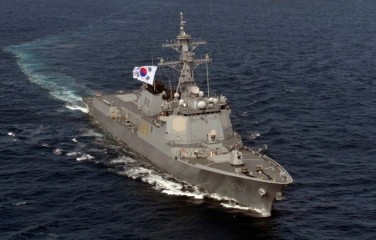
South Korea announced Thursday plans to expand the operational area of its Cheonghae naval unit to include waters near the Strait of Hormuz, raising concerns that Seoul could become entangled in the US-Iran war.
The Defense Ministry insisted the move would not constitute involvement in the conflict.
A revised motion to extend the unit's deployment and expand its mission was approved at a vice-ministerial meeting Thursday, according to the Defense Ministry, and would be submitted to the National Assembly following Cabinet approval and presidential endorsement next week.
The Cheonghae Unit, a South Korean naval antipiracy task force first deployed to the Gulf of Aden off Somalia in March 2009, has primarily been tasked with protecting merchant vessels against piracy. Its deployment requires annual parliamentary approval.
The proposal comes amid pressure from Washington for Seoul to play a greater role in ensuring freedom of navigation near the Strait of Hormuz, following months of deliberations over South Korea's possible contributions to regional maritime security.
Expanded mission and naval capabilities
Under the revised motion, the unit's operational area would extend from the Gulf of Aden to international waters south of Oman, near the port of Duqm, approximately 650 kilometers from the Strait of Hormuz. The expansion would roughly double its authorized operational radius to about 1,930 kilometers.
The ministry also plans to deploy a P-8A Poseidon maritime patrol aircraft, an explosive ordnance disposal team and unmanned mine-clearing equipment, increasing the unit's personnel ceiling by 75 to 395.
Of the additional personnel, 45 would be assigned to maritime patrol operations and 30 to explosive ordnance disposal.
The revised mandate would add support for restoring freedom of navigation along international shipping routes to the unit's existing antipiracy and vessel protection missions.
"The enhancement of the Cheonghae Unit's mission is to protect our citizens and safeguard our economic interests," a Defense Ministry official said.
According to the ministry, the expansion is primarily intended to address deteriorating maritime security off Somalia, where reported pirate incidents have risen from 11 last year to 36 so far this year.
It attributed the increase partly to multinational naval forces being redeployed toward the Red Sea and the Strait of Hormuz, leaving gaps in antipiracy operations.
However, the ministry acknowledged that the additional mine-clearing capabilities could also help prepare South Korean forces to join international efforts to remove sea mines from the Strait of Hormuz after the war.
"We have not ruled that out and have taken it into account in our operational planning, but it is not the primary objective," a ministry official said.
The ministry stressed that the expanded mission would remain noncombat in nature and under South Korea's independent military command.
"We will not participate in or intervene in the war under any circumstances," another Defense Ministry official said.
It also ruled out using the P-8A aircraft to monitor Iranian territory or the interior of the strait, adding that any future operations inside the waterway would require separate parliamentary approval and conditions allowing safe operations.
The revised mandate would remain effective through Dec. 31, 2027, if approved by the National Assembly.
Maritime security or indirect involvement?
The government has argued that securing maritime routes is essential to South Korea's economic interests, particularly given its dependence on Middle Eastern crude oil.
National Security Adviser Wi Sung-lac said on Oct. 30 that Seoul was considering strengthening the Cheonghae Unit to protect merchant vessels, secure crude oil shipments and safeguard South Korean nationals.
Wi also noted that countries including the United Kingdom, France and Japan had deployed naval assets to the region, while reiterating Seoul's commitment to staying out of the war.
Critics, however, warn that expanding the unit's operations and military capabilities could expose South Korean forces to the conflict regardless of the government's intentions.
Rep. Kim Joon-hyung, floor leader of the minor Rebuilding Korea Party, on Wednesday denounced the proposal as an attempt to circumvent President Lee Jae Myung's pledge against military involvement.
"Expanding the Cheonghae Unit's operational area amounts to a troop deployment. It is not a clever solution, but a deceptive workaround," Kim said during a press conference at the National Assembly.
Kim warned that South Korean forces could face Iranian retaliation even without participating in combat, while questioning whether the expansion would ease strains in the South Korea-US alliance or invite further demands from Washington.
"If (US) President Donald Trump boasts that South Korea was the first country in the world to dispatch troops, we would become the first country to join the Middle East war," he said.
The main opposition People Power Party has also questioned the government's approach.
"Does avoiding the word 'deployment' make the military risks disappear?" party spokesperson Rep. Park Sung-hoon asked on Oct. 17, demanding clarification on whether separate parliamentary approval would be required.
The ruling Democratic Party of Korea, meanwhile, has defended the administration's position.
"President Lee has already made clear that there will be no troop deployment involving the war," party spokesperson Rep. Kim Sung-hoi said last month, accusing the opposition of fueling unnecessary public anxiety.
flylikekite@heraldcorp.com