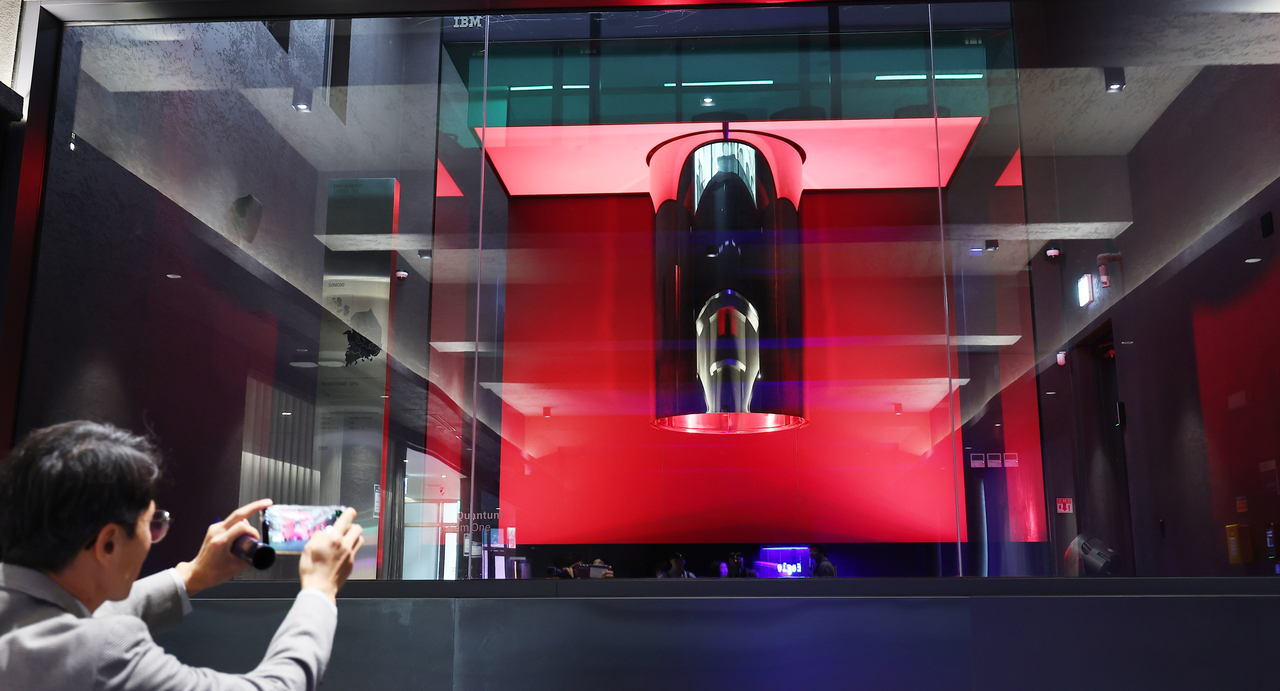
Yonsei University has upgraded its quantum computer with IBM’s latest processor, increasing its quantum circuit throughput 25-fold compared with its previous Eagle processor, according to IBM, as the university seeks to strengthen its leading position in quantum computing research in Korea.
Installed at Yonsei University’s International Campus in Songdo, Incheon, the Nighthawk r2 processor makes Yonsei the first IBM Quantum Network participant to operate Nighthawk at its own facility, according to the company. The university marked the upgrade at a ceremony Wednesday.
Cheong Jae-ho, director of Yonsei University’s Quantum Computing Project Group, said the new processor could help reduce the time and cost required to address complex problems across various fields through enhanced computing capabilities.
Cheong, who is also a medical professor, cited pharmaceutical development as one area that could benefit from the technology.
He said the university had developed a hybrid computing pipeline combining quantum algorithms and AI to accelerate calculations in early-stage drug development.
The work targets steps such as identifying disease-related proteins and finding and optimizing compounds that bind to them.
Cheong said simulations comparing the approach with AI-only algorithms suggested potential speed improvements of 40 to 50 percent or more.
“We have always questioned why we could not avoid the miserable reality that developing a new medicine takes 15 years total, including clinical trials, and 5 trillion won, but the success rate remains a mere 4 percent,” Cheong said at a press conference Wednesday.
“Even the smallest improvement can reduce the time it takes for a better medicine to reach patients, as well as its price, saving those who might otherwise die without it. That is one of the social values quantum computing can offer.”
Keeping pace with quantum advances
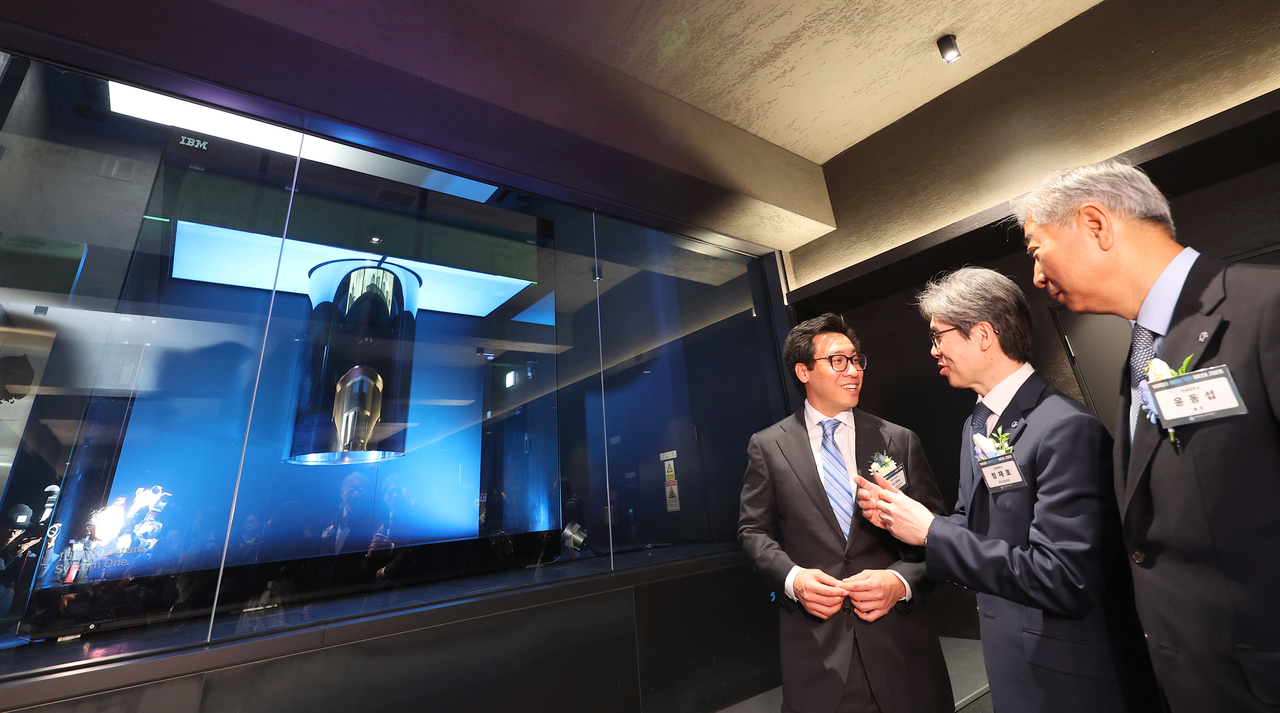
Yonsei became the second university in the world to install IBM Quantum System One, equipped with a 127-qubit Eagle processor, in 2024.
At Wednesday’s opening ceremony on the Songdo campus, the upgraded system appeared as the same as that unveiled in 2024: black, cylindrical, about 2 meters long and suspended from the ceiling.
The key change was inside: the coin-sized chip at the bottom of the cylinder had been replaced with one about the size of a thumb. Despite the small physical change, the upgrade represents a substantial improvement in computing performance, according to Cheong and IBM Quantum officials.
The new processor has 120 programmable qubits, supported by coupling and reset components, for a total of 458 physical quantum elements. IBM said the additional components shorten the time needed to reset qubits between circuit runs.
A qubit, or quantum bit, is the basic unit of information in a quantum computer. Unlike classical bits, which represent either 0 or 1, qubits can exist in combinations of the two states and become entangled with one another.
These properties could enable quantum computers to perform certain calculations more efficiently than conventional computers.
“With Nighthawk, the thing that is really standing out is its speed — 100,000 maximum circuits per second,” Jerry Chow, an IBM Fellow and chief technology officer for quantum-centric supercomputing, said at the press conference. He described the processor as the fastest and most powerful in IBM’s quantum computing lineup.
Chow emphasized that the increase in speed had not come at the expense of accuracy. The processor has a two-qubit gate fidelity of about 99.7 percent, equivalent to an error rate of roughly 0.3 percent.
Cheong said greater connectivity between qubits reduced the need for additional operations known as swap gates, helping limit errors.
“We’re excited to be able to really push this future together in using our quantum resources to advance the most challenging problems and really use it to advance applications throughout chemistry, materials, biology,” Chow added.
Quantum computing drives global partnerships
Yonsei University says keeping up with the latest developments in quantum computing is part of its effort to establish itself as a global hub for quantum research.
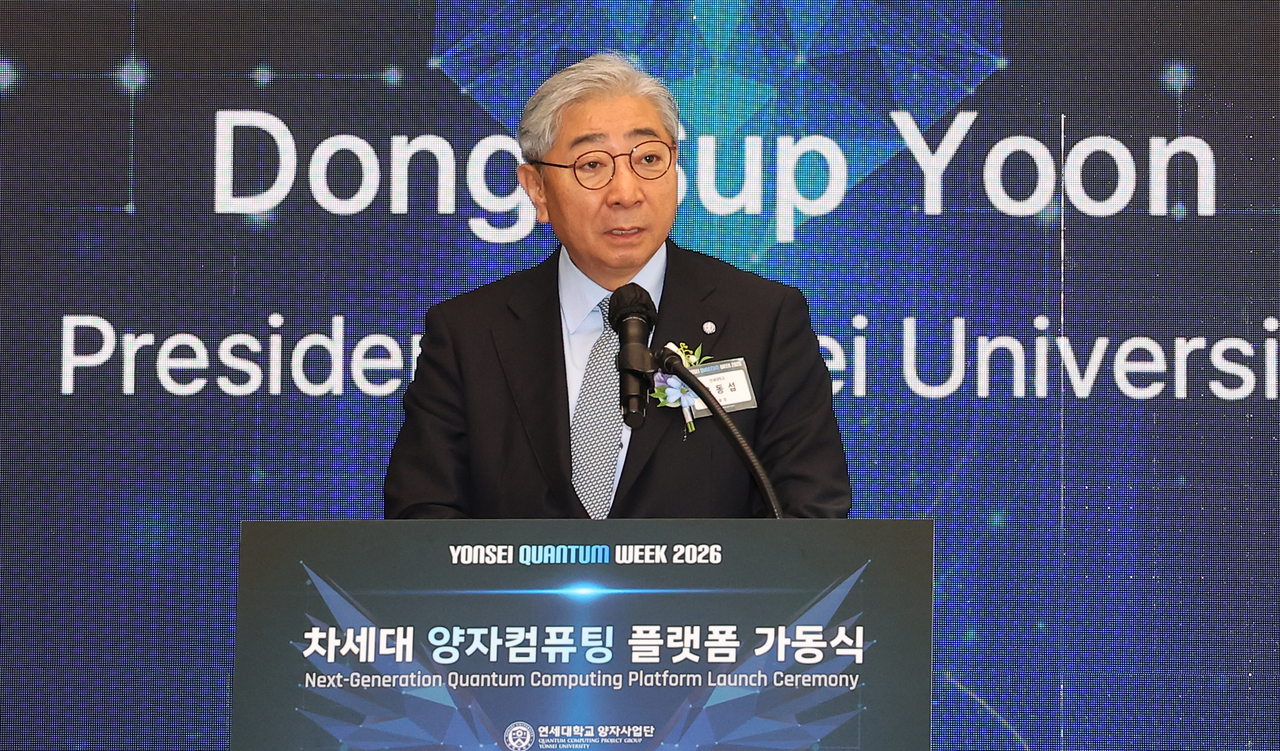
“(The deployment) is a decisive milestone as Yonsei moves toward the era of fault-tolerant quantum computing,” Yonsei University President Yoon Dong-sup said. “Building on this, we will contribute to the development of quantum science and technology in Korea and expand research collaboration across various fields, including AI and biotechnology.”
Cheong said the university hopes to advance research not only in pharmaceutical development but also in aerospace, climate change, energy and other areas where researchers are seeking to address challenges facing humanity with AI.
“Such complex challenges facing humanity cannot be solved by any single university, research institute or country, so we are building global partnerships around this resource,” Cheong added.
The university is moving ahead with plans to establish research centers focused on medical applications of quantum computing at both the University of Cambridge and its Songdo campus, with each institution hosting a center established by the other.
It has also connected its quantum computing facility to a supercomputer at RIKEN, Japan’s largest natural science research institute, to facilitate collaborative research.
The facility’s role is extending beyond academic research and education, Cheong said. Its computer is also available to national agencies and companies of various sizes, with the aim of strengthening technological capabilities across Korean society.
forestjs@heraldcorp.com