Education officials cite funding thresholds, concerns that separate Korean-language classes could disrupt students’ progress in other subjects
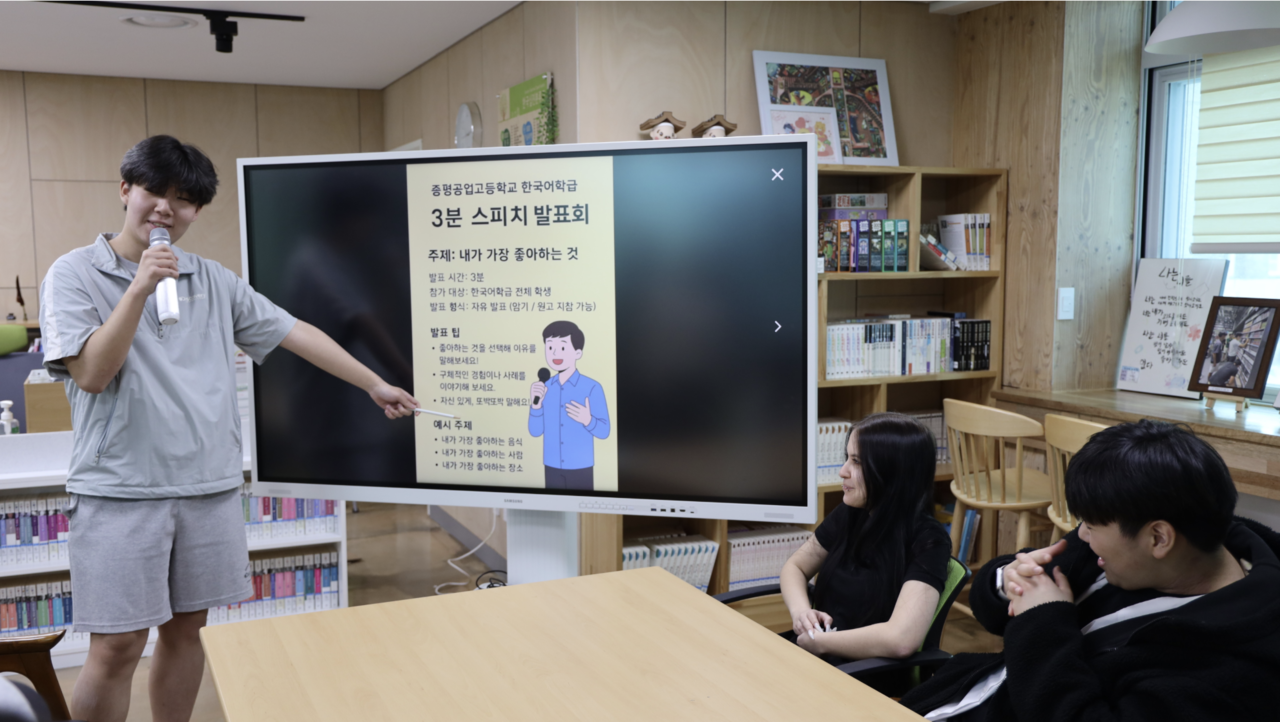
Eight of South Korea’s 16 provincial-level regions have no dedicated Korean-language classes for high school students from migrant backgrounds, despite the number of students more than doubling over the past four years.
Some 15,877 of the country’s 37,660 migrant-background high school students, or 42.2 percent, attend schools in those regions, according to Education Ministry data obtained by Democratic Party of Korea Rep. Han Byung-do.
Korean-language classes are specialized programs designed to help students from migrant backgrounds who have limited Korean proficiency adapt to the country’s education system. The number of migrant-background students does not necessarily reflect how many need Korean-language instruction, education officials said.
Regional disparities
Gyeonggi Province, home to the largest number of migrant-background high school students at 9,144, has no Korean-language classes.
The seven other regions without them are North Jeolla Province, Busan, Gangwon Province, Ulsan, Daejeon, Jeju and Sejong.
The data also revealed wide regional disparities in the availability of Korean-language classes, even among regions with similar numbers of migrant-background students.
South Gyeongsang Province has 3,060 migrant-background high school students but operates only three Korean-language classes, compared to 20 in neighboring North Gyeongsang Province, which has 3,223 such students.
A similar disparity was found between Busan and North Chungcheong Province. Busan has 1,441 migrant-background high school students but has not operated a Korean-language class at the high school level for five consecutive years.
North Chungcheong Province, with 1,468 applicable students, operates four classes.
Some regions have reduced the number of Korean-language classes despite an increase in the number of migrant-background students.
In Seoul, the number of migrant-background high school students increased from 3,644 last year to 3,959 this year, while the number of dedicated Korean-language classes fell from three to one.
Jeonnam-Gwangju also saw its migrant-background high school population increase from 2,393 to 2,669 over the same period, while the number of Korean-language classes fell from five to three.
In Gangwon Province, the number of migrant-background high school students rose from 643 in 2022 to 1,065 this year, while its sole Korean-language class was discontinued.
Daegu similarly reduced its classes from two to one, even as its migrant-background student population increased from 467 to 1,166.
Education officials cite practical hurdles
An official at the Gangwon Provincial Office of Education told The Korea Herald that although the province has 1,065 migrant-background high school students, only slightly more than 100 are estimated to need Korean-language instruction.
The official explained that most migrant-background students in the province are already proficient in Korean.
He also pointed to Education Ministry guidelines recommending at least five students in need of Korean-language instruction for a school to qualify for government funding to operate a dedicated class.
However, with most schools having only one or two students who require such support, few meet the threshold to apply, the official said.
Schools also face difficulties incorporating Korean-language classes into their regular curricula, particularly following the introduction of the high school credit system, he added.
Introduced nationwide in 2025, the system requires students to earn credits by meeting attendance and academic achievement requirements for individual courses.
“With the high school credit system in place, if students spend two to five months in separate Korean-language classes and cannot properly earn credits for their other subjects, it could raise concerns about college admissions,” the official said. “This limits how actively schools can operate such classes.”
An official at the Seoul Metropolitan Office of Education echoed similar concerns, explaining that the decline in Korean-language classes in the capital followed a change in how the programs were offered.
The education office had asked schools that previously operated Korean-language programs as after-school courses to incorporate them into their regular curricula, but some private schools chose not to do so.
“We asked private schools that had been offering the programs after school to establish them as regular classes, but they did not apply,” the official told The Korea Herald.
An Education Ministry official told The Korea Herald that the ministry was working with local education offices to expand Korean-language support for migrant-background students, noting that dedicated Korean-language classes were only one of several support measures.
“We are seeing an increase in the number of Korean-language classes at elementary and middle schools,” the official said. “Other forms of language support are also expanding, including foundational Korean-language courses taught by tutors dispatched to students’ homes by education offices or universities.”
seungku99@heraldcorp.com