Record arrivals and surging visitor spending couldn't offset rising outbound spending

Korea welcomed more than 15 million foreign nationals in the first eight months of this year, reaching the milestone about two months earlier than last year.
But the country’s tourism balance swung back into the red in July as Koreans spent more during overseas trips, ending a rare four-month run of surpluses.
According to the Ministry of Culture, Sports and Tourism on Monday, 15.05 million foreign nationals — including tourists, workers and residents — entered the country between January and August, up 21.6 percent from 12.38 million a year earlier. August alone saw 2.25 million foreign arrivals, up 23.3 percent on-year. Both the monthly and the cumulative totals are the highest since records began. Last year, arrivals did not pass 15 million until mid-October.
Growth came from every major source country. Arrivals from Taiwan rose 32.2 percent to 1.66 million. Visitors from China rose 29 percent to 4.82 million, and those from Japan rose 17.5 percent to 2.7 million. Among Southeast Asian markets, the Philippines sent 454,000 visitors, up 16.1 percent, and Vietnam sent 407,000, up 10.5 percent. Indonesia grew fastest in the region, rising 22.5 percent to 295,000.
Korea's growth outpaced that of its regional competitors. From January through August, foreign arrivals fell 2.7 percent in Japan and 3.1 percent in Thailand, while Vietnam posted a 14.4 percent gain, according to the ministry, which cited data from each country's tourism authorities. Japan still drew far more visitors overall, at 27.63 million.
Visitors are also spending more. Foreigners' card spending in the tourism sector reached 14.02 trillion won ($10.33 billion) through August, up 48.5 percent from 9.44 trillion won in the same period last year and also a record.
More visitors are also arriving outside the capital region. The share entering through regional airports and seaports reached 27.8 percent through August, the highest level this year. Arrivals through regional airports jumped 38.2 percent to 2.83 million.
Korean culture appears to be drawing visitors regardless of price. Yanolja Research, the research arm of travel platform Yanolja, named K-culture as one of the drivers of rising demand for travel to Korea. Its analysis of Google Trends data found that searches from Japan in the arts and entertainment category related to Korea rose 116 percent from a year earlier, while Korea-related food and drink searches jumped 198.3 percent. In Taiwan, the two categories rose 38.7 percent and 69.8 percent, respectively.
The pattern extended to long-haul markets. American arrivals reached 962,000 from January through July, up 11.6 percent on-year, and interest in K-culture-related searches rose between 32 and 55 percent in the US, Canada, Britain and Australia.
The ministry credited easier entry rules for part of the gains. Working with the Justice Ministry, it relaxed requirements for multiple-entry visas for 11 Southeast Asian countries, including the Philippines, Vietnam and Indonesia, starting March 30. Since May 28, Indonesian tour groups have been allowed visa-free entry on a trial basis. The KTO runs a visa support center in New Delhi and helped simplify application paperwork in Manila.
"Improved entry convenience and tailored marketing are diversifying visitors to Korea," said Kang Jung-won, the ministry's director general for tourism policy. He said that because October is the peak month for foreign arrivals, the ministry would closely manage visa issuance and airport and seaport processing and keep strengthening K-culture-linked marketing "to sustain strong demand for travel to Korea into the fourth quarter."
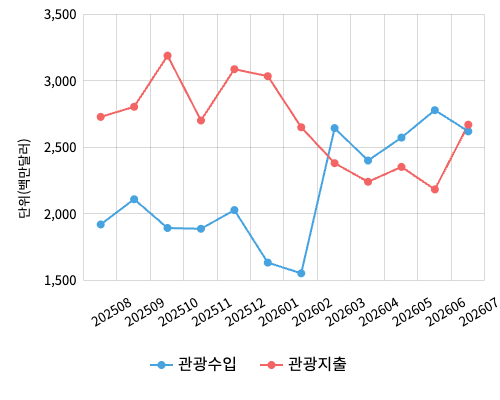
Despite the record arrivals, the tourism balance turned negative, ending a four-month run of surpluses. Data from the Korea Tourism Organization's Tourism Data Lab Monday showed a $50.3 million deficit in July. This compares with June, when Korea posted a $596.6 million surplus. In July, Koreans spent $2.67 billion on travel abroad, more than the $2.62 billion Korea earned from inbound tourism.
The shift came mainly from the outbound side. Between June and July, tourism receipts fell by about $160 million, while spending abroad rose by about $487 million. Foreign arrivals actually rose in July, to 2.09 million from 1.99 million in June. Foreigners' card spending, however, slipped to 1.95 trillion won from 2.06 trillion won.
The tourism balance had been in deficit for 72 straight months, from March 2020, when COVID-19 began to spread, through February this year. Annual deficits topped $10 billion three years in a row: $10.38 billion in 2023, $10.21 billion in 2024 and $10.76 billion in 2025. The gap stayed wide early this year, with deficits of $1.4 billion in January and $1.1 billion in February.
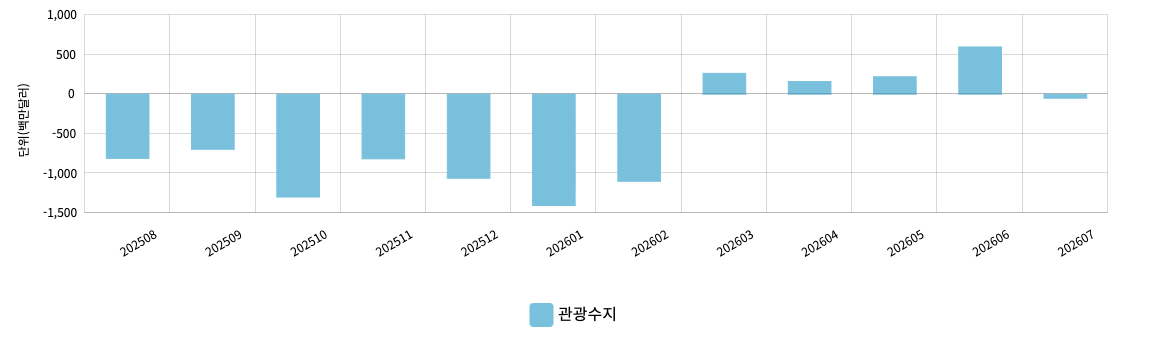
The balance then flipped to a $263.8 million surplus in March. It stayed positive in April, at $159.9 million, and in May, at $220.5 million. June's surplus was the second-largest monthly figure on record, behind $661.5 million in October 2008. In June, each foreign visitor spent $1,397 on average, compared with $1,091 for each Korean traveling abroad.
gypark@heraldcorp.com



![[Graphic News] Average parental age of S. Koreans rises](https://wimg.heraldcorp.com/news/cms/2026/09/27/news-p.v1.20260927.0bcbf944ca9043c4a6ad4401fcfae25c_T1.gif?type=h&h=800)