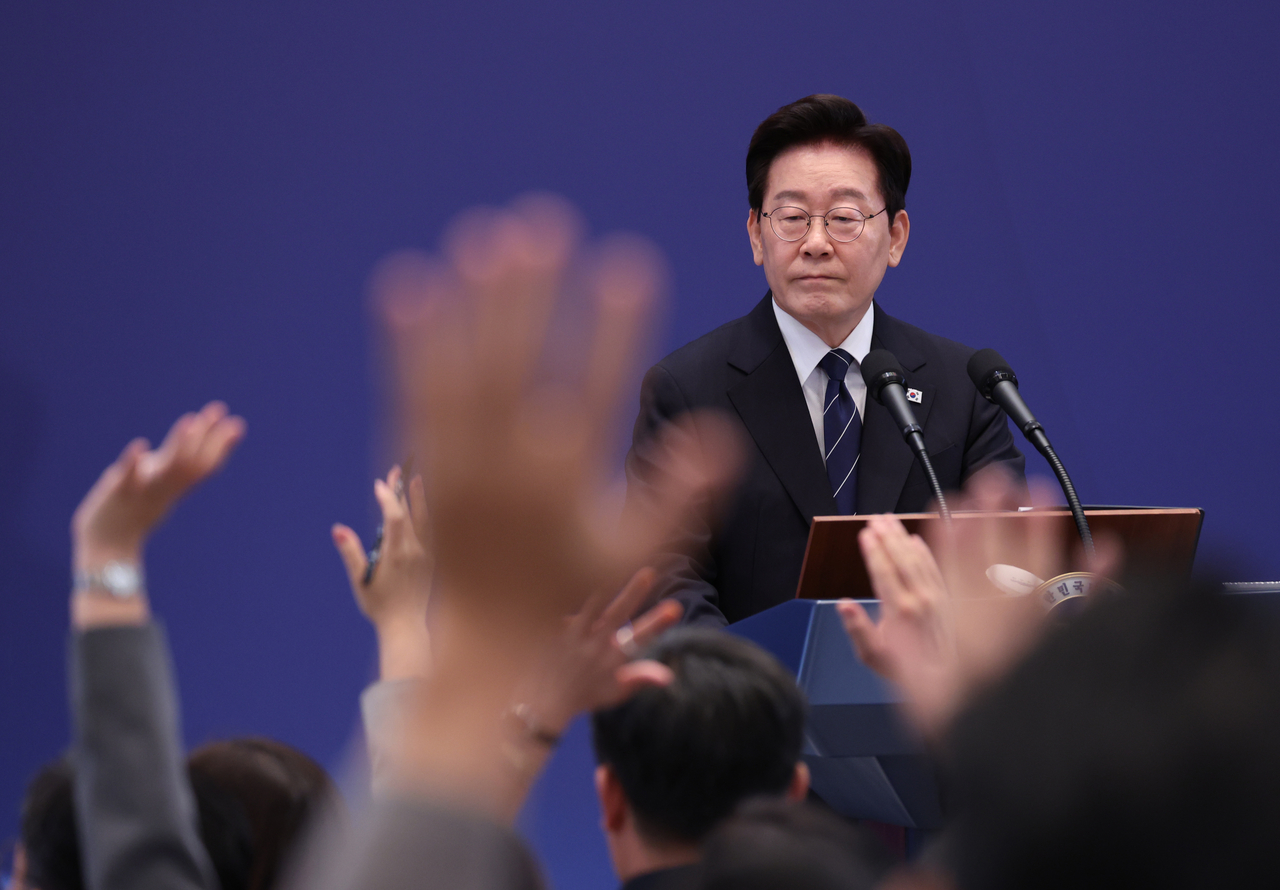
President Lee Jae Myung said Friday that South Korea and the United States are renegotiating parts of a $350 billion investment package over details in the agreement reached in working-level negotiations.
The remarks shed light on the last-minute postponement of plans to unveil South Korea's first project under its $350 billion strategic investment commitment to the US.
"I was told we were close to an agreement, but from what I saw in the details, there were some parts that were difficult to agree on, so we are still discussing them," Lee said during a special press conference at Cheong Wa Dae House in Seoul.
Lee said that issues revolve around the clause stipulating "commercial reasonableness," which concerns how the investing party would recover its investment, how returns would be distributed and how potential losses would be handled.
Seoul had initially planned to discuss the project through its US investment project management and operating committees this week before reporting it to the National Assembly and making the details public. A parliamentary briefing tentatively scheduled for Thursday was pushed back to Tuesday, while the public announcement was also put on hold.
Lee's comments indicate that Seoul and Washington have yet to complete negotiations over the detailed financial structure of the investment arrangement, including the operation of an umbrella investment special purpose vehicle, or I-SPV.
"The US investment issue is an extremely complex and difficult task, and one that has multifaceted implications for South Korea-US relations," Lee said, describing the $350 billion as money that ultimately amounts to taxpayers' funds.
Lee said Seoul had made compromises after taking into account US tariffs, the broader relationship with Washington, and investment agreements reached by other economies, including Japan, Taiwan and Singapore, but stressed that protecting South Korea's interests remained paramount.
At the center of the negotiations is what Seoul calls "commercial reasonableness," a provision South Korea secured in the memorandum of understanding governing the investment package.
Lee said the two sides had remained at odds until 7:30 a.m. on the day of his second summit with US President Donald Trump before Washington agreed to include the wording sought by Seoul.
"We will only undertake projects that are commercially reasonable. The law also requires an assessment of commercial reasonableness," Lee said. "The questions are how we recover the investment, how the returns are distributed and how projects that incur losses are handled."
The provision has emerged as a key safeguard for Seoul as the two sides move from their broader investment agreement to selecting and structuring individual projects.
Lee made clear that even projects considered potentially profitable would have to undergo scrutiny over how risks and returns are divided between the two countries.
"The national interest is extremely important, and I believe it must not be swayed by any relationship, pressure or coercion," Lee said.
"We are engaged in intense debate and consultations to structure these projects in a way that does not undermine the Republic of Korea's national interests and benefits both South Korea and the United States."
Lee clarified that he was not suggesting that Washington was actually applying pressure or coercion.
He did not give a timetable for concluding the negotiations or announcing the first investment project.
Separately, Lee said reported US calls for Samsung Electronics and SK hynix to expand memory chip production in the United States remain under discussion, signaling that Seoul would weigh such investments against South Korea's domestic industrial priorities.
Unlike projects under the $350 billion investment package, additional semiconductor plants would constitute direct investments financed by the companies themselves.
"Taiwan appears to be building semiconductor plants in the United States, and Samsung and SK hynix are already building semiconductor facilities there," Lee said.
"How much further they should expand is a matter related both to the business decisions of the companies concerned and to South Korea's industrial strategy."
Lee said the government would respect the companies' views while seeking "a reasonable conclusion" that protects South Korea's national interests, adding that the issue remains under debate.
Further US investment by the two chipmakers could have implications for Seoul's efforts to expand semiconductor production at home, including its planned Honam semiconductor mega-project.
Large-scale semiconductor fabrication plants require massive amounts of capital as well as skilled personnel and equipment, raising questions over how Korean chipmakers would allocate resources between new US facilities and domestic expansion.
The Honam project is also intended to strengthen South Korea's semiconductor supply chain while advancing the government's goal of promoting more balanced regional development.
mkjung@heraldcorp.com