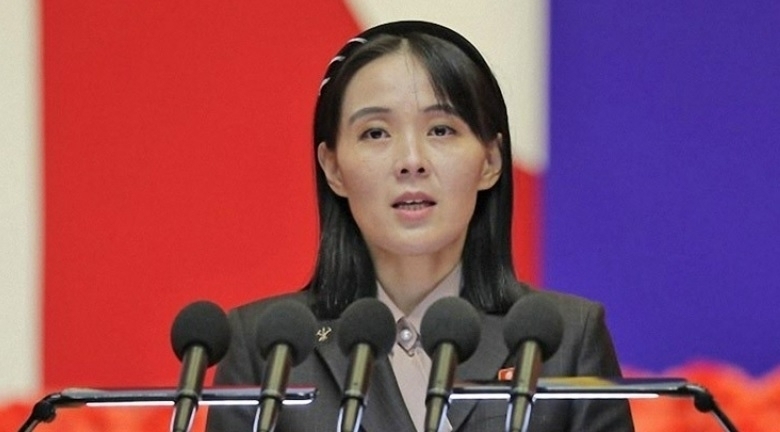
Kim Yo-jong, North Korean leader Kim Jong-un's sister and a ranking ruling party member, on Thursday declared Pyongyang's nuclear status "absolute" and irreversible, rejecting calls for denuclearization at an international nuclear gathering.
Analysts say the unusually high-level response may also have been calibrated to avoid directly antagonizing Washington amid renewed prospects for US-North Korea dialogue.
Kim Yo-jong, a director of the General Affairs Department of the Central Committee of the Workers’ Party of Korea, dismissed the calls for North Korea's denuclearization as "all noises, not surprising and not new," according to a statement carried by the state-run Korean Central News Agency.
"No matter how desperately the IAEA and the West may hold periodic meetings and talk about the denuclearization according to the fixed scenario, they can have no effect on the will and ability of the DPRK to take all necessary measures to defend the supreme interests of the state," Kim said, referring to North Korea by the abbreviation of its official name, the Democratic People’s Republic of Korea.
She went on to assert that North Korea's "position as a nuclear weapons state is absolute" and could not be reversed, claiming its nuclear status had been "permanently settled physically and legally."
"No one and nothing can ever reverse the crucial changes in the strength and position of the DPRK," she said.
The statement came as the 70th General Conference of the International Atomic Energy Agency was underway in Vienna. South Korea and European countries raised concerns at the conference over Pyongyang's expanding nuclear program and called on the North to comply with its international obligations and abandon its nuclear weapons program.
Ahead of the gathering, the IAEA also released its latest safeguards assessment of North Korea, reporting an expansion of the country's uranium enrichment capacity and other nuclear facilities.
Yang Moo-jin, chair professor at the University of North Korean Studies, said the substance of Kim's remarks was consistent with Pyongyang's increasingly categorical rejection of denuclearization, but the level at which the message was delivered was unusual.
North Korea has previously responded to IAEA developments through statements issued by its Foreign Ministry or atomic energy authorities, Yang noted. It was particularly unusual, he said, for Kim Yo-jong to respond directly to denuclearization calls raised during discussions at the General Conference rather than to a formal resolution adopted by the IAEA General Conference or Board of Governors.
Yang said the move could be "intended to head off further international efforts to promote denuclearization while reinforcing Pyongyang's claim that its status as a nuclear-armed state is already an established reality."
Another notable element was what Kim left out: a direct reference to the United States.
Yang said North Korea has previously attacked the IAEA by explicitly portraying it as a "stooge" or "mouthpiece" of Washington. In Thursday's statement, however, Kim directed her criticism at the IAEA, "the West," "hostile forces" and what she called "international rogues," without naming the US.
The omission could represent an effort by Pyongyang to control the level of its rhetoric as the possibility of renewed diplomacy with Washington draws attention, Yang said.
He assessed that North Korea may be seeking to avoid unnecessarily provoking the US while simultaneously signaling that recognition of its nuclear weapons status would have to precede any renewed dialogue.
"The message also appears designed to convey that Pyongyang would reject talks if Washington continues to insist that denuclearization itself be the starting point," Yang said.
An official at South Korea's Unification Ministry similarly said Thursday that it was "taking note" of Kim's remarks in light of US President Donald Trump's expressed interest in meeting the North Korean leader. The ministry assessed the statement as an apparent effort to reiterate North Korea's position on denuclearization amid moves toward possible US-North Korea dialogue.
On Wednesday, a spokesperson for the North's Defense Ministry criticized recent South Korea-US consultations on countering North Korean weapons of mass destruction threats. Seoul and Washington agreed at their annual Combined WMD Countermeasures Committee meeting last week to strengthen information sharing as Pyongyang continues to advance its nuclear and missile capabilities.
mkjung@heraldcorp.com


![[Surive&Thrive] Tips for getting around Seoul by subway (2)](https://wimg.heraldcorp.com/news/cms/2026/10/08/news-p.v1.20261006.1e7dee51d7f64cdba1a20b897d88cee6_T1.jpg?type=h&h=800)