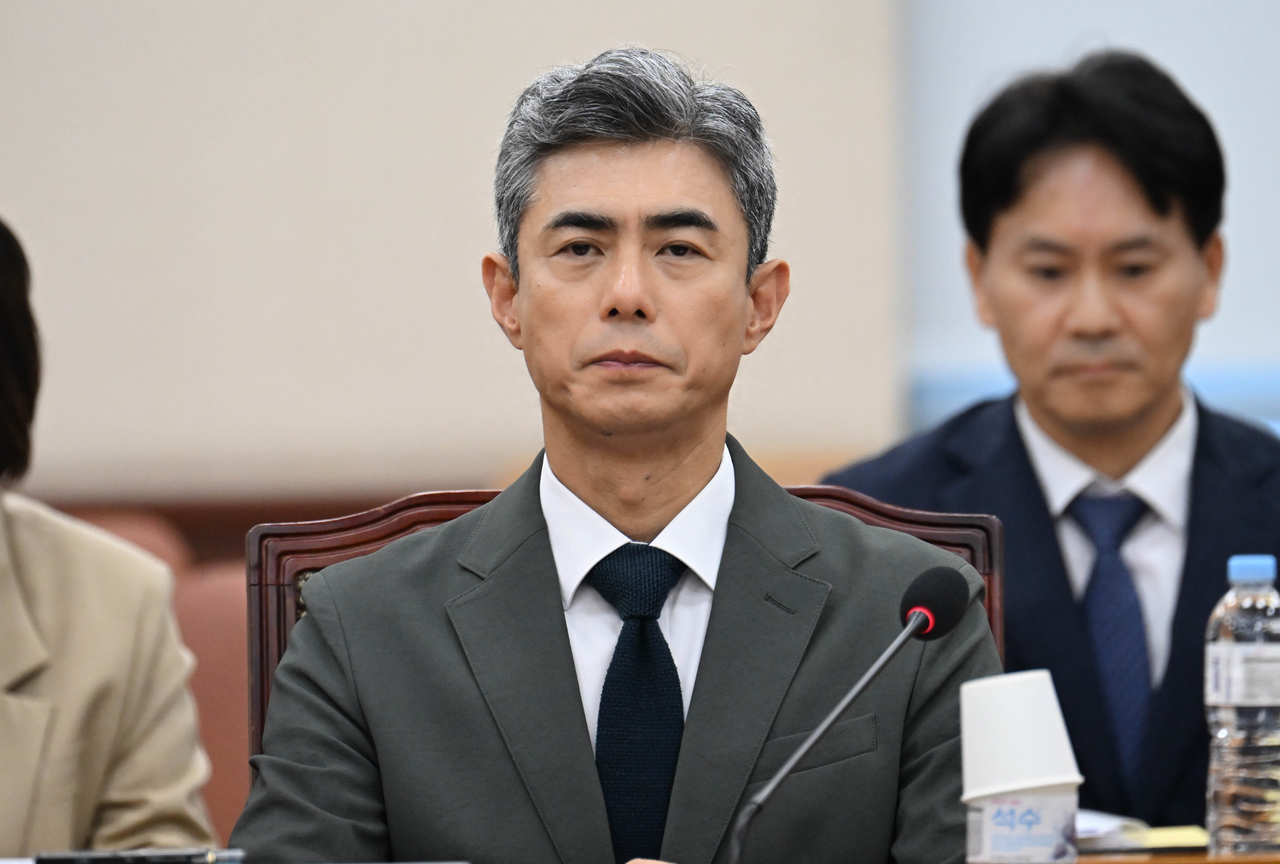
South Korea has made significant strides towards meeting the conditions for wartime operational control from the US, Defense Minister nominee Kang Shin-chul said Wednesday.
"I believe that the fulfillment of the conditions for OPCON transfer has been significantly reinforced, and the necessary groundwork has been laid," Kang told lawmakers of the National Defense Committee during his confirmation hearing.
His remarks were in line with the liberal Lee Jae Myung administration's push to complete OPCON transfer before the end of President Lee Jae Myung's term in 2030, calling it a crucial step to achieving military independence from external forces.
The transfer of the authority should proceed "in a way that would reinforce the South Korea-US alliance based on mutual trust," Kang added.
Regarding speculations that South Korea's deployment of military forces to the Strait of Hormuz is imminent, Kang said the matter "should be handled from the perspective of public safety and national interest."
Kang is a retired Army four-star general who formerly served as the deputy commander of the Combined Forces Command. He was South Korea's ambassador to Saudi Arabia at the time of his nomination in August to replace outgoing Defense Minister Ahn Gyu-back.
Kang was in active service when Yoon Suk Yeol imposed martial law in December 2024, when he was the deputy commander of the CFC. Kang said that the CFC had no involvement in the developments and that he focused on convincing Paul LaCamera, who was then the CFC commander, that South Korea was capable of independently overcoming its own political crisis.
At Wednesday's hearing, Kang also said he was "determined" to carry out military reform in line with the Lee administration's direction.
In particular, the proposed merger of the academies of South Korea's Army, Navy and Air Force is a crucial task to training talented cadets at a time when modern warfare is becoming multidimensional, Kang said.
However, the current plan to set up a military academy for the Army, Navy and Air Force in Daejeon and to relocate facilities related to respective academies to the new complex, has room for improvement, he said.
"Personally, I see some elements (in the current merger plan) that have room for improvement," Kang said, adding that the initial plan announced in July is "not perfect."
"I believe there are various approaches to integration, so I will collect these opinions, come up with a decent proposal and explain it to lawmakers," he said.
During the confirmation hearing, liberal-leaning lawmakers called on Kang to set up a system that would explicitly allow military personnel to disobey unjust orders, in the wake of the 2024 martial law when armed forces were deployed to seize control of the National Assembly. Kang said he would set up a measure to lawfully ensure this once he becomes defense minister.
In the meantime, the conservative People Power Party blasted the South Korean military for failing to prevent North Korean forces from crossing the military demarcation line to the south, where they are suspected to have set up mines. Confirming South Korea's sovereignty over area south of the demarcation line, Kang said any breach by North Korean forces must be "boldly addressed," but declined to speak further, citing confidentiality of the process.
Before Wednesday's hearing, Kang was under scrutiny for his use of a fake address to take personal benefit, as well as his family's history of real estate deals that skirted regulations.
For example, Kang was given the exclusive right in 2008 to buy a newly built home in Guro-gu, Seoul, as his own house was taken for a land development project there. Critics have claimed that his family should not have received the offer because it was intended for people who are worse off, and he did not live there when the right was offered.
Kang said he was compensated because his family had lost their house in the area of the land development, while denying speculation that his family reaped huge financial benefit through the new housing.
consnow@heraldcorp.com